
What Is Gno.land (GNOT)? How GnoVM, Storage Deposits, Tokenomics, and GovDAO Work

 Prefer us on Google


Gno.land (GNOT) is a Layer 1 smart-contract blockchain built around Gno, a deterministic programming language derived from Go. Its native GNOT coin pays transaction and contract-execution fees, supports cross-chain operations and is locked as a storage deposit when applications persist data onchain. The project’s central idea is to make smart contracts readable, reusable and familiar to the global Go developer community.
My assessment is that Gno.land is one of the more intellectually serious new Layer 1 projects, but its value proposition will be misunderstood if it is reduced to “another Go-based blockchain.” Its genuinely different idea is the combination of human-readable onchain source code, reusable packages, persistent realms and storage-backed state. The weakness is adoption: an elegant virtual machine does not matter commercially unless developers build applications that users repeatedly choose over established EVM and Cosmos alternatives.
The Essentials
Gno.land was created by Jae Kwon, who also co-founded Cosmos and created Tendermint. Applications are written in Gno, an interpreted and deterministic variation of Go designed specifically for smart contracts.
Unlike platforms where deployed contracts are primarily represented by compiled bytecode, Gno.land requires source code to be published onchain. Developers and users can inspect, reuse and fork that code.
GNOT is the network’s native coin. It is used for transaction fees, smart-contract execution, storage deposits and supported IBC or ICS interactions. The official token-sale documentation states a total GNOT supply of 1.333 billion, with approximately 197.32 million—about 14.8%—expected to circulate at the token generation event.
For more official information, please check GNO's official website : Gno.land
| Attribute | Gno.land (GNOT) |
|---|---|
| Project type | Layer 1 smart-contract blockchain |
| Native coin | GNOT |
| Programming language | Gno, derived from Go |
| Virtual machine | GnoVM |
| Consensus engine | Tendermint2 |
| Governance | GovDAO |
| Total supply | 1.333 billion GNOT |
| Initial circulating supply | Approximately 197.32 million GNOT |
| Initial circulating ratio | Approximately 14.8% |
| Core utility | Gas, contract execution, storage deposits and cross-chain interactions |
| Founder | Jae Kwon |
| Mainnet status | Live, according to the project’s 2026 roadmap and mainnet resources |
What Is Gno.land (GNOT) Designed to Do?
Gno.land is designed to make decentralized applications easier to read, audit, compose and maintain.
Most smart-contract platforms force developers to learn an ecosystem-specific language or work through compiled contract artifacts that are difficult for ordinary users to understand. Gno.land instead uses a language closely related to Go, one of the most established programming languages for backend systems, cloud infrastructure and distributed services.
The official documentation describes Gno.land as a smart-contract platform built on a novel interpretation of Go. It emphasizes modular applications, deterministic execution and a comparatively minimalist developer experience. gno.land Documentation
Gno.land’s ambition is not merely to make Go available on a blockchain. It attempts to make reusable source code a native component of the onchain environment.
A developer can publish a reusable package, while another developer can import it into an application. A stateful application is deployed as a realm. Because the source code remains visible onchain, developers can inspect dependencies and understand how different components interact.
The intended result resembles an open software repository combined with a blockchain execution environment. Gno.land has consequently been described as attempting to become a kind of onchain “GitHub,” although the comparison is imperfect. GitHub stores and coordinates software projects, while Gno.land also executes programs and maintains their state through network consensus.
How Does the Gno Programming Language Work?
Gno is derived from Go but modified for deterministic blockchain execution.
Ordinary Go programs can access external networks, operating-system resources, time-dependent inputs and other features that would produce different results on different machines. A blockchain cannot safely allow validators to reach different outputs from the same transaction.
Gno therefore excludes or modifies Go features that are inappropriate for consensus. According to the official documentation, libraries involving network or operating-system access are not available in the Gno execution environment.
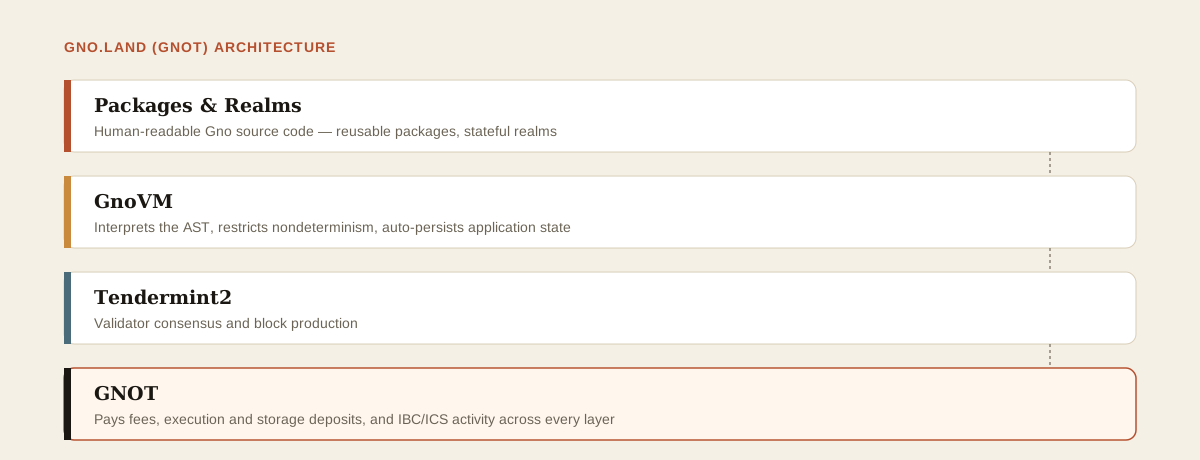
Gno code is parsed into an abstract syntax tree, or AST. Instead of compiling the program into opaque bytecode and executing that bytecode, GnoVM interprets the program through this structured representation.
The AST approach is important because it preserves a close relationship between the code developers write and the code the network executes. It also allows the GnoVM design to freeze and resume a program by persisting and loading its memory state.
The Gno documentation describes the language as deterministic, automatically persisted and automatically Merkle-ized. Developers do not need to manually serialize every application object into an external database merely to preserve state between contract calls.
| Feature | Conventional Web Go | Gno |
|---|---|---|
| Main environment | Servers and local applications | Deterministic blockchain execution |
| External network access | Generally available | Restricted for consensus safety |
| Operating-system access | Available | Restricted |
| Execution form | Compiled native code | Interpreted AST in GnoVM |
| State persistence | Developer manages databases and serialization | GnoVM provides automatic persistence |
| Primary application type | Web services and systems software | Smart contracts and decentralized applications |
| Code visibility | Depends on developer | Source code published onchain |
| Execution agreement | One machine or controlled cluster | Validators must produce identical results |
Gno is therefore similar enough to Go to reduce the learning curve, but it is not simply ordinary Go running unchanged on a blockchain.
-- Price
What Are Packages and Realms on Gno.land (GNOT)?
Gno.land divides onchain code into packages and realms.
A package is generally a reusable collection of code. It can provide types, functions and logic that other applications import. Packages are intended to encourage modular development rather than forcing every application to recreate the same functionality.
A realm is a stateful smart contract. It can store persistent information, expose functions and interact with users or other realms. Social applications, games, governance tools and decentralized exchanges can be constructed as realms.
Kraken’s GNOT listing description summarizes the distinction by describing packages as stateless, reusable libraries and realms as components that hold persistent state. It also notes that the code can be inspected and reused because contracts are stored onchain in human-readable form.
Consider a simplified decentralized forum. A reusable package might define standardized account permissions or text-formatting functions. The forum realm would store posts, replies, voting records and moderation decisions.
Another application could import the same package without copying all of its code. This creates stronger composability at the programming-language level.
Ethereum also supports contract-to-contract interaction, libraries and open-source verification. Gno.land’s distinction is that readable source publication and Go-style package composition are treated as core architectural principles rather than optional developer practices.
What Is GnoVM?
GnoVM is the execution environment responsible for running Gno programs.
Its job is comparable to the Ethereum Virtual Machine’s role in Ethereum, but its internal design and programming model are different. The EVM generally executes compiled bytecode produced from languages such as Solidity. GnoVM interprets structured Gno source representations.
GnoVM must ensure that each validator reaches the same result after executing a transaction. If one validator interpreted a contract differently from another, the network would fail to agree on state.
The environment therefore restricts nondeterministic behavior and provides controlled state persistence. The same contract call, executed against the same state, should produce the same result across the network.
GnoVM’s automatic persistence model is particularly significant. A realm’s relevant memory can be preserved between transactions without requiring developers to reproduce the database-oriented patterns common in many other blockchain frameworks.
This can make application code shorter and more closely resemble conventional software. However, convenience does not eliminate security risk. Persistent state, cross-realm calls, permissions and shared packages can still produce vulnerabilities. They merely present those problems through a different programming model.
How Does Gno.land (GNOT) Consensus Work?
Gno.land uses Tendermint2 as its consensus engine.
Tendermint2 is related to the broader Tendermint lineage associated with Cosmos, but it is presented by Gno.land as an evolved engine redesigned for simplicity, security and performance.
This means Gno.land should not be described as using “Proof of Contribution” as its blockchain consensus mechanism unless a current official specification explicitly defines that term.
Some older project discussions have used contribution-oriented language when describing ecosystem participation, rewards or governance. That does not mean validators reach consensus through a mechanism formally called Proof of Contribution.
For publication accuracy, the safer distinction is:
| Concept | Role in Gno.land (GNOT) |
|---|---|
| Tendermint2 | Blockchain consensus and validator agreement |
| GnoVM | Smart-contract execution |
| GovDAO | Onchain governance coordination |
| GNOT | Gas, storage deposits and other network operations |
| Contributor activity | Software, governance and ecosystem participation—not a confirmed replacement for validator consensus |
This distinction prevents a common SEO error in which project philosophy is mistaken for technical consensus.
What Is GovDAO on Gno.land (GNOT)?
GovDAO is Gno.land’s onchain governance system.
Gno.land’s roadmap identifies the inaugural GovDAO release as part of the Beta Mainnet phase. Kraken describes governance as being handled by a multi-tiered GovDAO.
The broader objective is to place governance logic inside transparent onchain applications. Participants should be able to examine the rules, proposals and decision processes rather than depend entirely on an opaque administrative system.
Governance nevertheless involves more than publishing code. The practical quality of GovDAO will depend on who can submit proposals, how voting or decision authority is distributed, which actions can be executed automatically, and whether concentrated token ownership translates into concentrated control.
This question is especially relevant because a large portion of the GNOT supply was allocated to company, investor and airdrop categories before broad public circulation.
A technically transparent governance system can still produce centralized outcomes if voting influence or administrative authority is heavily concentrated. Code transparency makes the structure easier to inspect; it does not automatically make the structure decentralized.
What Is the Token Utility of Gno.land (GNOT)?
GNOT has four primary forms of token utility documented by the project.
Transaction fees are paid in GNOT. Users need the coin when submitting transactions to the network.
Smart-contract execution also consumes GNOT as gas. Computation performed by a realm is metered so that network resources are not available without cost.
GNOT is additionally locked as a storage deposit when a realm persists data. This connects token demand with long-term state usage rather than only short-lived transaction volume.
Finally, the project says GNOT is used for IBC and ICS cross-chain interactions. This is intended to extend the token’s utility beyond purely local application execution.
| GNOT Utility | Function |
|---|---|
| Transaction fees | Pays for submitting transactions |
| Contract execution | Pays for GnoVM computation |
| Storage deposits | Reserves persistent onchain storage |
| IBC and ICS activity | Pays for supported cross-chain interactions |
| Ecosystem access | Enables users to interact with Gno.land applications |
The storage-deposit function is the most differentiated part of the design. Many blockchains primarily charge users when computation occurs. Gno.land also attaches an economic cost to maintaining persistent data.
How Do Gno.land (GNOT) Storage Deposits Work?
A storage deposit requires GNOT to be locked when an application stores persistent data.
Blockchain storage is not free. Validators and node operators may need to retain state for long periods, even if the user who created that state never returns. If an application can create unlimited permanent data for a small one-time transaction fee, the network accumulates costs without an enduring economic counterweight.
Gno.land attempts to address this by linking persistent state with locked GNOT. The official token-sale page describes holding GNOT as reserving ownership of storage on the network.
A simplified model looks like this:
A developer who deploys a data-heavy application may need more GNOT than a user who occasionally transfers tokens. Part of the developer’s GNOT can remain locked for as long as the relevant data occupies network storage.
This creates a possible link between application adoption and token demand. If more applications persist more useful state, more GNOT may be required as storage deposits.
The relationship is not automatically bullish, however. Its effect depends on deposit rates, refund rules, data-cleanup incentives and whether real applications create enough durable demand. A storage mechanism can generate token utility without generating strong token value capture if usage remains low or required deposits are negligible.
Gno.land (GNOT) Tokenomics and Supply Distribution
The official GNOT sale page states that the total supply is 1.333 billion GNOT.
Approximately 197.32 million GNOT—around 14.8% of the total supply—was identified as circulating at the token generation event. That leaves approximately 85.2% outside the initial circulating supply.
The published distribution is:
| Allocation | GNOT | Share of Total Supply |
|---|---|---|
| Cosmos airdrop | 350,000,000 | 26.26% |
| NewTendermint, LLC | 332,000,000 | 24.91% |
| Investors | 300,000,000 | 22.50% |
| AtomOne airdrop | 231,000,000 | 17.33% |
| Ecosystem Treasury | 60,000,000 | 4.50% |
| Core Treasury | 40,000,000 | 3.00% |
| Validator Treasury | 20,000,000 | 1.50% |
| Total Supply | 1,333,000,000 | 100% |
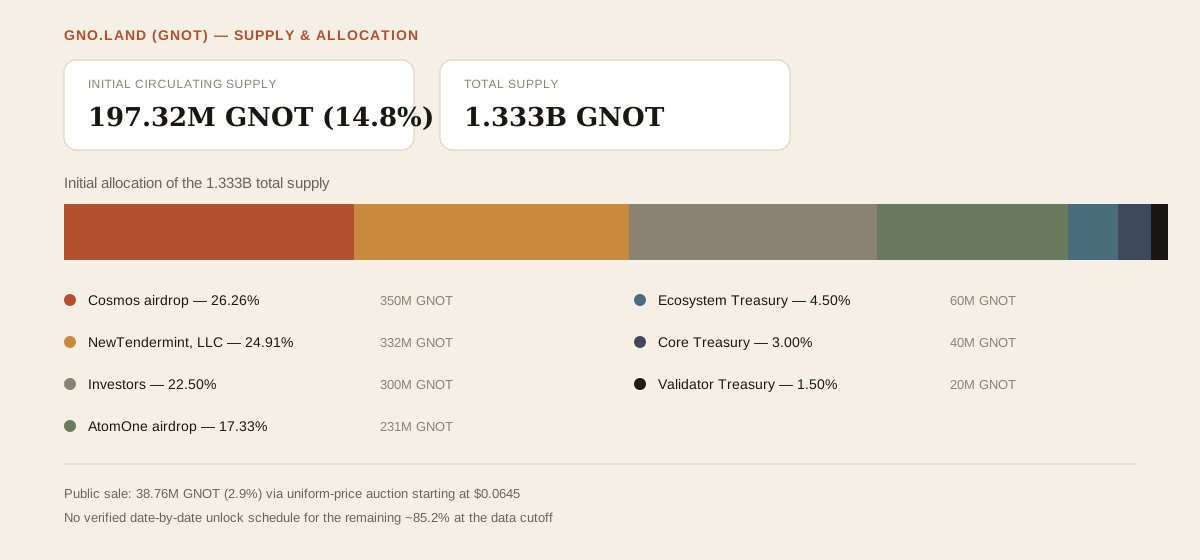
The public token sale allocated 38.76 million GNOT, approximately 2.9% of the total supply. It used a uniform-price auction beginning at $0.0645 per GNOT, with USDC and USDT accepted on Ethereum. The contribution window ran from July 20 to July 27, 2026.
At the starting auction price, the project displayed a fully diluted valuation of approximately $85.98 million.
What Does the Gno.land (GNOT) Circulating Ratio Mean?
An initial circulating ratio of approximately 14.8% means that most of the total GNOT supply was not liquid at the token generation event.
A low circulating ratio can make early price discovery more volatile. Relatively limited liquid supply must absorb demand from traders, while the fully diluted valuation reflects the value of the entire 1.333 billion supply at the current price.
Using CoinMarketCap’s September 29 snapshot of approximately $0.07 per GNOT, the implied fully diluted valuation was around $94 million. The market capitalization calculated from the self-reported circulating supply was much lower, near $14 million. CoinMarketCap also reported several million dollars in 24-hour trading volume, but these figures can change quickly and should be refreshed before publication.
The gap between market capitalization and fully diluted valuation is important:
When only a small percentage of supply circulates, market capitalization can make the network appear cheaper than its total token valuation suggests.
That does not prove GNOT is overvalued. It shows that investors need to understand future supply growth before comparing Gno.land with projects whose circulating ratios are substantially higher.
Does Gno.land (GNOT) Have a Vesting and Unlock Risk?
Yes. The published supply structure creates potential dilution and vesting risk because approximately 85.2% of the total supply was outside initial circulation.
The official sale page identifies several allocation categories and gives the initial amounts expected to circulate from each. It also mentions a one-year lockup for US investors. However, the retrieved source does not provide a complete date-by-date public unlock schedule for every non-circulating allocation.
That missing detail matters. Knowing the total allocation is not enough to model sell pressure. Traders need to know when investor, company, treasury and airdrop balances become transferable.
The most useful unlock questions are:
| Question | Why It Matters |
|---|---|
| When does each allocation begin unlocking? | Identifies the first possible supply shock |
| Is vesting cliff-based or linear? | Distinguishes sudden unlocks from gradual emissions |
| Are airdrop balances immediately transferable? | Affects early selling pressure |
| Can treasury tokens be deployed through governance? | Determines discretionary supply risk |
| Are company and investor wallets publicly labeled? | Makes circulation changes easier to monitor |
| Does locked storage count as circulating supply? | Affects interpretation of available liquidity |
Until a complete unlock calendar is independently verified, articles should not state that the remaining supply unlocks linearly or on any invented timetable.
This is a case where precision is more valuable than false completeness. The total allocation and initial circulation are documented; the full release schedule was not established by the reviewed primary source.
Who Created Gno.land (GNOT)?
Gno.land was founded by Jae Kwon, one of the best-known technical figures associated with Tendermint and Cosmos.
The official project page lists Kwon as the creator of Tendermint and Cosmos. It also identifies a broader team across engineering, research, operations, finance and marketing. Named contributors include Manfred Touron, Morgan Bazalgette, Alexis Colin, Guilhem Fanton and others.
The development organization is associated with NewTendermint. The GNOT distribution assigns 332 million tokens, or 24.91% of total supply, to NewTendermint, LLC for use at its discretion.
That allocation gives the development company a meaningful long-term stake, but it also creates a concentration question. Users evaluating GNOT should distinguish between technical credibility and token decentralization. A founder’s history in blockchain infrastructure can strengthen the project’s engineering case without automatically resolving supply concentration.
What Applications Are Being Built on Gno.land (GNOT)?
The Gno.land ecosystem includes infrastructure and early applications intended to demonstrate the programming model.
Gnoscan is the project’s official explorer for addresses, transactions, blocks and contracts. Adena provides a non-custodial wallet. GnoSwap is a decentralized exchange built with Gno, while Boards is an onchain forum. The Gno Playground offers a browser-based environment for writing, testing and deploying packages and realms.
GnoSwap’s documentation explains that its pools use GRC-20 tokens. Native GNOT must therefore be wrapped into a compatible GRC-20 representation for certain decentralized-exchange functions.
This distinction resembles the relationship between native ETH and WETH on Ethereum. The native coin pays network fees, while a wrapped token standard may be needed for uniform smart-contract interactions.
The ecosystem remains early. The presence of wallets, explorers, development tools and a decentralized exchange shows that basic infrastructure exists, but it does not yet demonstrate large-scale consumer adoption.
For Gno.land, the most important future evidence will be application retention rather than deployment counts. A thousand experimental packages are less valuable than a small number of realms people use every week.
What Makes Gno.land (GNOT) Different From Ethereum and Cosmos SDK Chains?
Gno.land combines ideas that individually exist elsewhere but packages them into a distinctive development model.
| Area | Gno.land | Ethereum | Typical Cosmos SDK Chain |
|---|---|---|---|
| Main contract language | Gno | Solidity and others | Chain modules, CosmWasm or custom logic |
| Developer familiarity | Closely related to Go | Requires EVM-specific skills | Often Go for chain development |
| Contract representation | Human-readable source onchain | Compiled bytecode with optional verification | Depends on implementation |
| Reusable code model | Onchain packages and realms | Libraries and contracts | Modules and smart contracts |
| Persistent state | GnoVM automatic persistence | Explicit contract storage | Application-specific |
| Storage economics | GNOT storage deposits | Gas-based storage costs | Chain-specific |
| Consensus | Tendermint2 | Proof of Stake | Commonly CometBFT/Tendermint-family |
| Governance | GovDAO | Protocol and application governance vary | Commonly token governance modules |
Gno.land’s strongest differentiation is not raw throughput or a marketing claim about scalability. It is the attempt to make onchain software resemble readable, composable Go development.
The challenge is network effects. Ethereum has far more liquidity, tooling and deployed applications. Cosmos developers already have established Go-based frameworks. Gno.land must prove that its package-and-realm model creates enough practical improvement to persuade developers to adopt another ecosystem.
What Could Drive Demand for Gno.land (GNOT)?
Sustainable GNOT demand would need to come from network usage rather than listing speculation alone.
Transactions require GNOT. Contract computation consumes GNOT. Persistent application data can lock GNOT as storage deposits. Cross-chain interactions may also require the token.
This produces a potential value path:
The weakest link is the first one. Token utility cannot compensate for the absence of compelling applications.
Exchange listings can improve liquidity and visibility, but they do not create durable demand by themselves. Kraken opened GNOT trading on September 16, 2026, while CoinGecko identified KuCoin as a major GNOT trading venue at the data cutoff.
The more meaningful catalysts will be developer growth, stable tooling, successful IBC connections, active realms and measurable storage demand.
What Are the Main Risks of Gno.land (GNOT)?
The first risk is adoption. Gno.land must compete for developers against Ethereum, Solana, Move-based chains and established Cosmos ecosystems. Go familiarity helps, but developers also care about users, liquidity, tooling and commercial opportunities.
The second risk is supply dilution. Only about 14.8% of GNOT was initially circulating, while investors, NewTendermint, airdrops and treasuries account for most of the supply. Future unlocks could create selling pressure if demand does not grow at the same pace.
The third risk is concentration. NewTendermint and investors together received 47.41% of total supply. The effect depends on vesting, custody, governance rules and actual wallet behavior, but the percentage deserves scrutiny.
The fourth risk is technical maturity. GnoVM offers a novel programming and persistence model. Novel systems may contain failure modes that are less understood than those of older execution environments.
The fifth risk is valuation. A relatively low market capitalization can look attractive while obscuring a much larger fully diluted valuation. Comparisons should use both figures.
Finally, GNOT can be confused with Gnosis (GNO). They are unrelated assets. GNO is the ticker for Gnosis, while GNOT is the native coin of Gno.land. Searching or trading the wrong ticker can expose users to an entirely different market.
Is Gno.land (GNOT) Available on WEEX?
WEEX publishes Gno.land price and conversion pages, but a live GNOT/USDT spot or GNOT/USDT perpetual market was not independently verified at the September 29, 2026 data cutoff.
The existence of a WEEX token-information page is not sufficient proof that the corresponding trading pair is available. A token page can provide price conversion, educational information or a futures calculator without confirming an active order book.
Users should search the live WEEX Spot and Futures interfaces for the exact ticker GNOT. They should also confirm the full name “Gno.land” because WEEX separately supports Gnosis (GNO), which is a different cryptocurrency.
The verified WEEX GNO pages and older GNO listing campaign relate to Gnosis—not Gno.land. They must not be used as GNOT trading links.
No active GNOT-specific WEEX campaign, staking product or fee discount was verified. For this reason, the article should not direct readers to a GNO/USDT market or imply that GNOT is already tradable on WEEX.
If a future GNOT listing appears, the correct article update should include the direct GNOT spot or futures URL, supported deposit network, launch time, campaign period and applicable fees.
WEEX Editorial View: Gno.land (GNOT) Must Prove That Better Code Produces Better Applications
Gno.land has a stronger technical thesis than most newly listed Layer 1 tokens. Human-readable contracts, automatic state persistence, Go-style composability and storage deposits address real developer and network-design problems.
But sophisticated architecture is not the same as product-market fit. Crypto history contains many technically impressive chains that never created enough user demand to justify their token valuations.
The project’s large non-circulating supply makes execution especially important. Investors are not evaluating only whether GnoVM is clever. They are evaluating whether application usage can grow fast enough to absorb future dilution from company, investor, treasury and airdrop allocations.
My view is that Gno.land deserves attention from developers before it deserves confidence from momentum traders. The project should be judged through active realms, recurring users, storage demand and transparent unlock data—not founder reputation or exchange listings alone.
If Gno.land can turn Go familiarity into a thriving onchain software ecosystem, GNOT will have a defensible utility model. If it cannot, storage deposits and readable source code will remain elegant solutions waiting for a problem large enough to monetize.
FAQs About Gno.land (GNOT)
1. What Is Gno.land (GNOT)?
Gno.land is a Layer 1 smart-contract platform that uses Gno, a deterministic programming language derived from Go. GNOT is its native coin for fees, contract execution, storage deposits and cross-chain operations.
2. Who Created Gno.land (GNOT)?
Gno.land was founded by Jae Kwon, the creator of Tendermint and a co-founder of Cosmos. Development is associated with NewTendermint and a broader open-source contributor community.
3. What Is the Maximum Supply of Gno.land (GNOT)?
The official token-sale documentation identifies a total supply of 1.333 billion GNOT. Approximately 197.32 million GNOT, or 14.8%, was expected to circulate at the token generation event.
4. Is Gno.land (GNOT) the Same as Gnosis (GNO)?
No. Gno.land uses the ticker GNOT, while Gnosis uses GNO. They are separate projects with different networks, teams and token utilities.
5. Can You Trade Gno.land (GNOT) on WEEX?
A live GNOT spot or perpetual market was not independently verified on WEEX at the data cutoff. WEEX pages for Gnosis (GNO) must not be confused with Gno.land (GNOT).
Sources
- Gno.land, “GNOT Token Sale,” accessed September 29, 2026 — token utility, distribution, sale terms, team, roadmap and ecosystem. (Gno.land)
- Gno.land Documentation, accessed September 29, 2026 — platform architecture, Gno development and storage resources. (gno.land Documentation)
- Gno.land Documentation, “What Is Gno?” — AST interpretation, determinism, persistence and Go compatibility. (gno.land Documentation)
- Kraken, “GNOT Is Available for Trading,” September 16, 2026 — mainnet description, GNOT utility and market launch. (Kraken Blog Kraken Blog)
- CoinMarketCap, “Gno.land Price,” accessed September 29, 2026 — market, supply and fully diluted valuation snapshot. (CoinMarketCap)
- GnoSwap Documentation, “FAQ,” accessed September 29, 2026 — GRC-20 pools and wrapped GNOT requirements. (GnoSwap Docs)
Data Cutoff: September 29, 2026, 16:52 UTC+8. The reviewed primary source did not provide a complete date-by-date unlock schedule for all non-circulating GNOT allocations.
This content is provided for general informational purposes only and doesn't constitute financial, investment, legal, or tax advice. Any events, rewards, online promotions, or related information mentioned herein should not be considered a recommendation, solicitation, or invitation to purchase, sell, trade, or otherwise deal in any crypto assets. Crypto assets are highly volatile and may result in loss. The availability of WEEX services, products, and related events may vary by region. You are responsible for ensuring that your participation is in accordance with applicable local laws and regulations.
You may also like
What Is Coinbase Wrapped Zcash (cbZEC)? How It Brings Zcash to Base Without Native ZEC Privacy
Safest Crypto Wallet in 2026: Matching Wallet Type to the Threat You're Actually Worried About
What Is Coinbase Wrapped HYPE (cbHYPE)? How It Works on Base, 1:1 Backing, Risks, and HYPE Conversion
Is QNT a Stock or Crypto? Quant (QNT) and Quantinuum Stock Are Not the Same Asset
No KYC Crypto Wallet: 6 Picks and 5 Places Your ID Still Leaks
THORChain Bitget Dispute: Who Can Actually Freeze Stolen Crypto?
What Is Quant (QNT) Crypto? How Overledger Works, QNT Utility, and Token Supply Explained
Best Decentralized Crypto Wallet for Beginners: What Self-Custody Really Asks of You

Best Crypto App for Beginners: Exchange App, Wallet App, or Both?
Which Stocks Are Undervalued Right Now? What the Major Screens Say in September 2026
Coincheck FLR DAI Delisting Dates and Holder Checklist
What an Iranian Parliament Report Says About Crypto Mining and Power Shortages
Bitcoin Cash Futures: CME Contracts vs Perpetuals Explained
Which Crypto to Buy for Beginners: A Simple 3-Tier Starter Plan
How to Get a Crypto Wallet: Pick, Set Up, and Fund It Safely
Common P2P Crypto Scams and How to Spot Them
How to Choose a P2P Crypto Merchant on WEEX
How to File a WEEX P2P Appeal: Evidence and Video Requirements
Is WEEX P2P Crypto Trading Safe? Risks and Checks Before You Trade
WEEX P2P Order Limits: Minimums, Maximums, and Available Ads
P2P Crypto Trading Fees: Spreads and Payment Costs Explained
P2P vs. Spot Trading: Which Does What?
What Is P2P Crypto Trading? How It Works and How to Get Started
P2P vs. C2C Crypto Trading: Are They Different?
P2P vs. OTC Crypto Trading: Key Differences Explained
Bitget Resumes Withdrawals in Phases: Schedule in Vietnam Time and What to Check
Bitget Phased Withdrawal Restart: Schedule (UTC+8) and Checks for Taiwan Users
Taiwan's Travel Rule Starts in October: What Domestic Crypto Transfers Will Require
Germany's Crypto Tax Draft 2027: What the 50 Percent Substitute Assessment Means

Who Can Operate in Russia's Crypto Market from 5 October 2026
What Is Coinbase Wrapped Zcash (cbZEC)? How It Brings Zcash to Base Without Native ZEC Privacy
Safest Crypto Wallet in 2026: Matching Wallet Type to the Threat You're Actually Worried About
What Is Coinbase Wrapped HYPE (cbHYPE)? How It Works on Base, 1:1 Backing, Risks, and HYPE Conversion
Is QNT a Stock or Crypto? Quant (QNT) and Quantinuum Stock Are Not the Same Asset
No KYC Crypto Wallet: 6 Picks and 5 Places Your ID Still Leaks
THORChain Bitget Dispute: Who Can Actually Freeze Stolen Crypto?


