
Is QNT a Stock or Crypto? Quant (QNT) and Quantinuum Stock Are Not the Same Asset

 Prefer us on Google


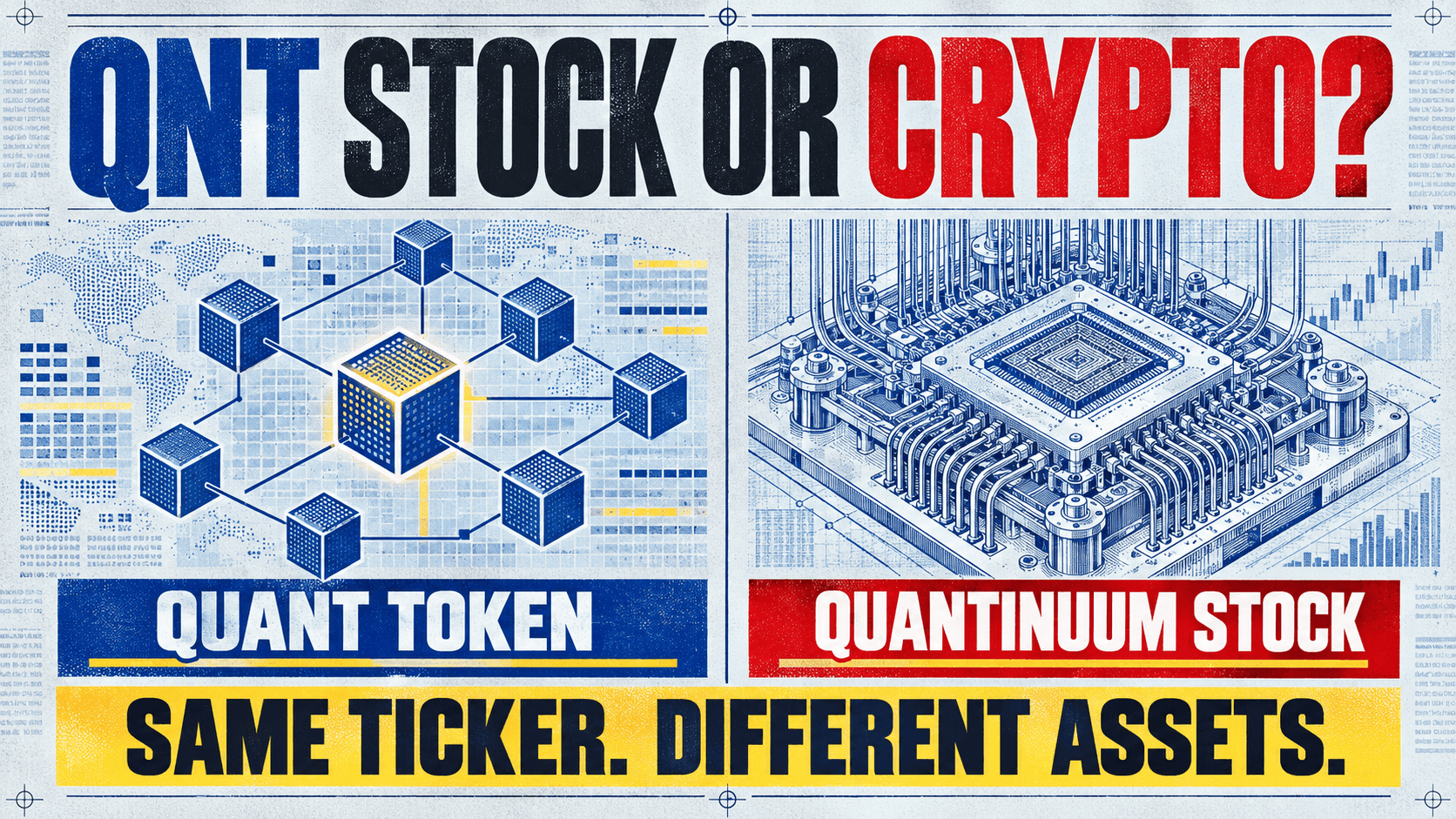
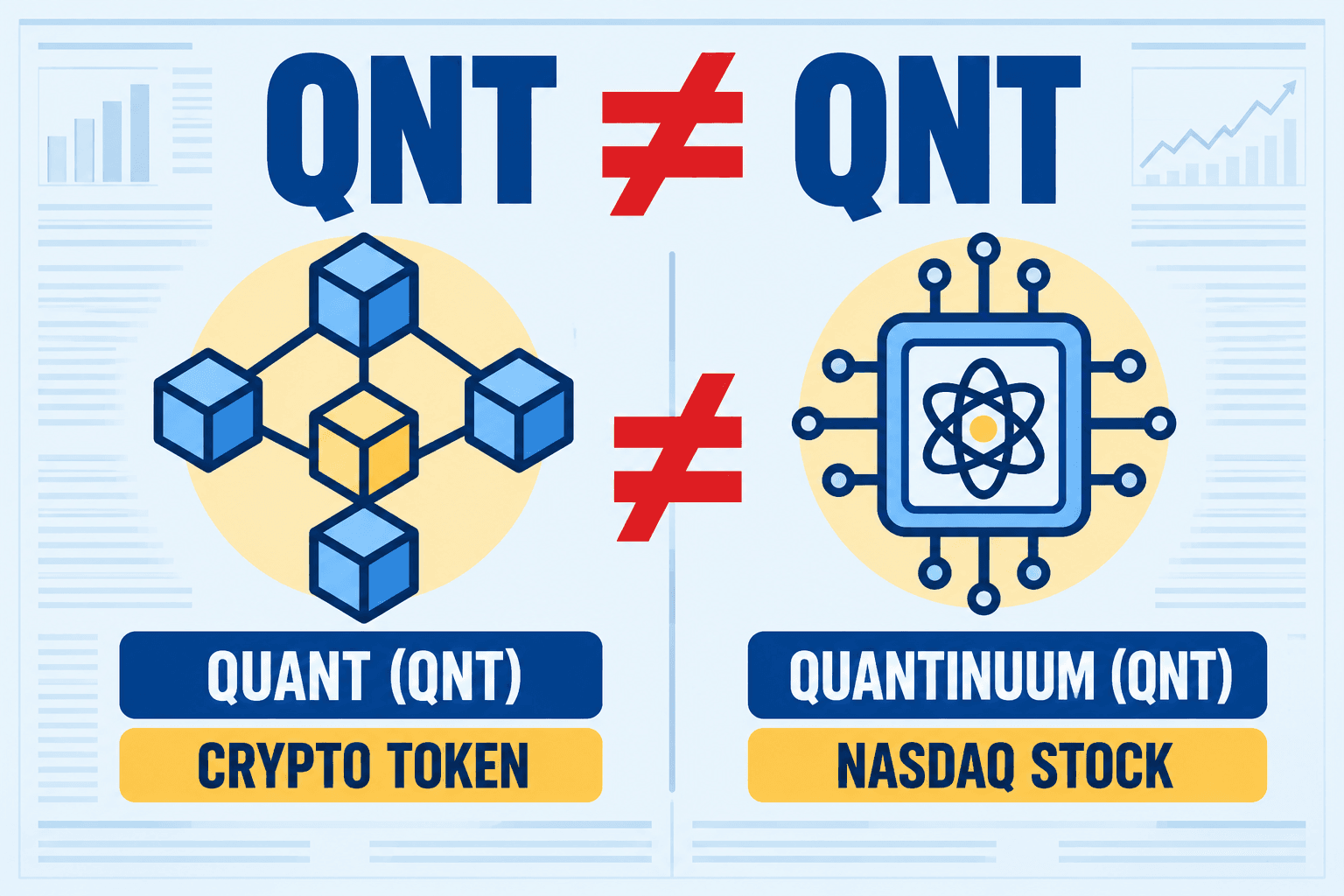
QNT can refer to two completely different assets. Quant (QNT) is an Ethereum-based cryptocurrency used within Quant’s blockchain interoperability ecosystem. Quantinuum Inc. (Nasdaq: QNT) is a publicly traded quantum-computing company whose Class A shares began trading in June 2026. They share the same three-letter symbol, but buying Quant crypto does not give you Quantinuum shares, and buying Quantinuum stock does not provide exposure to the Quant token or Overledger.
This ticker collision is more dangerous than an ordinary naming coincidence. Both assets are technology-related, both can appear in financial search results, and both experienced elevated attention in 2026. A trader who checks only “QNT price” without verifying the full asset name, exchange and instrument type can research one asset and place an order on the other. Market platforms should label both clearly; users should never be expected to infer the difference from the ticker alone.
At a Glance
| Feature | Quant (QNT) | Quantinuum Inc. (QNT) |
|---|---|---|
| Asset type | Cryptocurrency | Class A common stock |
| Market | Crypto exchanges | Nasdaq Global Market |
| Symbol | QNT | QNT |
| Underlying organization | Quant | Quantinuum Inc. |
| Main field | Blockchain interoperability and programmable money | Quantum-computing hardware and software |
| What the buyer owns | A transferable utility token | An equity interest in a public company |
| Shareholder rights | No ordinary company-shareholder rights | Rights attached to Class A common stock |
| Trading hours | Generally available around the clock | Nasdaq trading sessions and supported extended hours |
| WEEX availability | QNT/USDT spot and perpetual futures verified | No WEEX Quantinuum stock market verified |
| Are they related? | No | No |
Why Can QNT Mean Both a Stock and a Cryptocurrency?
Ticker symbols are not globally unique identifiers.
A cryptocurrency exchange can assign the ticker QNT to Quant’s utility token, while a securities exchange can independently approve QNT as the trading symbol for Quantinuum’s Class A common stock.
The markets operate under different listing systems:
- Crypto exchanges use symbols to identify tokens and trading pairs.
- Nasdaq uses symbols to identify listed securities.
- Search engines may combine results from both markets.
- Finance apps may prioritize either the stock or cryptocurrency depending on the selected category.
- Social posts frequently omit the exchange, asset type and full name.
For years, most searches for QNT referred to the Quant cryptocurrency because Quantinuum was privately held. That changed in June 2026 when Quantinuum completed its initial public offering and began trading on Nasdaq under the same ticker.
As of September 2026, saying “QNT is not a stock” is no longer fully accurate. The correct answer is:
Quant’s QNT is a cryptocurrency, while Quantinuum’s QNT is a Nasdaq-listed stock.
What Is Quant (QNT) Cryptocurrency?
Quant (QNT) is an ERC-20 utility token associated with Quant, a UK-based financial technology company founded by Gilbert Verdian.
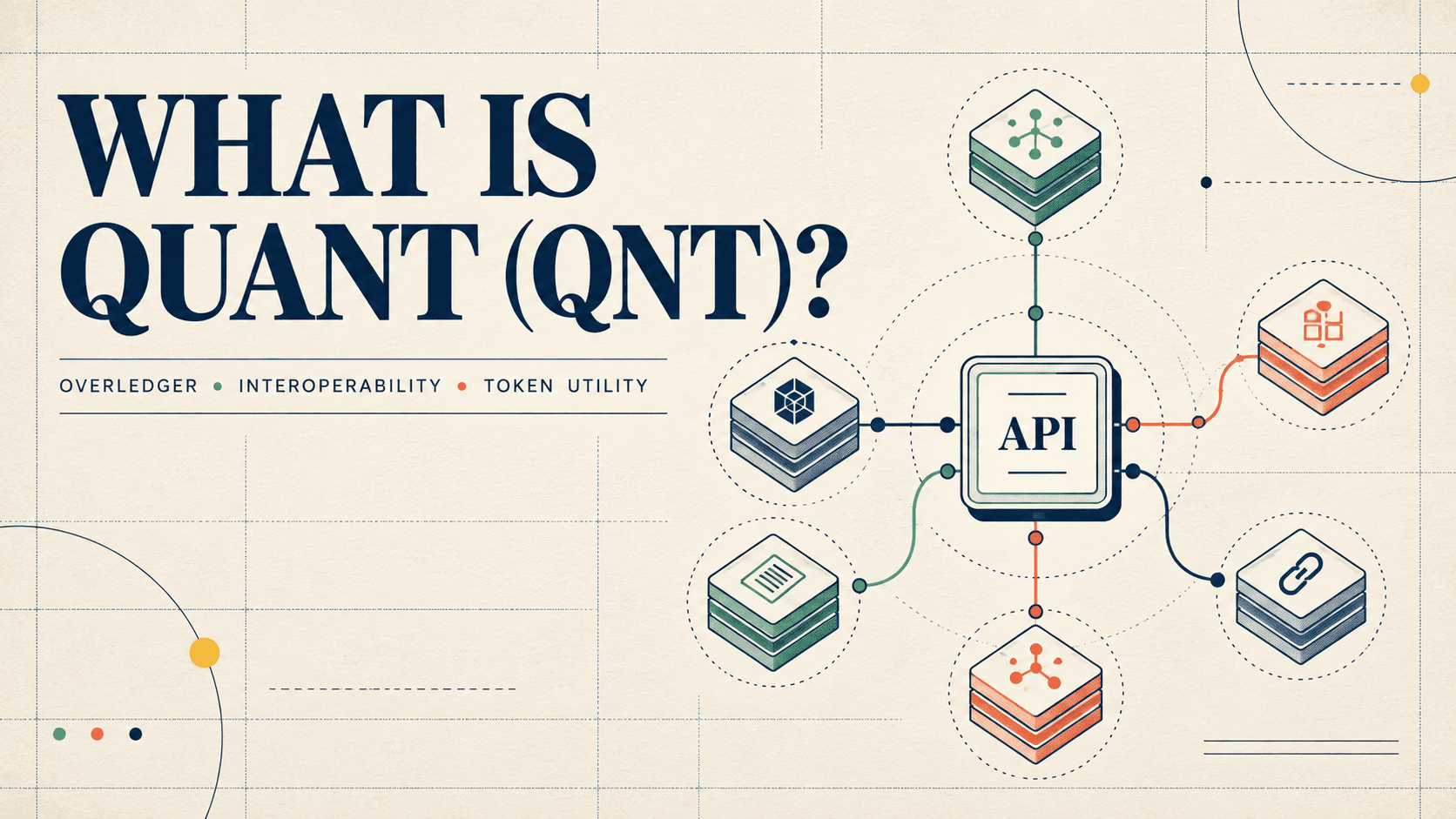
Quant developed Overledger, an API-based interoperability platform designed to connect public blockchains, private distributed ledgers, banking infrastructure and conventional business applications. The objective is to let organizations interact with multiple networks without rebuilding their applications for every blockchain.
Quant’s official materials describe Overledger as a universal API connector capable of linking digital money, assets, payment rails, financial applications and blockchain networks.
What Is Quant (QNT) Used For?
QNT is described as a utility token that may be used in connection with Quant products and services. Its stated functions have included:
- Access to supported Quant services
- Licensing or subscription-related functions
- Overledger transactions
- Ecosystem fees
- Staking where applicable
- Economic coordination within parts of the Overledger ecosystem
Quant’s terms define QNT as a utility token that customers may use for Quant products and services. The company has also said Overledger transactions are powered by QNT, while corporate customers can be offered fiat-payment options.
The fiat option makes token value capture less direct than some investors assume. A company can adopt Quant’s technology without visibly purchasing QNT on a public exchange itself. Public documentation does not fully disclose how every enterprise payment, license or transaction translates into open-market token demand.
What Does Owning Quant (QNT) Mean?
A QNT holder owns cryptocurrency tokens recorded on Ethereum. Ownership normally allows the holder to:
- Transfer QNT to a compatible wallet
- Trade QNT on supported crypto markets
- Use QNT for supported ecosystem functions
- Retain control through the corresponding private key when self-custodied
Owning QNT does not ordinarily provide:
- Shares in Quant
- Dividends from Quant
- Voting rights over Quant’s corporate decisions
- A claim on Quant’s revenue
- Ownership of Overledger
- Equity in Quantinuum
- Exposure to Quantinuum’s quantum computers
The token may benefit from market expectations around Quant’s adoption, but that is different from holding an enforceable equity claim on the company.
-- Price
What Is Quantinuum (QNT) Stock?
Quantinuum Inc. is a quantum-computing company formed from the combination of Honeywell Quantum Solutions and Cambridge Quantum.
The combination closed in November 2021. Quantinuum’s business spans quantum-computing hardware, software, cybersecurity, chemistry, optimization and quantum-assisted artificial intelligence.
Unlike the Quant crypto project, Quantinuum works on computing systems that use quantum-mechanical properties to perform certain types of calculations.
Its business is not based on:
- Overledger
- Blockchain interoperability
- The QNT cryptocurrency
- Tokenized bank deposits
- ERC-20 token utility
- Crypto transaction fees
The similar name is coincidental. The two organizations do not become related simply because they share a ticker.
Is Quantinuum (QNT) Publicly Traded?
Yes. Quantinuum’s Class A common stock began trading on the Nasdaq Global Market under the symbol QNT on June 4, 2026.
Quantinuum’s official IPO announcement stated that the shares were expected to begin trading on June 4 under the QNT symbol. Its final prospectus shows an initial public offering of 28 million Class A shares priced at $60 per share.
That represents gross proceeds of approximately $1.68 billion before underwriting discounts, commissions and offering expenses.
Independent market coverage reported that the shares opened at $68, briefly trading above the $60 IPO price, before closing their first session at approximately $60.38.
This means older articles stating that Quantinuum stock is unavailable to the public are outdated.
Quantinuum (QNT) IPO Timeline
| Date | Event |
|---|---|
| November 30, 2021 | Honeywell Quantum Solutions and Cambridge Quantum completed their combination to form Quantinuum |
| February 2026 | Quantinuum confidentially submitted IPO documentation, according to later reporting |
| April 22, 2026 | The company publicly announced its confidential U.S. IPO filing |
| June 3, 2026 | Final prospectus priced 28 million shares at $60 each |
| June 4, 2026 | Quantinuum shares began trading on Nasdaq under QNT |
| June 5, 2026 | The IPO was expected to close, subject to customary conditions |
| September 8, 2026 | Quantinuum filed an 8-K concerning a U.S. Department of Commerce award agreement |
The SEC filing dated September 8 confirms that Quantinuum’s Class A common stock is registered under the symbol QNT on the Nasdaq Global Market.
What Is the Difference Between Quant (QNT) Crypto and Quantinuum (QNT) Stock?
The central difference is the legal and economic claim attached to each asset.
Quant (QNT) Is a Token
A QNT token is a digital asset on Ethereum. Its price depends on crypto-market supply and demand, expectations around Quant’s products, exchange liquidity and broader cryptocurrency conditions.
The holder does not become a shareholder in Quant.
Quantinuum (QNT) Is Equity
A share of Quantinuum Class A common stock represents an equity interest in Quantinuum Inc. Its valuation is connected to the company’s business, financial performance, assets, liabilities, growth prospects and quantum-computing market.
The holder does not receive Quant cryptocurrency.
Their Prices Are Unrelated
At the data cutoff used for this article:
- Quantinuum stock traded at approximately $49.11 per share.
- Quant crypto traded at approximately $245.42 per token.
The observations were recorded on September 29, 2026. Quantinuum’s latest cited stock trade occurred at 00:15 UTC, while the crypto feed did not provide an equally precise trade timestamp.
The numerical prices should not be compared as if one asset were “cheaper.” A $49 share is not automatically less expensive than a $245 token. Investors must consider:
- Shares or tokens outstanding
- Market capitalization
- Fully diluted valuation
- Revenue and cash flow
- Token utility and value capture
- Liquidity
- Ownership rights
- Risk profile
The price of one individual unit says very little about relative valuation.
Does Quant (QNT) Crypto Give You Exposure to Quantinuum Stock?
No.
Buying the Quant token does not give its holder any direct financial exposure to Quantinuum’s revenue, patents, quantum-computing systems or common stock.
Likewise, buying Quantinuum stock does not provide:
- QNT cryptocurrency
- Access to Overledger
- A claim on Quant’s business
- Participation in the Quant token ecosystem
The two assets may occasionally move in the same direction because of market sentiment or ticker confusion, but that would not establish a fundamental connection.
If Quantinuum releases a new quantum computer, that event affects the investment case for Quantinuum stock. It does not improve Overledger’s blockchain interoperability.
If Quant announces a new tokenized-payment partnership, that may influence Quant crypto. It does not create revenue for Quantinuum.
Could Ticker Confusion Move Either QNT Market?
Temporarily, yes—but the scale is difficult to prove.
Ticker confusion can affect search volume, social engagement and retail order flow. When one QNT asset appears in headlines, users may search the ticker and encounter the other one.
The risk is greater when a post says only:
- “QNT is up today”
- “QNT stock is rallying”
- “Buy QNT”
- “QNT announces new partnership”
- “QNT price target”
Without the full name and venue, none of these statements reliably identifies the asset.
However, it would be irresponsible to attribute a specific price move to mistaken orders without supporting trading or account-level evidence. Search confusion is observable; the number of trades caused by it usually is not.
For publishers, the responsible format is:
- Quant (QNT) crypto
- Quantinuum Inc. (Nasdaq: QNT)
- QNT/USDT
- Quantinuum common stock
That small amount of additional context prevents a substantial factual error.
How Can You Tell Which QNT Asset a Platform Shows?
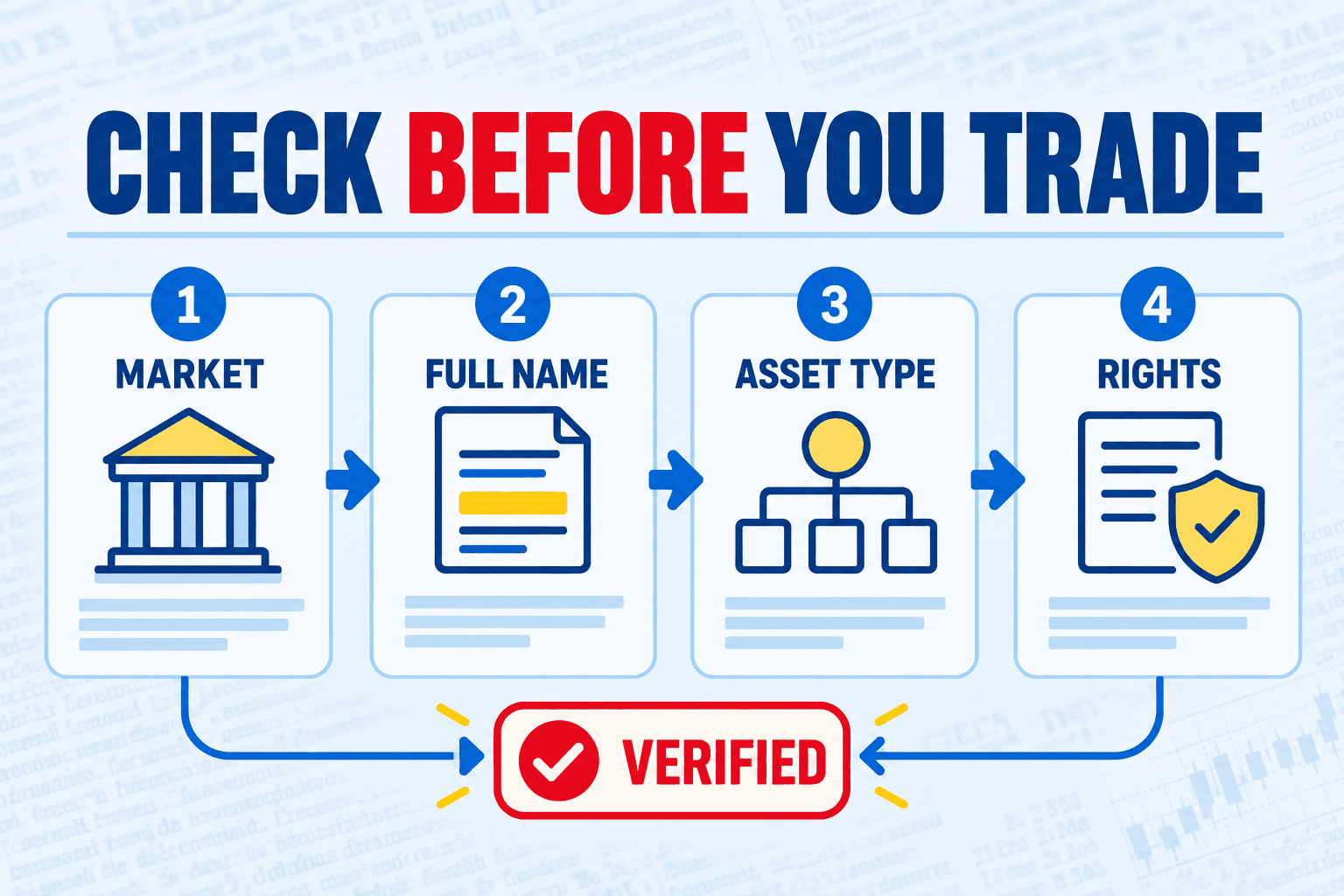
Check four fields before relying on a quote or placing an order.
1. Check the market
If the asset appears on Nasdaq or in a brokerage’s U.S. equities section, it is likely Quantinuum stock.
If it appears on a cryptocurrency exchange in a pair such as QNT/USDT, it is the Quant token.
2. Check the full asset name
Look for either:
- Quant
- Quant Network
- Quantinuum Inc.
Do not rely on QNT alone.
3. Check the instrument type
A platform may describe the instrument as:
- Cryptocurrency
- Token
- Spot pair
- Perpetual contract
- Class A common stock
- Equity
- Stock derivative
These labels indicate what the user is actually trading.
4. Check the rights attached to it
Ask whether the asset represents a transferable token or an ownership interest in a corporation.
A cryptocurrency wallet address indicates Quant crypto. A brokerage position recorded as Class A common stock indicates Quantinuum equity.
What Does a QNT Wallet Address Tell You?
The presence of a wallet or smart-contract address is a clear sign that a platform is discussing Quant cryptocurrency rather than Quantinuum common stock.
Quant’s QNT is an ERC-20 token. It can be held in an Ethereum-compatible wallet and transferred on-chain.
Quantinuum shares are securities. They are normally held through a brokerage or eligible custody system rather than transferred to an Ethereum wallet.
Never send QNT cryptocurrency to a brokerage account expecting Quantinuum shares. Never interpret a brokerage purchase of Nasdaq QNT as a crypto withdrawal.
The shared ticker does not create convertibility between the assets.
What Are the Investment Drivers for Quant (QNT) Crypto?
Quant crypto is generally influenced by:
- Adoption of Quant’s Overledger infrastructure
- Institutional blockchain partnerships
- Token utility and value-capture expectations
- Token supply and holder concentration
- Crypto spot liquidity
- Perpetual-futures positioning
- Bitcoin and broader crypto-market sentiment
- Exchange listings and availability
- Regulatory treatment of crypto assets
One recent example is The Clearing House’s September 24, 2026 announcement selecting Quant for an institutional tokenized-deposit initiative. That announcement relates to Quant’s blockchain infrastructure and QNT crypto sentiment—not Quantinuum’s quantum-computing business.
What Are the Investment Drivers for Quantinuum (QNT) Stock?
Quantinuum stock responds to a different set of factors:
- Progress toward fault-tolerant quantum computing
- Hardware performance and system roadmaps
- Customer contracts
- Quantum-software commercialization
- Revenue growth
- Research and development spending
- Operating losses and cash requirements
- Competition from other quantum-computing companies
- Government awards and strategic investments
- Share issuance and dilution
- Expectations across the broader technology sector
Quantinuum was created by combining Honeywell Quantum Solutions’ hardware with Cambridge Quantum’s software and applications. Its technology and financial prospects should therefore be compared with quantum-computing businesses—not blockchain interoperability tokens.
Which QNT Asset Is More Risky?
They carry different risks, so one simple ranking would be misleading.
| Risk | Quant (QNT) Crypto | Quantinuum (QNT) Stock |
|---|---|---|
| Market hours | Around-the-clock volatility | Exchange-session and gap risk |
| Regulation | Crypto classification and exchange rules | Securities regulation and public-company requirements |
| Fundamental basis | Token usage, liquidity and adoption expectations | Company revenue, expenses, technology and capital needs |
| Ownership rights | Utility token, no ordinary equity rights | Class A common stock |
| Valuation challenge | Unclear token value capture | Early-stage quantum revenue and high R&D requirements |
| Custody | Wallet, exchange and smart-contract risks | Brokerage and securities-custody risks |
| Dilution | Token supply and treasury movements | New share issuance and stock-based compensation |
| Technology risk | Enterprise blockchain adoption | Commercial-scale quantum computing execution |
| Ticker confusion | Can be mistaken for the stock | Can be mistaken for the cryptocurrency |
Quant crypto may experience faster and less constrained price swings. Quantinuum stock has more conventional disclosure and shareholder structures, but the company operates in a capital-intensive emerging industry where commercialization remains uncertain.
“Stock” does not mean safe, and “crypto” does not automatically mean worthless. The correct comparison begins with what each asset represents.
Can You Buy Quant (QNT) Crypto on WEEX?
Yes. WEEX currently provides access to Quant cryptocurrency through QNT/USDT markets.
Buying Quant (QNT) in the WEEX Spot Market
The WEEX Quant (QNT)/USDT spot market is used to exchange USDT for the QNT cryptocurrency.
A basic process is:
- Sign in to WEEX.
- Deposit or acquire USDT.
- Open QNT/USDT in the spot market.
- Confirm that the asset name is Quant, not Quantinuum.
- Choose a limit or market order.
- Review the amount and estimated fee.
- Confirm the transaction.
After a completed spot purchase, the account holds QNT cryptocurrency—not Quantinuum shares.
Trading Quant (QNT) Perpetual Futures on WEEX
Eligible users can also access the WEEX Quant (QNT)/USDT perpetual-futures market.
A QNT perpetual contract provides derivatives exposure to the cryptocurrency’s price. It is not a futures contract on Quantinuum stock.
Before placing an order, review:
- Contract name
- Index price
- Mark price
- Funding rate
- Funding countdown
- Margin mode
- Leverage
- Liquidation price
- Stop-loss settings
WEEX materials available during the review period showed that QNT perpetual funding was scheduled at 00:00, 08:00 and 16:00 UTC. Current specifications should always be checked on the live contract page.
No QNT-specific WEEX campaign or fee discount was independently verified for this article.
Can You Buy Quantinuum (QNT) Stock on WEEX?
No Quantinuum stock or Quantinuum-linked WEEX stock contract was independently verified during this review.
The QNT markets verified on WEEX refer to the Quant cryptocurrency. Users should not assume that entering QNT on a crypto trading page provides exposure to Nasdaq-listed Quantinuum.
Investors seeking Quantinuum common stock would need a brokerage that:
- Supports Nasdaq-listed U.S. equities
- Lists Quantinuum Inc.
- Operates in the investor’s jurisdiction
- Clearly labels the instrument as Nasdaq: QNT or Quantinuum Class A common stock
Availability can differ by country and account type.
Frequently Asked Questions
1. Is QNT a Stock or a Cryptocurrency?
Both assets exist. Quant (QNT) is a cryptocurrency, while Quantinuum Inc. trades as QNT stock on Nasdaq. They are unrelated assets.
2. Is Quant (QNT) the Same Company as Quantinuum?
No. Quant develops blockchain interoperability and programmable-money infrastructure. Quantinuum develops quantum-computing hardware and software.
3. When Did Quantinuum (QNT) Stock Go Public?
Quantinuum’s Class A shares began trading on the Nasdaq Global Market on June 4, 2026, under the ticker QNT.
4. Does Buying Quant (QNT) Crypto Give Me Quantinuum Shares?
No. Holding QNT cryptocurrency does not provide equity, dividends or shareholder rights in Quantinuum.
5. Which QNT Is Available on WEEX?
The verified QNT/USDT spot and perpetual markets on WEEX refer to Quant cryptocurrency. No Quantinuum stock market on WEEX was verified during this review.
WEEX Editorial View: Using the Same Ticker Was Predictably Confusing
The crypto market does not own the symbol QNT, and Nasdaq was entitled to approve it for Quantinuum. But from a retail-user perspective, the collision is objectively poor identification design.
The confusion is not theoretical. A search for “QNT stock” can now return a genuine Nasdaq security, while a crypto exchange displays an unrelated QNT token. Prices, news and charts can all look plausible to someone who notices the ticker but misses the full name.
Publishers and platforms should stop using bare QNT when the context is not unmistakable. Quant should be labeled “Quant (QNT) crypto,” and the stock should be labeled “Quantinuum Inc. (Nasdaq: QNT).” Anything less transfers an avoidable verification burden to the reader.
The practical conclusion is simple: the ticker is no longer enough. The market, legal instrument and full entity name must be checked before any QNT trade.
Sources
- U.S. Securities and Exchange Commission, Quantinuum Inc. final IPO prospectus, dated June 3, 2026. (sec.gov)
- U.S. Securities and Exchange Commission, Quantinuum Inc. Form 8-K, filed September 8, 2026. (sec.gov)
- Quantinuum, “Quantinuum Announces Pricing of Upsized Initial Public Offering,” accessed September 29, 2026. (quantinuum.com)
- Quantinuum, “Introducing Quantinuum,” originally published November 30, 2021. (quantinuum.com)
- Quant, “Overledger” and “Principles,” accessed September 29, 2026. (quant.network)
- WEEX, QNT/USDT spot and perpetual-futures pages, accessed September 29, 2026. (www.weex.com)
- Current market feeds for Quantinuum stock and Quant cryptocurrency, observed September 29, 2026. The cryptocurrency feed did not provide an exact data timestamp.
This content is provided for general informational purposes only and doesn't constitute financial, investment, legal, or tax advice. Any events, rewards, online promotions, or related information mentioned herein should not be considered a recommendation, solicitation, or invitation to purchase, sell, trade, or otherwise deal in any crypto assets. Crypto assets are highly volatile and may result in loss. The availability of WEEX services, products, and related events may vary by region. You are responsible for ensuring that your participation is in accordance with applicable local laws and regulations.
You may also like

What Is Coinbase Wrapped HYPE (cbHYPE)? How It Works on Base, 1:1 Backing, Risks, and HYPE Conversion
No KYC Crypto Wallet: 6 Picks and 5 Places Your ID Still Leaks
What Is Quant (QNT) Crypto? How Overledger Works, QNT Utility, and Token Supply Explained

Best Decentralized Crypto Wallet for Beginners: What Self-Custody Really Asks of You
Does a Negative Funding Rate Mean a Short Squeeze Is Coming?

Best Crypto Exchange for Beginners 2026: What Actually Matters When Choosing One

Best Crypto Cold Wallet 2026: Top Picks Matched to How You Hold
How to Connect Phantom Wallet to a Solana DApp
How to Install and Set Up Phantom Wallet
Funding Rate Crypto: What BTC and ETH Are Paying Right Now

INTC Stock Surged 14%: Intel Only Has Enough Chips for Half Its Clients
XPL Unlock on Sept 25: How to Long or Short Plasma Futures Safely
Bitcoin Funding Rate After a $648M Short Squeeze: What Longs Pay
What Is Blockchain Technology? Follow One Transaction to See

How Does Mining Actually Work on Pi Network?
What Is Pi Network? A Complete Beginner's Guide

How to Look Up a Wallet Address and Transaction History
Funding Rate Explained: How Perpetual Futures Fees Hit Your PnL

PENGU Airdrop on WEEX: Get 10 USDT in PENGU Before October 6
BTC Futures Trading on WEEX: Claim BTC Rewards Before Sep 25
What Is a Funding Rate? How Perpetual Futures Charge Longs and Shorts
How Does WEEX KYC Verification Work? A Taiwan User Guide
Macro Protocol (MTP): Listing Status and a Safe Verification Guide
Lumentum (LITE) Perpetual Futures: Why 25x Leverage Is the Limit
Lisk Chain Shutdown October 31: How to Move LSK Safely
What Is BONK? WEEX Spot and 1000BONK Futures Status and Risk Checks
What Is BRETT? WEEX Spot and Futures Status and Risk Checks
What Is FLOKI? WEEX Spot and 1000FLOKI Futures Status and Risk Checks

What Is WIF (dogwifhat)? WEEX Spot and Futures Status and Risk Checks

How to Test a Trading Strategy on WEEX Demo Before Going Live
What Is Coinbase Wrapped HYPE (cbHYPE)? How It Works on Base, 1:1 Backing, Risks, and HYPE Conversion
No KYC Crypto Wallet: 6 Picks and 5 Places Your ID Still Leaks
What Is Quant (QNT) Crypto? How Overledger Works, QNT Utility, and Token Supply Explained
Best Decentralized Crypto Wallet for Beginners: What Self-Custody Really Asks of You
Does a Negative Funding Rate Mean a Short Squeeze Is Coming?
Best Crypto Exchange for Beginners 2026: What Actually Matters When Choosing One


