
What Is Coinbase Wrapped Zcash (cbZEC)? How It Brings Zcash to Base Without Native ZEC Privacy

 Prefer us on Google


Coinbase Wrapped Zcash (cbZEC) is a token issued on Base that represents Zcash (ZEC) held by Coinbase. Each cbZEC is intended to be backed 1:1 by an equivalent amount of ZEC in Coinbase custody, giving Base users exposure to ZEC and access to compatible DeFi applications. However, cbZEC does not carry Zcash’s native shielded-transaction privacy onto Base: its transfers remain publicly visible on the Base blockchain.
That privacy distinction is the most important fact about cbZEC, yet it is likely to be overlooked. Coinbase has created a practical route for bringing ZEC liquidity into Base, but cbZEC should not be marketed as “private Zcash on Base.” It is a transparent, custody-backed representation of a privacy-focused asset. That does not make the token pointless, but it means its strongest use case is cross-ecosystem liquidity—not private payments.
Quick Read
Coinbase Wrapped Zcash (cbZEC) connects Zcash’s market value with the Base ecosystem. Coinbase holds the underlying ZEC, issues cbZEC on Base and allows eligible users to convert between the wrapped token and their underlying ZEC balance through supported transfer routes.
The official Base contract published by Coinbase is:
0xB2000000000000000000008501b13360000cb2EC
Coinbase states that its standard wrapped assets are backed 1:1 by the underlying cryptocurrencies in its custody. It also says that these wrapped assets do not have separate order books on Coinbase. Users can receive them through supported multichain withdrawals or access them through compatible third-party markets.
| Attribute | Coinbase Wrapped Zcash (cbZEC) |
|---|---|
| Underlying asset | Zcash (ZEC) |
| Blockchain | Base |
| Backing model | 1 cbZEC backed by 1 ZEC |
| Issuer and custodian | Coinbase |
| Primary purpose | Bring ZEC-linked value into Base applications |
| Native Zcash privacy | No |
| Base transfer visibility | Public |
| Gas token | ETH on Base |
| Official contract | 0xB2000000000000000000008501b13360000cb2EC |
| Separate Coinbase trading pair | No |
How Does Coinbase Wrapped Zcash (cbZEC) Work?
Coinbase Wrapped Zcash operates through a custody-and-issuance model rather than by moving native ZEC directly onto Base.
ZEC remains an asset on the Zcash network. Coinbase holds ZEC in custody and issues a corresponding quantity of cbZEC on Base. The wrapped token can then be transferred between Base addresses or integrated into Base-compatible smart contracts.
When an eligible Coinbase customer sends ZEC to a Base address through a supported Coinbase withdrawal flow, Coinbase can deliver cbZEC to that address. When cbZEC is deposited back into a supported Coinbase account, Coinbase says it converts the wrapped token into the underlying ZEC balance.
The process can be understood in five stages:
- A customer holds Zcash (ZEC) through a supported Coinbase account.
- The customer chooses to send the asset through the Base network.
- Coinbase retains the corresponding ZEC within its custody infrastructure.
- An equivalent amount of Coinbase Wrapped Zcash (cbZEC) is delivered on Base.
- When supported cbZEC is returned to Coinbase, the account is credited with the underlying ZEC.
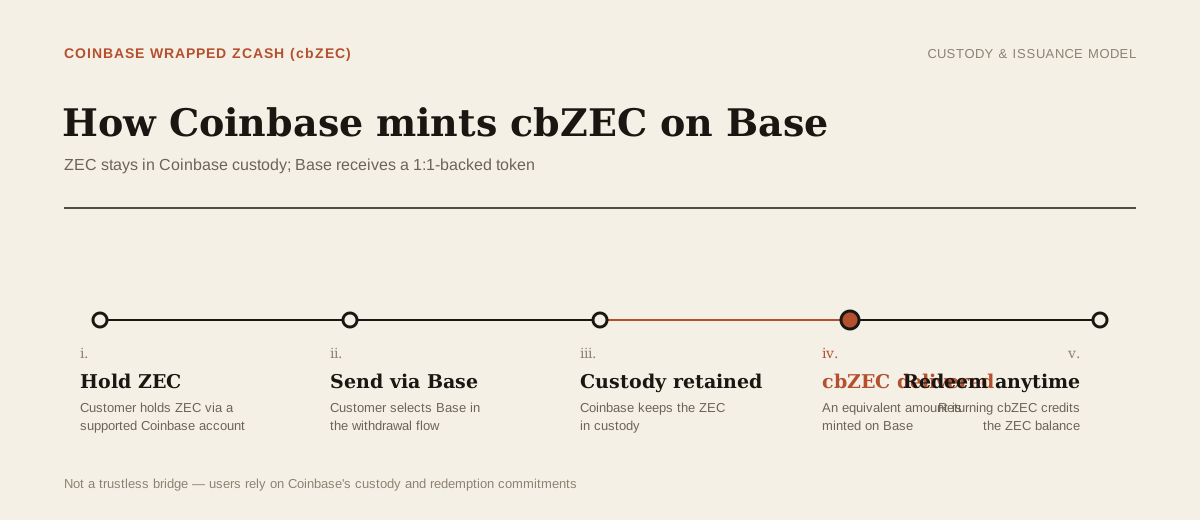
This structure creates a bridge between two ecosystems, but it is not a trustless bridge. The user depends on Coinbase to maintain the backing, process conversions and continue supporting the relevant network routes.
The Base token contract records cbZEC transfers, while the backing ZEC exists separately under Coinbase custody. The token contract alone cannot prove every operational detail of the offchain custody arrangement. Users therefore rely on both onchain verification and the issuer’s custody commitments.
What Is the Difference Between Zcash (ZEC) and Coinbase Wrapped Zcash (cbZEC)?
Zcash (ZEC) and Coinbase Wrapped Zcash (cbZEC) can represent similar market value, but they are different assets on different networks.
ZEC is the native cryptocurrency of the Zcash blockchain. It can be transferred through transparent or shielded transaction systems, depending on the wallet, address type and transaction route. Zcash explains that shielded addresses protect financial information, while transparent addresses make transaction information publicly visible.
cbZEC is a token on Base. Its ownership and transfers are recorded through the Base network’s public ledger. It does not execute transactions through Zcash’s shielded pools and does not automatically provide the privacy properties associated with shielded ZEC.
| Feature | Zcash (ZEC) | Coinbase Wrapped Zcash (cbZEC) |
|---|---|---|
| Native network | Zcash | Base |
| Asset type | Native cryptocurrency | Custody-backed wrapped token |
| Privacy options | Transparent and shielded transactions | Public Base transactions |
| Primary utility | Zcash payments, transfers and network use | Base DeFi and Base transfers |
| Backing | Native asset | ZEC held by Coinbase |
| Network fees | Paid according to Zcash network rules | Paid in ETH on Base |
| Contract address | Not an ERC-20-style Base token | Official Base contract required |
| Main infrastructure risk | Zcash network and wallet implementation | Coinbase custody, Base and token contract |
| Redemption dependency | None for native ownership | Depends on supported Coinbase conversion |
The two assets should not be treated as technically interchangeable. A wallet supporting native ZEC may not support cbZEC, and a Base wallet displaying cbZEC cannot necessarily send it to a native Zcash address.
-- Price
Is Coinbase Wrapped Zcash (cbZEC) Private?
No. Coinbase Wrapped Zcash does not provide native Zcash shielded privacy when it is transferred on Base.
This is the decisive limitation of the product. Zcash’s privacy features are implemented through the Zcash protocol, its shielded pools and compatible address types. Moving the economic value of ZEC into a Base token does not reproduce those protocol features.
Zcash distinguishes between transparent and shielded addresses. Transparent Zcash activity is publicly visible, while shielded transactions can protect the sender, receiver, amount and associated wallet information. Zcash also uses unified addresses to help compatible wallets handle different receiving types.
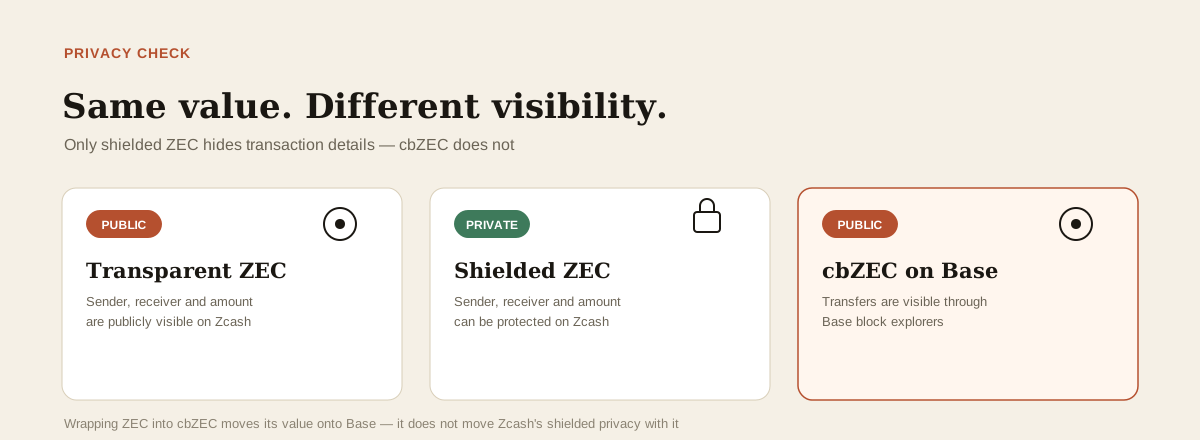
cbZEC transfers, by contrast, are visible through Base block explorers. Observers can examine the sending address, receiving address, token amount, transaction time and contract interactions. Wallet addresses may remain pseudonymous, but that is not the same as Zcash’s shielded privacy.
The following statement is therefore inaccurate:
cbZEC lets users make private Zcash payments on Base.
A more accurate description is:
cbZEC lets users represent and use ZEC-linked value within the transparent Base smart-contract ecosystem.
This distinction matters for users whose primary reason for holding ZEC is transactional privacy. Those users should evaluate native shielded ZEC infrastructure rather than assume cbZEC offers equivalent protection.
Why Did Coinbase Create Coinbase Wrapped Zcash (cbZEC)?
Zcash and Base serve different technical environments.
Zcash was designed around peer-to-peer electronic cash and privacy-preserving transactions. Base is an Ethereum Layer 2 network built around EVM-compatible smart contracts and applications. A native ZEC balance cannot automatically interact with Base lending markets, decentralized exchanges or liquidity protocols.
cbZEC gives developers a Base-compatible token that represents ZEC without requiring every application to develop its own Zcash integration. A Base protocol can integrate one token contract using familiar EVM tooling.
For users, this creates several possible benefits. ZEC-linked value can be transferred through Base wallets, traded in compatible Base liquidity pools and used by applications that explicitly support cbZEC. Developers can also combine cbZEC with other Base assets inside programmable financial products.
For Coinbase, cbZEC expands a broader wrapped-asset strategy. Coinbase has introduced Base representations of several external assets, including Bitcoin, Dogecoin, XRP, Cardano, Litecoin, Hyperliquid and Zcash. The company presents these tokens as transferable, 1:1-backed assets intended to bring more cryptocurrencies into onchain applications.
The business logic is straightforward: the more widely Base applications support Coinbase-wrapped assets, the easier it becomes for users to move assets held through Coinbase into the Base ecosystem.
What Gives Coinbase Wrapped Zcash (cbZEC) Value?
cbZEC does not have an independent monetary system. Its market value is intended to follow ZEC because each token represents underlying ZEC held in Coinbase custody.
The backing relationship gives arbitrageurs a reason to trade price differences. If cbZEC trades below ZEC, an eligible participant may buy cbZEC and convert it back into the underlying asset. If cbZEC trades above ZEC, a participant may obtain newly wrapped ZEC and sell cbZEC at the premium.
In practice, several costs can prevent immediate parity:
Network fees, swap fees, account eligibility, processing time and available pool liquidity all influence whether an arbitrage opportunity is profitable.
This is why “backed 1:1” and “trades exactly 1:1” are not identical statements. Backing describes the intended relationship between issued cbZEC and custodied ZEC. The market price is determined by actual buyers and sellers.
A shallow liquidity pool can produce a large price impact even when Coinbase continues to hold the correct amount of ZEC. Conversely, cbZEC could trade slightly above ZEC when immediate demand on Base exceeds the available token supply.
Coinbase Wrapped Zcash (cbZEC) Supply and Fully Diluted Valuation
Coinbase Wrapped Zcash does not have conventional token emissions, mining rewards or a separate vesting schedule. Its supply changes as ZEC enters or exits the wrapping system.
CoinMarketCap’s late-September 2026 snapshot reported approximately 3,206 cbZEC in circulating supply. The same source did not identify a fixed maximum supply. These figures are highly changeable because newly wrapped or redeemed tokens can alter supply without following a predetermined emission calendar.
| Metric | What It Means for Coinbase Wrapped Zcash (cbZEC) |
|---|---|
| Circulating supply | cbZEC currently issued and counted as circulating |
| Total supply | Issued cbZEC less any tokens removed through redemption or burning |
| Maximum supply | No independent fixed maximum was identified |
| Token emissions | Based on wrapping activity, not mining rewards |
| Vesting | No separate cbZEC vesting allocation |
| Fully diluted valuation | Value of total cbZEC supply at the current market price |
| Underlying supply constraint | Ultimately related to available ZEC and Coinbase’s backing policy |
The absence of a fixed cbZEC maximum supply should not be confused with unlimited economic value creation. Under Coinbase’s stated model, additional cbZEC should require additional ZEC backing.
ZEC itself has a different supply model. CoinMarketCap reports a maximum ZEC supply of 21 million coins, comparable in headline terms to Bitcoin’s supply limit. cbZEC does not create a second independent ZEC economy; it represents part of the existing ZEC supply within another network.
Analysts should avoid adding the market capitalization of ZEC and cbZEC as though they were unrelated assets. That would double-count underlying exposure.
What Is the Token Utility of Coinbase Wrapped Zcash (cbZEC)?
The token utility of cbZEC is based on portability and smart-contract compatibility.
Native ZEC cannot be inserted directly into an EVM smart contract on Base. cbZEC provides a standardized Base token that applications can recognize, transfer and potentially accept as collateral.
A Base decentralized exchange can create a cbZEC/USDC or cbZEC/WETH liquidity pool. A lending market could choose to support cbZEC as collateral after evaluating its liquidity and custody risks. Portfolio applications can track it alongside other Base assets. Users can also transfer cbZEC between Base addresses without returning to the Zcash network for every transaction.
These use cases remain conditional. The existence of a token contract does not guarantee meaningful protocol support. A token can be technically compatible with Base while having limited liquidity, few active pools or no acceptance by major lending platforms.
The quality of cbZEC’s utility should therefore be measured through actual integrations, available liquidity, transaction volume and redemption access—not by the number of protocols that merely display the token.
Can Coinbase Wrapped Zcash (cbZEC) Be Used for Shielded Payments?
cbZEC cannot be used directly in Zcash’s shielded pools while it remains on Base.
A holder who wants native Zcash privacy would need to convert cbZEC into ZEC through a supported route and then move the resulting ZEC into a compatible Zcash wallet. The user would also need to select an appropriate shielded or unified address and understand the privacy behavior of the wallet.
This conversion creates a privacy boundary. Base transactions completed before the conversion remain publicly visible. Converting assets into native ZEC does not erase the earlier Base transaction history.
Users should also understand that a transfer passing through a centralized exchange may create additional records associated with the account. Zcash protocol privacy and exchange-level account privacy are separate issues.
For that reason, cbZEC is better understood as a liquidity wrapper than a privacy wrapper.
How to Verify Coinbase Wrapped Zcash (cbZEC)
The token’s complete contract address should be verified before any swap, transfer or approval:
0xB2000000000000000000008501b13360000cb2EC
The ticker cbZEC is not sufficient. Anyone can create another Base token with a similar name, copied logo or nearly identical ticker.
Verification should include the network, contract address and receiving platform. The selected network must be Base, the contract must match Coinbase’s published address and the destination must explicitly support cbZEC rather than only native ZEC.
Users should then inspect the proposed swap route. The interface should show the verified token contract, expected output, price impact, liquidity source and network fee. If a small trade causes unusually large price impact, the pool may not have enough liquidity for the intended transaction.
Token approvals deserve equal attention. An approval gives a smart contract permission to move assets from a wallet. Users should avoid granting unlimited approval to an unfamiliar application merely because the page displays a Coinbase-related token name.
What Are the Main Risks of Coinbase Wrapped Zcash (cbZEC)?
Custody risk is fundamental. cbZEC depends on Coinbase holding the corresponding ZEC and maintaining the operational process through which wrapped tokens are issued and redeemed.
Smart-contract risk is also present. cbZEC is controlled through a Base token contract. A contract vulnerability, administrative failure or problematic upgrade could affect transfers and integrations even if the underlying ZEC remains secure.
Liquidity is likely to be the most immediate market risk. The cbZEC circulating supply and market capitalization remain small relative to native ZEC. A user who sees deep global ZEC markets may incorrectly assume the same depth exists for cbZEC. The liquidity available in a particular Base pool can be far lower.
Depegging can occur when market selling exceeds available liquidity or when redemption becomes difficult. A custody-backed token may trade below its underlying asset without the backing necessarily having failed.
Network confusion creates another risk. Native ZEC, cbZEC and other wrapped ZEC products may use similar names. Sending cbZEC to a native Zcash address or sending native ZEC to an unsupported Base address can result in lost or inaccessible funds.
Finally, there is privacy misunderstanding. A user may buy cbZEC believing that the token conceals transactions because Zcash is associated with privacy. Base activity remains public. For many users, this misunderstanding is more likely to cause harm than an exotic smart-contract failure.
Coinbase Wrapped Zcash (cbZEC) Versus Other Wrapped ZEC Tokens
The expression “wrapped ZEC” does not identify a single universal token.
Different issuers can create different representations of ZEC on different networks. Each may use its own contract, custodian, bridge mechanism, redemption process and liquidity market.
| Comparison Factor | Coinbase Wrapped Zcash (cbZEC) | Another Wrapped ZEC Product |
|---|---|---|
| Issuer | Coinbase | Depends on the project |
| Network | Base | May use Ethereum or another chain |
| Official contract | Coinbase-published Base address | Separate contract |
| Backing | Coinbase says 1:1 ZEC custody | Depends on issuer |
| Redemption | Through supported Coinbase flows | Depends on bridge or custodian |
| Liquidity | Base-specific pools | Network-specific pools |
| Privacy | Public blockchain transfers | Usually public on EVM chains |
| Interchangeability | Not automatically interchangeable | Must be separately converted |
A token called WZEC, wrapped ZEC or bridged ZEC should never be assumed to be cbZEC. Even if two products track the same underlying asset, their contracts and risk structures can differ completely.
How to Obtain Coinbase Wrapped Zcash (cbZEC)
Eligible Coinbase users may be able to obtain cbZEC through a supported withdrawal of ZEC to Base. Coinbase’s general wrapped-asset instructions say users should select the underlying asset, enter the recipient address, choose the supported alternative network and review the transaction before sending.
A careful workflow is:
- Confirm that the Coinbase account and region support cbZEC transfers.
- Prepare a self-custody wallet configured for Base.
- Add the official cbZEC contract to the wallet if the asset is not automatically displayed.
- Keep enough ETH on Base to pay future transaction fees.
- Select Zcash (ZEC) in the Coinbase send flow and choose Base only when Coinbase explicitly shows it as supported.
- Confirm the receiving address, network and amount before sending.
- After settlement, compare the received contract with Coinbase’s published address.
Users may also swap for cbZEC through a Base decentralized exchange. That route should be evaluated for contract authenticity, liquidity, price impact and approval risk.
How to Trade Zcash (ZEC) on WEEX
A dedicated Coinbase Wrapped Zcash (cbZEC) market was not independently verified on WEEX at the September 29, 2026 data cutoff. Users should not send cbZEC to a WEEX ZEC deposit address unless the deposit interface explicitly identifies Base and cbZEC as supported.
Native Zcash (ZEC), however, is available through WEEX spot and perpetual-futures markets:
Trade Zcash (ZEC) in the WEEX spot market
Trade Zcash (ZEC)/USDT perpetual futures on WEEX
Spot trading involves buying or selling ZEC itself within the exchange account. Perpetual futures provide exposure to ZEC price movements without delivering native ZEC and introduce additional variables such as leverage, funding rates, margin requirements and liquidation prices.
To use the spot market, search for ZEC/USDT, confirm that the page is labeled Spot, review the current order book and choose an appropriate market or limit order. Before withdrawing, check which Zcash address types and networks are supported.
In the futures market, traders should verify the mark price rather than relying only on the last traded price. They should also review the current funding rate, selected leverage, margin mode and estimated liquidation price before opening a position.
WEEX previously ran a ZEC new-user campaign with a 50,000 USDT reward pool from November 3 to November 10, 2025. That campaign is marked as ended and should not be presented as currently available. (WEEX Spot Trading Competition)
No current cbZEC-specific promotion or verified cbZEC fee discount was identified at the data cutoff. Current fees and campaigns should be checked on the live WEEX market and events pages before publication.
What Coinbase Wrapped Zcash (cbZEC) Means for Zcash (ZEC)
cbZEC can expand access to ZEC-linked liquidity without changing the Zcash protocol itself.
If Base users want ZEC exposure for swaps, liquidity provision or collateral, cbZEC provides a more direct route than selling into another asset and rebuilding the position elsewhere. Additional demand for cbZEC may also require more ZEC to be held in Coinbase custody.
However, wrapping does not increase Zcash’s maximum supply or create new independent ZEC value. It relocates the economic representation of existing ZEC.
The more interesting effect is strategic. Zcash has historically been positioned around private digital cash, while Base is designed around transparent, composable smart contracts. cbZEC separates ZEC’s market exposure from its native privacy functionality.
That separation could attract a new group of users who value the asset but do not require shielded payments. It could also weaken the public understanding of what makes Zcash technically distinct if cbZEC becomes more visible than native shielded use.
The outcome depends on whether cbZEC becomes meaningful Base collateral or remains a small wrapped asset with limited pools.
WEEX Editorial View: Coinbase Wrapped Zcash (cbZEC) Solves Liquidity, Not Privacy
cbZEC is a useful bridge between Zcash’s economic value and Base’s application ecosystem. It can make ZEC-linked capital easier to deploy, reduce integration work for Base developers and give existing ZEC holders another route into EVM-based DeFi.
But the product’s branding carries an unavoidable risk of confusion. Zcash is best known for privacy, while cbZEC is a publicly traceable Base token. Treating those two characteristics as compatible without qualification is misleading.
The honest case for cbZEC does not require exaggerating its privacy. It should be evaluated as a Coinbase-custodied liquidity instrument: useful when a user specifically needs ZEC exposure inside Base, unnecessary when the goal is simply to hold native ZEC and unsuitable when the goal is to make shielded Zcash payments.
I consider that narrower description a strength rather than a weakness. Wrapped assets are most credible when their limits are explained as clearly as their integrations. cbZEC may expand ZEC’s distribution, but it should never be mistaken for an export of Zcash’s privacy technology.
FAQ
About Coinbase Wrapped Zcash (cbZEC)
1. What Is Coinbase Wrapped Zcash (cbZEC)?
Coinbase Wrapped Zcash is a Base token representing Zcash held in Coinbase custody. Coinbase states that each cbZEC is backed 1:1 by ZEC.
2. Is Coinbase Wrapped Zcash (cbZEC) Private?
No. cbZEC transfers occur publicly on Base. The token does not reproduce Zcash’s native shielded-transaction functionality.
3. What Is the Official Coinbase Wrapped Zcash (cbZEC) Contract?
The official Base contract published by Coinbase is 0xB2000000000000000000008501b13360000cb2EC.
4. Can Coinbase Wrapped Zcash (cbZEC) Lose Its Peg?
Yes. cbZEC can temporarily trade above or below ZEC because of liquidity conditions, swap fees, redemption friction, technical interruptions or changes in market confidence.
5. Can Coinbase Wrapped Zcash (cbZEC) Be Sent to a Zcash Address?
Not directly. cbZEC is a Base token, while native ZEC uses the Zcash network. The wrapped token must first be converted through a supported route.
6. Does Coinbase Wrapped Zcash (cbZEC) Have a Maximum Supply?
No separate fixed maximum supply was identified for cbZEC. Its supply changes as ZEC is wrapped or redeemed. Native ZEC has a maximum supply of 21 million coins.
7. Can Coinbase Wrapped Zcash (cbZEC) Be Traded on Coinbase?
Coinbase states that its standard wrapped assets do not have separate Coinbase order books. cbZEC can instead be created or redeemed through supported network transfers and may trade through third-party Base markets.
8. Can Coinbase Wrapped Zcash (cbZEC) Be Traded on WEEX?
A dedicated cbZEC market was not verified on WEEX. Native Zcash (ZEC) is available through ZEC/USDT spot and perpetual-futures markets.
Sources
- Coinbase Help, “Coinbase Wrapped Assets,” accessed September 29, 2026 — supported assets, networks and transfer process. (help.coinbase.com)
- Coinbase, “Wrapped Assets,” accessed September 29, 2026 — backing policy, official contract and redemption model. (www.coinbase.com)
- Zcash, “What Is the Difference Between Shielded and Transparent Zcash?” — privacy distinction. (z.cash)
- Zcash, “What Are Zcash Unified Addresses?” — unified-address functionality. (z.cash)
- CoinMarketCap, “Coinbase Wrapped ZEC” — circulating supply and market snapshot. (CoinMarketCap)
- WEEX, ZEC spot, perpetual futures and concluded campaign pages, checked September 29, 2026. (WEEX Spot Trading Competition)
Data Cutoff: September 29, 2026, 16:27 UTC+8. Some market-data pages did not provide an exact observation timestamp; live supply, liquidity, prices, fees and availability should be refreshed before publication.
This content is provided for general informational purposes only and doesn't constitute financial, investment, legal, or tax advice. Any events, rewards, online promotions, or related information mentioned herein should not be considered a recommendation, solicitation, or invitation to purchase, sell, trade, or otherwise deal in any crypto assets. Crypto assets are highly volatile and may result in loss. The availability of WEEX services, products, and related events may vary by region. You are responsible for ensuring that your participation is in accordance with applicable local laws and regulations.
You may also like
What Is Coinbase Wrapped HYPE (cbHYPE)? How It Works on Base, 1:1 Backing, Risks, and HYPE Conversion
What Is Phantom Wallet? A Complete Guide to the Solana Wallet
Is Hyperliquid Safe? Risks You Should Know Before You Trade
Hyperliquid vs Centralized Exchanges: What's the Difference?
How to Trade on Hyperliquid: A Step-by-Step Guide
What Is Hyperliquid? A Complete Guide to the Perpetuals Exchange
What Is Lighter Crypto(LIT Crypto), and Why Is the LIGHTER Token Rising in September 2026?
NEAR Price Jumps 80% in a Week: What Confidential Intents Changed

Pump.fun (PUMP) Price Prediction: Attributed Scenarios, Tokenomics and Risks
What Is Genius Terminal (GENIUS)? Product, Tokenomics and Trading Risks

Who Is Attending TOKEN2049 Singapore 2026? Top Speakers, Exchanges and Exhibitors to Watch
HYPE Token Unlock and Leverage: What the $1.2B Number Hides
SanDisk Stock Perpetuals: Trading SNDK While Nasdaq Sleeps
HYPE Futures Trading Strategy: Sizing Rules Around Unlocks
Cathie Wood Robinhood Stock: What Her 2026 Trades Really Show
Amazon Stock and the Plane Crash: AMZN Pricing With NYSE Shut
What Is PONS? Inside the "100x Coin" Taking Over Robinhood Chain
XPL/USDT After the August 25 Unlock: Will Ecosystem Incentives Create Demand or Selling Pressure?
Bitcoin at $75,000: Anatomy of a $3 Billion Short Squeeze
How to Trade Unitree Stock When You Can't Buy 688836
What Is Based (BASED)? The Hyperliquid Super App Token Explained
Why Did SIREN Crash? The Whale Dump Explained, and What SIREN Is

Why POPCAT Crashes? A Complete Explanation
Memecoin Season 2025 is Coming?
What Is Coinbase Wrapped HYPE (cbHYPE)? How It Works on Base, 1:1 Backing, Risks, and HYPE Conversion
What Is Phantom Wallet? A Complete Guide to the Solana Wallet
Is Hyperliquid Safe? Risks You Should Know Before You Trade
Hyperliquid vs Centralized Exchanges: What's the Difference?
How to Trade on Hyperliquid: A Step-by-Step Guide
What Is Hyperliquid? A Complete Guide to the Perpetuals Exchange


