
No KYC Crypto Wallet: 6 Picks and 5 Places Your ID Still Leaks

 Prefer us on Google


Any self-custody wallet is a no KYC crypto wallet: MetaMask, Phantom, Trust Wallet, Sparrow and hardware devices like Trezor let you create an address and hold crypto without uploading an ID. The harder question is what happens after setup, because identity usually gets attached the moment you buy crypto inside the app, withdraw from an exchange, or buy a device that ships to your home. This guide gives six no KYC wallet picks matched to what you hold, the five places your identity still leaks in, where the legal line sits as of September 2026, and how to move funds from a verified WEEX account into your own wallet safely.
What Makes a Crypto Wallet "No KYC"?
KYC (know your customer) is an identity check a regulated business runs before serving you: a passport scan, a selfie, sometimes proof of address. Exchanges, brokers and payment apps run it because they hold customer funds and fall under anti-money-laundering law.
A self-custody wallet holds nothing on your behalf. When you install one, the app generates a recovery phrase and private keys on your device, and the company behind it never sees or controls them. With no account and no custody, there is no one to verify. That is why "no KYC" isn't a special feature some wallets offer; it is how non-custodial wallets work by design.
Two points trip up beginners. First, no KYC is not anonymous. Bitcoin, Ethereum and Solana are public ledgers, and every transfer from your address is visible to anyone forever. Second, no KYC applies to the wallet, not to everything inside it. Many wallets bundle "Buy" and "Sell" buttons run by third-party payment providers, and those providers do ask for ID.
So the useful way to pick a no KYC crypto wallet is by what you hold and how you plan to use it, then decide how much privacy you actually need.
Best No KYC Crypto Wallets by What You Hold
None of the wallets below asks for identity documents to create or use a wallet as of September 2026. They are grouped by the assets and habits they suit, not ranked by a single score.
MetaMask: Ethereum, DeFi and Now Bitcoin
MetaMask is the default wallet for Ethereum and EVM chains, and most DeFi apps are built to connect to it first. It is no longer Ethereum-only: MetaMask added Solana in May 2025 and native Bitcoin in December 2025, so one recovery phrase now covers all three. The privacy catch is the network connection. By default MetaMask routes requests through Infura, a Consensys-owned node service, which can see your IP address alongside your wallet address. You can swap in a different RPC endpoint in network settings.
Phantom: Solana-First Users
Phantom started as a Solana wallet and still has the smoothest Solana experience, with Ethereum, Base and Bitcoin support added over time. There is no account, no email and no ID to set it up. It suits beginners who mainly hold SOL or trade Solana tokens and want a mobile app that handles token swaps and NFTs in one place.
Trust Wallet: Widest Coin Coverage on Mobile
Trust Wallet covers a very long list of chains and tokens and needs no sign-up. It is a reasonable pick if you hold assets across many networks and mostly use your phone. One dated warning: on December 24, 2025, a malicious version 2.68 of its Chrome extension was pushed through a leaked Chrome Web Store API key and drained roughly $7 million from users who unlocked it; mobile apps were not affected and the company said it would reimburse victims. The lesson applies to every browser-extension wallet: keep extensions updated, and keep meaningful balances off them.
Sparrow Wallet: Bitcoin-Only Holders Who Want Control
Sparrow is a desktop Bitcoin wallet built for people who want to see exactly what they are signing. It offers coin control (choosing which coins to spend), works with hardware devices, and can connect to your own Bitcoin node so no third-party server learns which addresses are yours. It has a steeper learning curve than a phone app, but it closes one of the leaks most beginners never think about.
Cake Wallet: Monero Holders
Cake Wallet is an open-source mobile wallet for Monero (XMR) and Bitcoin. Monero hides amounts and counterparties on-chain, which makes it the most private asset in this list. Keep the regulatory direction in mind: from July 1, 2027, the EU's Anti-Money Laundering Regulation bars regulated platforms from handling privacy coins, so moving XMR to and from EU-licensed exchanges will get harder, even though holding it in your own wallet remains unaffected.
Trezor or Ledger: Cold Storage for Larger Balances
Hardware wallets keep keys offline and ask for no ID to set up or use. For anything you would be upset to lose, they are the standard answer. The identity leak here is the purchase itself: buying from the manufacturer means handing over a name and shipping address. Ledger's 2020 e-commerce data breach exposed customers' names, phone numbers and home addresses, which were later used for phishing and threat letters. Buy only from the manufacturer or an authorized reseller, and treat any "Ledger" or "Trezor" message asking for your recovery phrase as a scam.
For a broader comparison beyond the no KYC angle, see WEEX Learn's best crypto wallet 2026 guide.
Where Your Identity Still Attaches to a No KYC Wallet
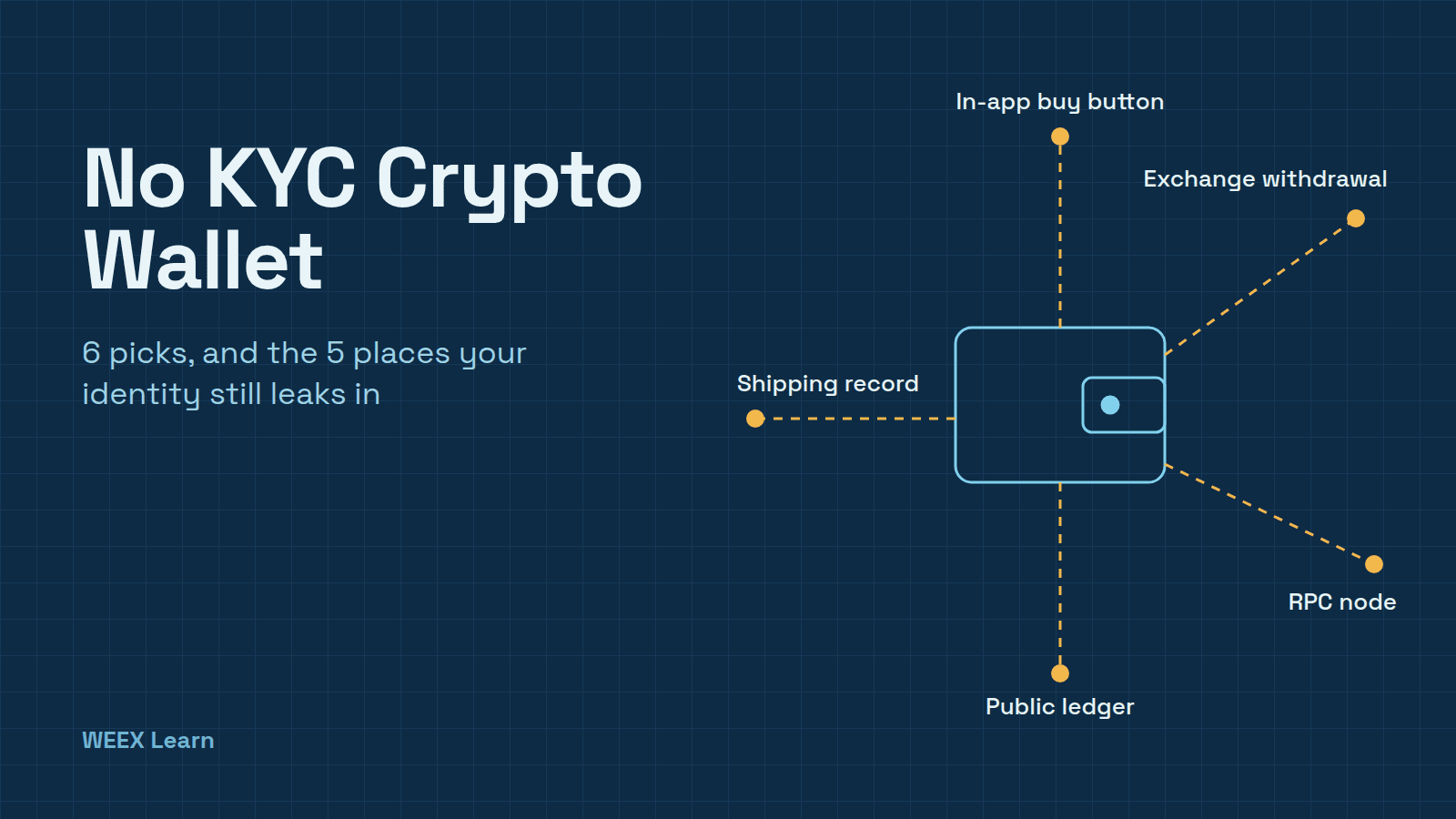
A wallet that never asked for your passport can still be tied to your name within a day of use. These are the five points where that usually happens, roughly ordered from most to least common in practice.
- The in-app "Buy" button. Card and bank purchases inside wallets are handled by third-party providers, and they run full KYC. Once you buy through one, that provider knows the receiving address belongs to you.
- Exchange withdrawals and deposits. When you withdraw from a verified exchange account to your wallet, the exchange records the destination address against your identity. Under the EU's Transfer of Funds Regulation, in force since December 30, 2024, a regulated provider must take extra verification steps for transfers of €1,000 or more to or from a self-hosted wallet, often by asking you to prove the address is yours.
- The node or RPC provider. Every time your wallet checks a balance or sends a transaction, it talks to a server. Unless you run your own node or change the default, that server can log your IP address next to your addresses.
- Hardware purchase records. Name, address and email from a device order sit in a retailer database, and databases leak, as Ledger's did.
- The public ledger itself. Reusing one address, registering an ENS or SNS name, or posting an address on social media links activity across everything that address ever touched.
The first two matter most, because they connect a legal identity to an address directly, and that link then extends to every address the funds later move through. That is not a reason to avoid exchanges; it is a reason to understand that "no KYC wallet" describes the setup, not the whole trail.
-- Price
Is a No KYC Crypto Wallet Legal?
In most major jurisdictions, yes. Holding crypto in a wallet you control, without identifying yourself to the wallet developer, is legal. The EU's AMLR is a useful reference because it is the strictest large framework coming: Article 79 bans anonymous accounts at crypto service providers from July 1, 2027, yet states explicitly that the rule does not apply to users or providers of self-hosted wallets. The obligations fall on the exchange at the other end of a transfer, not on your wallet.
Where people get into trouble is a different category of tool. In November 2025, a U.S. court sentenced the two founders of Samourai Wallet to five and four years in prison after they pleaded guilty to operating an unlicensed money-transmitting business; prosecutors said its mixing services processed more than $237 million in criminal proceeds. The distinction is worth spelling out: a wallet that stores your keys is ordinary software, while services built to break the transaction trail for others are where enforcement has concentrated.
Two practical points follow. Tax obligations don't change with the wallet type, so gains realized from a no KYC wallet are still reportable where you live. And rules vary by country, so check your local position before assuming what applies in the EU or U.S. applies to you.
How to Move Crypto From WEEX to a No KYC Wallet
For most beginners, the realistic setup is two layers: a verified exchange account to buy crypto with local currency, and a no KYC self-custody wallet to hold it. The transfer between them is where people lose money, mostly by choosing the wrong network.
- In your wallet, tap "Receive," pick the asset and network, and copy the address.
- In the WEEX app or website, open your assets, choose Withdraw, and select the same coin.
- Select the network that matches your wallet address exactly, for example USDT on TRC-20 only if your wallet is showing a Tron address.
- Paste the address and check the first and last six characters against your wallet screen.
- Send a small test amount first, confirm with your email or SMS code and two-factor authentication, and wait for it to arrive.
- Send the rest to the same address on the same network.
WEEX doesn't add a platform fee on crypto withdrawals; you pay the blockchain network fee, and withdrawals usually process within 15 to 30 minutes, longer when networks are congested. Withdrawal limits are tied to verification level, so completing KYC on the exchange side raises how much you can move. The full walkthrough, including stuck-withdrawal fixes, is in the guide on how to withdraw from WEEX. If this is your first self-custody wallet, the setup and recovery-phrase test are covered in how to get a crypto wallet.
Choosing a No KYC Wallet Without Overestimating Privacy
Every no KYC crypto wallet on this list removes the identity check at setup, and that is genuinely useful: nobody can freeze your wallet, and your keys don't sit in a company database. What it doesn't do is make your activity invisible. For most beginners, the better question isn't "which wallet is anonymous" but "which wallet fits my assets, and which leak points do I care about." Pick MetaMask or Phantom for everyday on-chain use, Sparrow or a hardware device for Bitcoin you plan to keep, and a hardware wallet for any balance you can't afford to lose. Buy on a verified WEEX account, hold in your own wallet, and always send a test transfer first.
FAQ
1. Does MetaMask require KYC?
No. Creating and using a MetaMask wallet needs no ID, email or account. KYC only appears if you use the in-app buy or sell feature, which routes you to third-party payment providers that verify identity.
2. Is a no KYC wallet the same as an anonymous wallet?
No. A no KYC wallet just skips identity checks at setup. Transactions on Bitcoin, Ethereum and Solana stay public, and your identity can be linked through exchange withdrawals, purchase providers or address reuse.
3. Can I buy crypto inside a no KYC wallet without ID?
Usually not with a card or bank transfer. Built-in purchase options are run by regulated providers that require identity checks. Most beginners buy on a verified exchange and withdraw to their own wallet instead.
4. Do I still pay tax on crypto held in a no KYC wallet?
Yes, in most countries. Tax rules apply to gains and income regardless of which wallet holds the assets. Keep records of purchase prices and transfers, because your wallet provider cannot generate them for you.
Risk Warning
Crypto assets are highly volatile, and you can lose part or all of the value you hold. A no KYC self-custody wallet puts full responsibility on you: a lost or exposed recovery phrase cannot be reversed, and transfers sent to the wrong address or network are usually unrecoverable. Browser-extension wallets can be compromised through malicious updates, and phishing messages impersonating wallet brands are common. Privacy coins may lose exchange access as rules tighten, which can reduce liquidity. Regulatory treatment of self-hosted wallets differs by country and can change. This article is educational and is not financial, legal or tax advice.
This content is provided for general informational purposes only and doesn't constitute financial, investment, legal, or tax advice. Any events, rewards, online promotions, or related information mentioned herein should not be considered a recommendation, solicitation, or invitation to purchase, sell, trade, or otherwise deal in any crypto assets. Crypto assets are highly volatile and may result in loss. The availability of WEEX services, products, and related events may vary by region. You are responsible for ensuring that your participation is in accordance with applicable local laws and regulations.
You may also like
What Is Coinbase Wrapped HYPE (cbHYPE)? How It Works on Base, 1:1 Backing, Risks, and HYPE Conversion
Is QNT a Stock or Crypto? Quant (QNT) and Quantinuum Stock Are Not the Same Asset
What Is Quant (QNT) Crypto? How Overledger Works, QNT Utility, and Token Supply Explained
Best Decentralized Crypto Wallet for Beginners: What Self-Custody Really Asks of You
Does a Negative Funding Rate Mean a Short Squeeze Is Coming?

Best Crypto Exchange for Beginners 2026: What Actually Matters When Choosing One
Best Crypto Cold Wallet 2026: Top Picks Matched to How You Hold
How to Connect Phantom Wallet to a Solana DApp
How to Install and Set Up Phantom Wallet
Funding Rate Crypto: What BTC and ETH Are Paying Right Now
INTC Stock Surged 14%: Intel Only Has Enough Chips for Half Its Clients
XPL Unlock on Sept 25: How to Long or Short Plasma Futures Safely
Bitcoin Funding Rate After a $648M Short Squeeze: What Longs Pay
What Is Blockchain Technology? Follow One Transaction to See
How Does Mining Actually Work on Pi Network?
What Is Pi Network? A Complete Beginner's Guide
How to Look Up a Wallet Address and Transaction History
Funding Rate Explained: How Perpetual Futures Fees Hit Your PnL
PENGU Airdrop on WEEX: Get 10 USDT in PENGU Before October 6
BTC Futures Trading on WEEX: Claim BTC Rewards Before Sep 25
What Is a Funding Rate? How Perpetual Futures Charge Longs and Shorts
How Does WEEX KYC Verification Work? A Taiwan User Guide
Macro Protocol (MTP): Listing Status and a Safe Verification Guide
Lumentum (LITE) Perpetual Futures: Why 25x Leverage Is the Limit
Lisk Chain Shutdown October 31: How to Move LSK Safely
What Is BONK? WEEX Spot and 1000BONK Futures Status and Risk Checks
What Is BRETT? WEEX Spot and Futures Status and Risk Checks
What Is FLOKI? WEEX Spot and 1000FLOKI Futures Status and Risk Checks
What Is WIF (dogwifhat)? WEEX Spot and Futures Status and Risk Checks
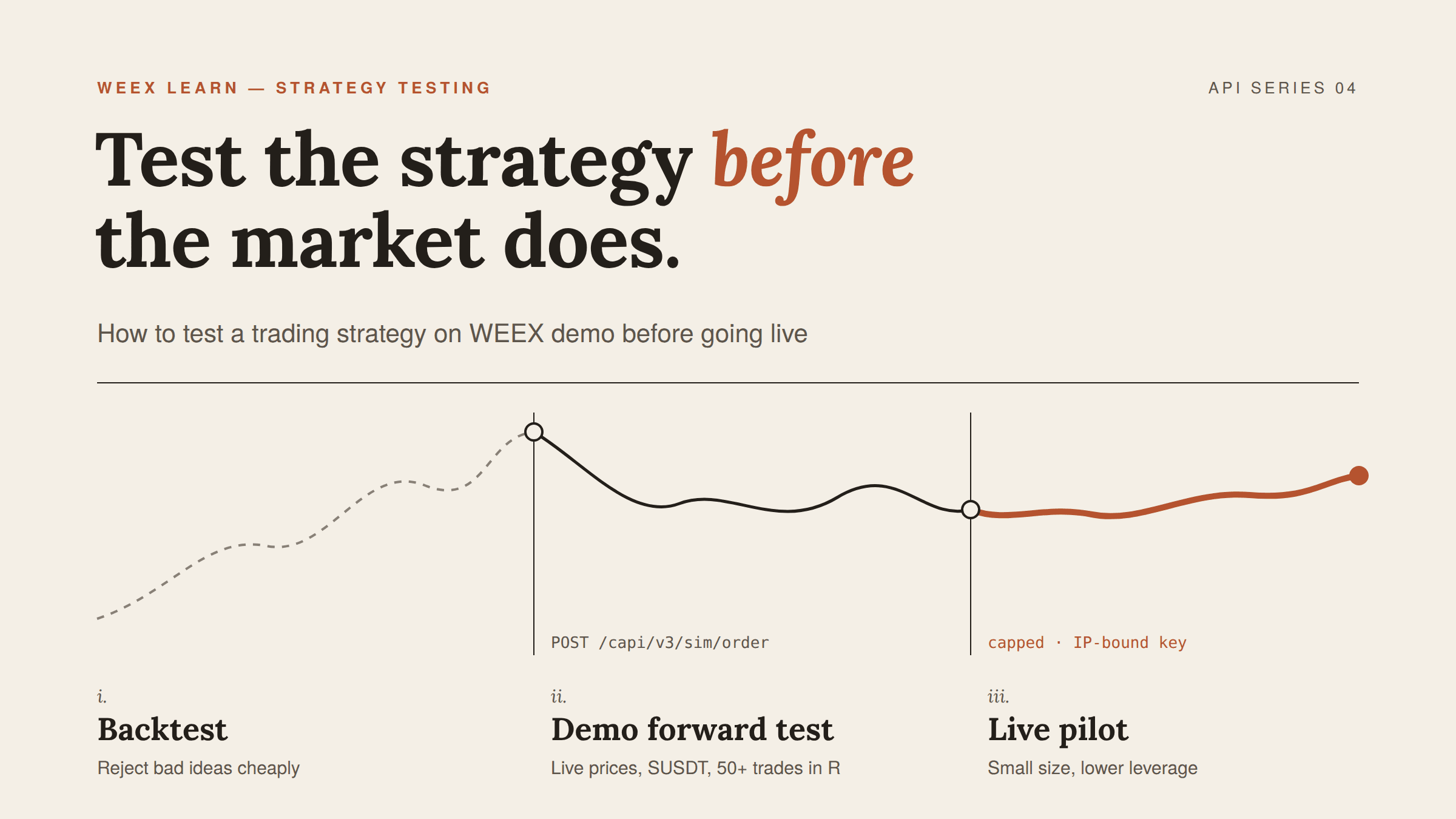
How to Test a Trading Strategy on WEEX Demo Before Going Live
What Is Coinbase Wrapped HYPE (cbHYPE)? How It Works on Base, 1:1 Backing, Risks, and HYPE Conversion
Is QNT a Stock or Crypto? Quant (QNT) and Quantinuum Stock Are Not the Same Asset
What Is Quant (QNT) Crypto? How Overledger Works, QNT Utility, and Token Supply Explained
Best Decentralized Crypto Wallet for Beginners: What Self-Custody Really Asks of You
Does a Negative Funding Rate Mean a Short Squeeze Is Coming?
Best Crypto Exchange for Beginners 2026: What Actually Matters When Choosing One




