
Margin Trading & Futures on WEEX: A 2026 Tutorial

 Prefer us on Google


What Is Margin Trading?
Margin trading is borrowing money to trade. You put down a small piece of the trade value. The exchange lends you the rest.
This lets you open bigger positions than what you actually have in your account.
Example: You want a $10,000 position with 10x leverage. You only need $1,000 as margin. The other $9,000 comes from WEEX.
On WEEX, margin trading works for both spot and futures. You can go long (bet price goes up) or short (bet price goes down).
Key point: Gains and losses hit the full $10,000 position, not just your $1,000. So profits get bigger. Losses get bigger too.
How Margin Trading Works on WEEX
When you open a margin trade on WEEX, you pick a few things:
- Leverage: How many times you want to multiply your position. WEEX goes up to 100x on some pairs. Lower is safer for new people.
- Margin mode: Isolated or cross. More on that below.
- Direction: Long (price up) or short (price down).
You put up your margin. WEEX borrows the rest from its liquidity pool.
While the trade is open, your margin acts as collateral. If the market moves against you too hard, WEEX closes the position automatically. That's liquidation.
Isolated vs Cross Margin: What's the Difference?
WEEX gives you two margin modes. Pick based on how you like to risk.
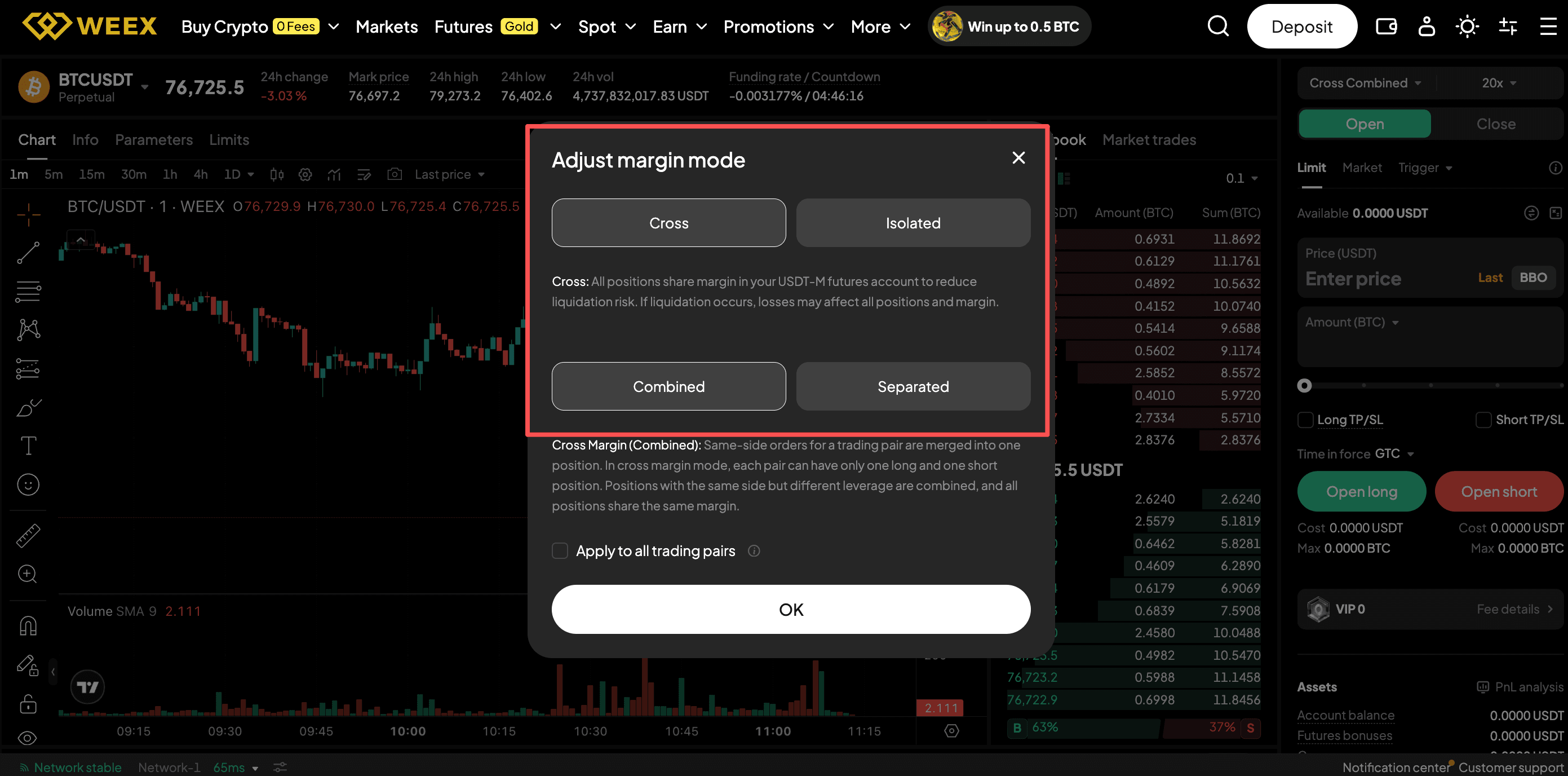
Isolated Margin
- Risk stays only with that one position.
- If that trade gets liquidated, you only lose that position's margin. The rest of your account is fine.
- Best for: risky trades where you want to cap the damage.
Cross Margin
- Your whole account balance backs all open positions.
- A losing position can borrow margin from winning positions. Stays alive longer.
- But if your total account drops too low, everything gets liquidated at once.
- Best for: hedging or low-leverage traders.
WEEX advice for beginners: Start with isolated margin. Easier to manage risk.
Long vs Short: Two Ways to Profit
Long position – You think price will go up.
Buy now. Sell later higher.
Short position – You think price will go down.
Borrow the asset. Sell it now. Buy it back cheaper later. Return it. Keep the difference.
On WEEX, both long and short trades use margin. Shorting crypto is common because prices drop a lot.
Liquidation: What You Must Know
If the market moves against you and your margin can't cover the loss, WEEX liquidates you.
How it works:
- Every position has a liquidation price.
- When price hits that level, WEEX closes the trade automatically.
- You lose your margin. Sometimes more if slippage happens.
Example (simplified):
You open a $5,000 long BTC position with 5x leverage. You put $1,000 margin. If BTC drops 20%, your position loses $1,000 – your whole margin. WEEX would have closed you before that 20% loss (maintenance margin is lower).
On WEEX: You can see your liquidation price before opening the trade. Use a stop-loss to exit earlier than liquidation.
Margin Trading vs Futures Trading – What's the Difference?
People mix these up. They're not the same.
Feature | Margin Trading (Spot) | Futures Trading |
What you own | Real spot token | A contract, not the coin |
Expiry | No expiry (pay interest daily) | Perpetual futures have funding rates every 8h |
Liquidation based on | Spot price | Futures mark price |
On WEEX, both are available. For short-term speculation, futures are more common. For holding a leveraged position in an actual token, use margin trading.
Leverage – Start Low
High leverage sounds exciting. 50x, 100x – one good move and you double your money.
One bad move and you lose everything.
Reality check: A 1% move against a 100x position wipes out 100% of your margin.
WEEX recommendation for beginners:
- Start with 2x or 3x leverage. Not 50x.
- Trade small. 1-2% of your account per trade.
- Use stop-losses. Always.
WEEX supports up to 400x leverage for experienced traders.
5 Tips for Safe Margin Trading on WEEX
- Start small with low leverage: 2x, not 20x. Learn how liquidation feels on tiny amounts.
- Use isolated margin: Don't risk your whole account on one dumb trade.
- Set stop-loss orders: Decide your max loss before opening the trade. Stick to it.
- Check liquidation price: WEEX shows it clearly. Make sure it's far from current price.
- Don't trade news: Volatility spikes around announcements. Leverage + volatility = fast liquidation.
Final Thoughts
Margin trading and futures let you amplify your trades – both wins and losses. On WEEX, the tools are simple. Isolated margin protects your downside. Leverage from 2x to 100x serves different risk levels.
But here's the truth. Most beginners lose money with leverage. Not because the platform is bad. Because they use too much leverage, skip stop-losses, and panic trade.
Start slow. Use 2x. Trade small. Learn liquidation with tiny amounts. Then scale up.
WEEX has demo trading. Practice there first. Real money can wait.
Ready to trade? WEEX offers zero fees, instant execution, and the security you need. Sign up on WEEX Now and Start Trading!
FAQ
What is margin trading on WEEX?
Margin trading on WEEX lets you borrow funds to open larger positions. You put down a percentage as collateral. WEEX lends the rest. Profits and losses get amplified.
What leverage can I use on WEEX?
WEEX offers leverage from 2x up to 100x on some pairs. Higher leverage means higher liquidation risk. Start low.
How do I avoid liquidation on WEEX?
Use low leverage (2-5x). Set stop-loss orders above your liquidation price. Watch your positions. Don't overtrade.
Can I short crypto on WEEX?
Yes. Both margin trading and futures trading on WEEX allow short positions. Borrow and sell first, then buy back later cheaper.
Is margin trading suitable for beginners?
Generally no. But if you insist, start with very low leverage (2x), tiny positions, and isolated margin. Practice on demo mode first.
Disclaimer: This content is provided for general branding and informational purposes only and doesn't constitute financial, investment, legal, or tax advice. Any events, rewards, online events, or related information mentioned herein should not be considered a recommendation, solicitation, or invitation to purchase, sell, trade, or otherwise deal in any crypto assets or to use any services. Crypto assets are highly volatile and may result in loss. WEEX services and online events may not be available in all regions and are subject to applicable laws, regulations, and eligibility requirements. You are responsible for ensuring that your use of WEEX services complies with local laws and for carefully assessing the risks before participating in any crypto-related activities.
You may also like
Tesla Stock Is Down 17% in 2026: What Q2 Earnings Need to Deliver to Turn the Story Around

What Is Mark Cuban's Stock Options Philosophy? How SpaceX Turned Welders Into Millionaires

SPCX Stock Price and the $25 Billion Short Position: Is a Short Squeeze Coming?

Is SPCX Stock Price a Buy? What Uber, Airbnb and Rivian's IPO Crashes Tell Investors
SPCX Stock Price Hits All Time Low: What Investors Should Do Right Now

How Will the CLARITY Act and Bank-Grade Stablecoin KYC Rules Change Crypto Trading in 2026

Why Is BitMine Buying Millions of Ethereum Tokens and Staking $9 Billion in ETH in 2026

How to Protect Your Bitcoin from Physical Attacks: Lessons From the NYC Crypto Torture Case in 2026
What Is the NYC Crypto Kidnapping Case? The Soho Bitcoin Attack Explained — 2026 Case Analysis

SpaceX Stock (SPCX): Now Public, and Back Where It Started
USA Rare Earth (USAR): What It Is and How to Trade the Token
NVIDIA Stock in 2026: Real Shares, Tokenized NVDA, and Perpetuals Compared
How to Buy USAR Coin: Buying Tokenized USA Rare Earth Stock the Right Way
WEEX Poker Party Series 4: Draw Cards to Split a $1M USDT Pool
Can TENDIES Coin Recover After the Pullback? Price Outlook Explained
Who Really Makes Money on Prediction Markets? Smart Money vs Retail Traders
The Hidden Problem With Prediction Markets: Who Pays the Winners?
Prediction Markets Are the Future of Finance or Just Gambling?
How Polymarket and Kalshi Turned Predictions Into a Billion-Dollar Business

Why Prediction Markets Are So Hard to Regulate: The CFTC vs SEC Debate
Are Prediction Markets Legal? CFTC vs SEC Regulation Explained
Why Is TSMC Stock Down After a 77% Profit Jump? What Wall Street Is Actually Worried About
Is Samsung Stock a Buy at Its Lowest Level Since the AI Boom Began?
Samsung Stock and the KOSPI Bear Market: What the 30% Decline From Peak Tells Investors
Oil Price Above $90: What the US-Iran War Means for Your Portfolio Right Now
Iran War and Bitcoin: Why Crypto Is Not Acting Like a Safe Haven at $90 Oil
KOSPI Stock Market Enters Bear Market: What a 25% Drop From the Peak Means for Investors
KOSPI Stock Bear Market: What It Means for Samsung, SK Hynix and Korean Chip Stocks
Is the KOSPI Stock Market a Buy After Entering Bear Market Territory?
SK Hynix Leveraged ETFs SKHL SKHX SKHZ: What Each One Does and Who Should Use Them
Tesla Stock Is Down 17% in 2026: What Q2 Earnings Need to Deliver to Turn the Story Around
What Is Mark Cuban's Stock Options Philosophy? How SpaceX Turned Welders Into Millionaires
SPCX Stock Price and the $25 Billion Short Position: Is a Short Squeeze Coming?
Is SPCX Stock Price a Buy? What Uber, Airbnb and Rivian's IPO Crashes Tell Investors
SPCX Stock Price Hits All Time Low: What Investors Should Do Right Now
How Will the CLARITY Act and Bank-Grade Stablecoin KYC Rules Change Crypto Trading in 2026
Contents
Popular coins
Latest articles



