
Nasdaq Hits New High: How to Trade U.S. Stocks on WEEX TradFi

 Prefer us on Google


Key Takeaways:
- Nasdaq hit an all-time high of 30,170 on May 28, 2026
- Q1 earnings growth reached 25-28%, far above early-year expectations
- You don't need a traditional broker to trade U.S. stocks anymore
- WEEX TradFi offers two ways to trade: stock tokens (spot) and USDT-margined perpetuals
- Trade 24/7, go long or short, use leverage, and settle everything in USDT
Nasdaq Hits New High on May 28
On May 28, 2026, U.S. stocks rebounded sharply after a period of geopolitical uncertainty. The Nasdaq Composite climbed to an intraday high of 30,170 points — a new all-time record.
What drove the rally? A strong Q1 earnings season. S&P 500 earnings growth is now expected to reach 25-28%, well above what analysts predicted at the start of the year. Tech and AI companies led the way. Profit margins hit multi-year highs.
For traders, this creates real opportunities. The question is: what's the fastest, most flexible way to trade U.S. stocks right now?
Traditional brokers come with baggage — FX fees, limited hours, slow settlement, and approval delays. That's where WEEX TradFi comes in.
How to Trade U.S. Stocks on WEEX TradFi: Best Way for Beginners
WEEX TradFi gives you the easiest way to trade U.S. Stocks. Here is how the pros are trading NVDAUSDT perpetual contracts on WEEX.
Step 1: Deposit your funds
You cannot trade stock futures with Bitcoin or Ethereum directly on most pairs. Deposit USDT using your preferred network (TRC20, ERC20, etc.).
Step 2: Search for NVDA Futures
Head to the Futures page. Type NVDAUSDT. You will see the perpetual contract.
Note: WEEX recently increased leverage limits here. As of early 2026, you can access up to 100x leverage on NVDA .
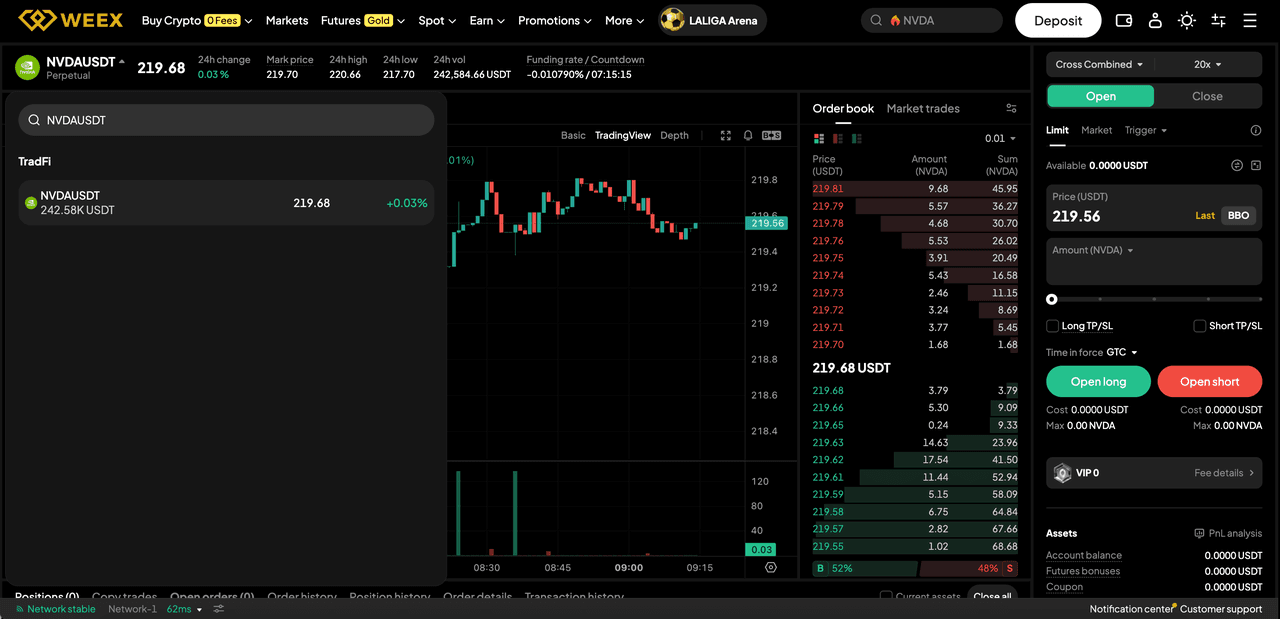
Step 3: Go Long or Go Short
- Go Long (Buy): You think the AI hype continues and earnings will crush estimates.
- Go Short (Sell): You think the stock is overheated and due for a correction (remember, it dropped 30% earlier this year before rebounding ).
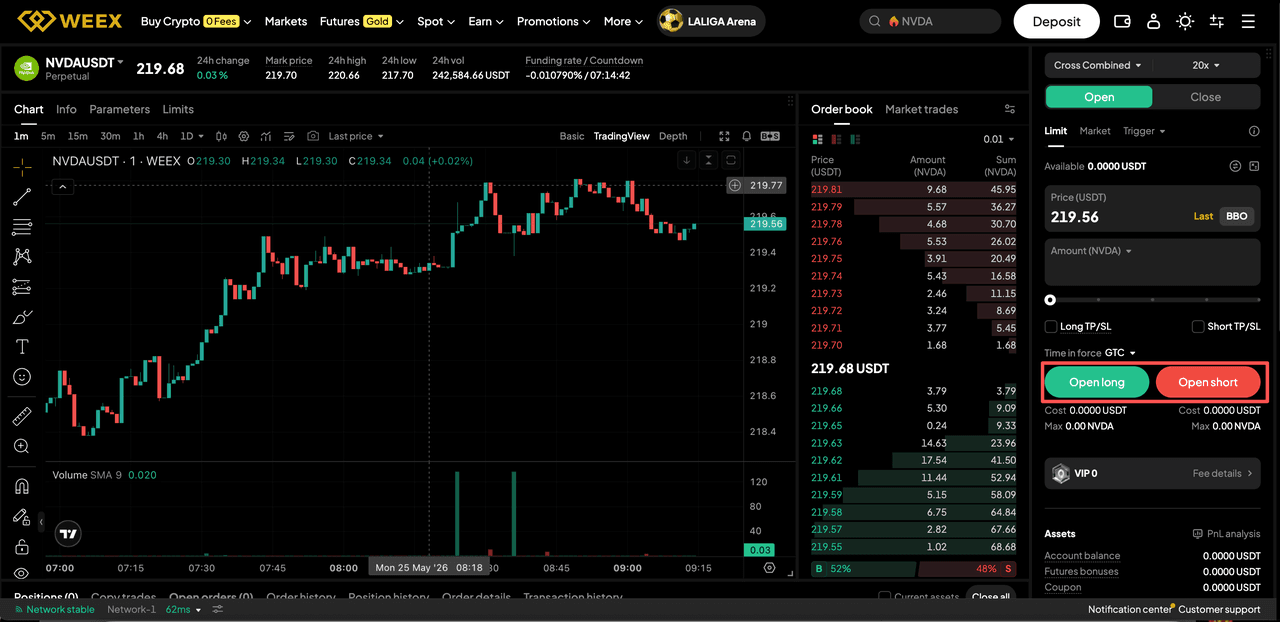
Always set your Stop Loss and Take Profit before you click buy. With 50x leverage, a 2% move against you can liquidate your position if you are not careful.
What are TradFi perpetuals?
They work exactly like crypto perpetual contracts — but the underlying asset is a traditional financial asset like a stock, commodity, or index.
Key features of TradFi perpetuals:
| Feature | How It Works |
| Settlement | USDT-margined, just like BTC or ETH perpetuals |
| Expiry | No expiration date — hold as long as you want |
| Direction | Go long OR short |
| Leverage | Amplify your position size |
| Asset types | Stocks (NVDA, TSLA, AAPL), indices (NASDAQ, S&P 500), commodities (gold, oil) |
Why traders prefer perpetuals over stock tokens:
- Short selling — Stock tokens only go long. Perpetuals let you profit from down moves.
- Leverage — Control a larger position with less capital.
- Hedging — Short Nasdaq perpetuals to hedge a long crypto portfolio.
- Same UI — If you trade crypto perps, you already know how this works.
Best for: Active traders, hedgers, and anyone who wants leverage or short exposure.
Why Trade U.S. Stocks on WEEX TradFi?
Here's the hard truth about traditional brokers: FX conversion fees, limited hours, slow T+2 settlement, and account approval delays.
WEEX TradFi removes all of it.
| Advantage | How WEEX TradFi Delivers |
| No FX fees | Settle everything in USDT. No USD bank account needed. |
| 24/7 trading | Trade when news breaks — not just 9:30 AM to 4:00 PM ET. |
| No approval delays | Get started fast. No broker interviews or paperwork. |
| One account | Switch between crypto and stocks instantly. Use crypto profits to add stock positions. |
| Short selling | Profit from down moves using perpetuals. Traditional stock shorting is complicated and expensive. |
| Leverage | Amplify returns (and risks) with controlled leverage. |
Note: WEEX TradFi is built for crypto natives who want stock exposure without leaving the crypto ecosystem.
Conclusion: Trade U.S. stocks on WEEX TradFi
The Nasdaq's new high at 30,170 is not an endpoint. It's a new starting point for an AI-driven earnings cycle. Q1 earnings confirmed fundamental resilience, offering traders opportunities in trend following, breakout buying, and event-driven plays. The market has shifted from recovery to structural growth, and the data backs it up.
WEEX TradFi gives you best way to trade this market. Stock tokens provide simple, 24/7, fractional spot-only exposure. TradFi perpetuals offer leveraged, long/short, USDT-margined futures on stocks and indices. No FX fees. No broker approval. No limited hours. Just USDT, your strategy, and 24/7 access to the world's largest stock market.
Ready to trade? Sign up on WEEX Now and Start Trading!
FAQ
Q: How do I trade U.S. stocks on WEEX TradFi?
Two ways. Use stock tokens for spot, long-only exposure. Use TradFi perpetuals for leverage and short selling. Both settle in USDT. No traditional broker needed.
Q: Can I trade after hours on WEEX TradFi?
Yes. Stock tokens trade 24/7, including weekends. Perpetuals also trade continuously. Just expect wider spreads during off-hours.
Q: What assets are available on WEEX TradFi?
Stocks (NVDA, TSLA, AAPL, AMZN, MSFT, AMD, ORCL, SMCI), indices (Nasdaq, S&P 500), commodities (gold, oil), and more.
Disclaimer: This content is provided for general branding and informational purposes only and doesn't constitute financial, investment, legal, or tax advice. Any events, rewards, online events, or related information mentioned herein should not be considered a recommendation, solicitation, or invitation to purchase, sell, trade, or otherwise deal in any crypto assets or to use any services. Crypto assets are highly volatile and may result in loss. WEEX services and online events may not be available in all regions and are subject to applicable laws, regulations, and eligibility requirements. You are responsible for ensuring that your use of WEEX services complies with local laws and for carefully assessing the risks before participating in any crypto-related activities.
You may also like
Tesla Stock Is Down 17% in 2026: What Q2 Earnings Need to Deliver to Turn the Story Around

What Is Mark Cuban's Stock Options Philosophy? How SpaceX Turned Welders Into Millionaires

SPCX Stock Price and the $25 Billion Short Position: Is a Short Squeeze Coming?
Is SPCX Stock Price a Buy? What Uber, Airbnb and Rivian's IPO Crashes Tell Investors
SPCX Stock Price Hits All Time Low: What Investors Should Do Right Now

How Will the CLARITY Act and Bank-Grade Stablecoin KYC Rules Change Crypto Trading in 2026

Why Is BitMine Buying Millions of Ethereum Tokens and Staking $9 Billion in ETH in 2026
How to Protect Your Bitcoin from Physical Attacks: Lessons From the NYC Crypto Torture Case in 2026
What Is the NYC Crypto Kidnapping Case? The Soho Bitcoin Attack Explained — 2026 Case Analysis
SpaceX Stock (SPCX): Now Public, and Back Where It Started
USA Rare Earth (USAR): What It Is and How to Trade the Token
NVIDIA Stock in 2026: Real Shares, Tokenized NVDA, and Perpetuals Compared
How to Buy USAR Coin: Buying Tokenized USA Rare Earth Stock the Right Way
WEEX Poker Party Series 4: Draw Cards to Split a $1M USDT Pool
Can TENDIES Coin Recover After the Pullback? Price Outlook Explained
Who Really Makes Money on Prediction Markets? Smart Money vs Retail Traders
The Hidden Problem With Prediction Markets: Who Pays the Winners?
Prediction Markets Are the Future of Finance or Just Gambling?
How Polymarket and Kalshi Turned Predictions Into a Billion-Dollar Business

Why Prediction Markets Are So Hard to Regulate: The CFTC vs SEC Debate
Are Prediction Markets Legal? CFTC vs SEC Regulation Explained
Why Is TSMC Stock Down After a 77% Profit Jump? What Wall Street Is Actually Worried About
Is Samsung Stock a Buy at Its Lowest Level Since the AI Boom Began?
Samsung Stock and the KOSPI Bear Market: What the 30% Decline From Peak Tells Investors
Oil Price Above $90: What the US-Iran War Means for Your Portfolio Right Now
Iran War and Bitcoin: Why Crypto Is Not Acting Like a Safe Haven at $90 Oil
KOSPI Stock Market Enters Bear Market: What a 25% Drop From the Peak Means for Investors
KOSPI Stock Bear Market: What It Means for Samsung, SK Hynix and Korean Chip Stocks
Is the KOSPI Stock Market a Buy After Entering Bear Market Territory?
SK Hynix Leveraged ETFs SKHL SKHX SKHZ: What Each One Does and Who Should Use Them
Tesla Stock Is Down 17% in 2026: What Q2 Earnings Need to Deliver to Turn the Story Around
What Is Mark Cuban's Stock Options Philosophy? How SpaceX Turned Welders Into Millionaires
SPCX Stock Price and the $25 Billion Short Position: Is a Short Squeeze Coming?
Is SPCX Stock Price a Buy? What Uber, Airbnb and Rivian's IPO Crashes Tell Investors
SPCX Stock Price Hits All Time Low: What Investors Should Do Right Now
How Will the CLARITY Act and Bank-Grade Stablecoin KYC Rules Change Crypto Trading in 2026
Contents
Popular coins
Latest articles



