
How to Choose the Right Stock Trading Platform for Beginners: Why WEEX Stands Out for Crypto-Native Traders

 Prefer us on Google
The platform you trade on matters a lot. Pick the wrong one, and you'll be fighting clumsy interfaces, hidden fees, or worse, missing out on moves because the market's closed. Get it right, and everything flows.
Most traditional brokerages? They come with baggage. Regional locks, endless KYC paperwork, and trading hours that feel stuck in the 20th century. That's where WEEX is doing something different.
Before we get into the nitty-gritty, here's the truth: the "best" platform for your buddy might be totally wrong for you. Know what you actually need before you start comparing. That's the real starting line.
Key Takeaways
- Your ideal platform depends on your experience, style, and what you actually trade—not just what's popular.
- Always compare fees, available markets, usability, and learning resources side by side.
- Beginners should lean into demo accounts, educational content, and simple interfaces.
- Seasoned traders? You'll want advanced charts, API hooks, and automation.
- Regulation matters—but don't overlook on-chain platforms that operate without borders.
How to Choose the Right Stock Trading Platform
Fees, Features, and What's Actually Available
Run through these before you hand over any ID or deposit:
- Fees and commissions: Some platforms hit you per trade. Others pad spreads or charge subscriptions. "Commission-free" sounds great until you realize they're making money off your order flow. Read the fine print. Always.
- Available markets: Can you actually buy what you want? Some platforms only give you domestic stocks. Others open up international exchanges. Know the difference.
- Charting and research: Active traders live on candlesticks, indicators, and screeners. Beginners? They just want clean price data without the noise. Pick accordingly.
- Order types: Market, limit, stop-loss—that's the bare minimum. If you're serious, look for conditional orders, trailing stops, and OCO. They give you way more control.
- Mobile vs. desktop: Most people check positions on their phone and execute complex trades on a laptop. Make sure both work well and actually sync.
- Automation: Planning to run bots or algorithms? Then you need API access or built-in automation tools. Don't assume every platform has this.
Regulation and Security
Only trade on platforms regulated by real financial authorities in your region. That's not negotiable. Regulation means your funds are segregated and the platform has to meet basic standards.
Also, check for two-factor authentication, account insurance (if they offer it), and clear policies on how they handle your money. None of this eliminates risk, but it does cut down on nasty surprises.
That said, the rules are changing. Fully on-chain platforms operate differently—and for plenty of traders, that's exactly why they're interesting.
Why WEEX Stands Out in Stock Trading Platforms
Traditional brokerages have rules. Lots of them. Market hours, KYC checks, location bans—it's a long list. WEEX flips that script.
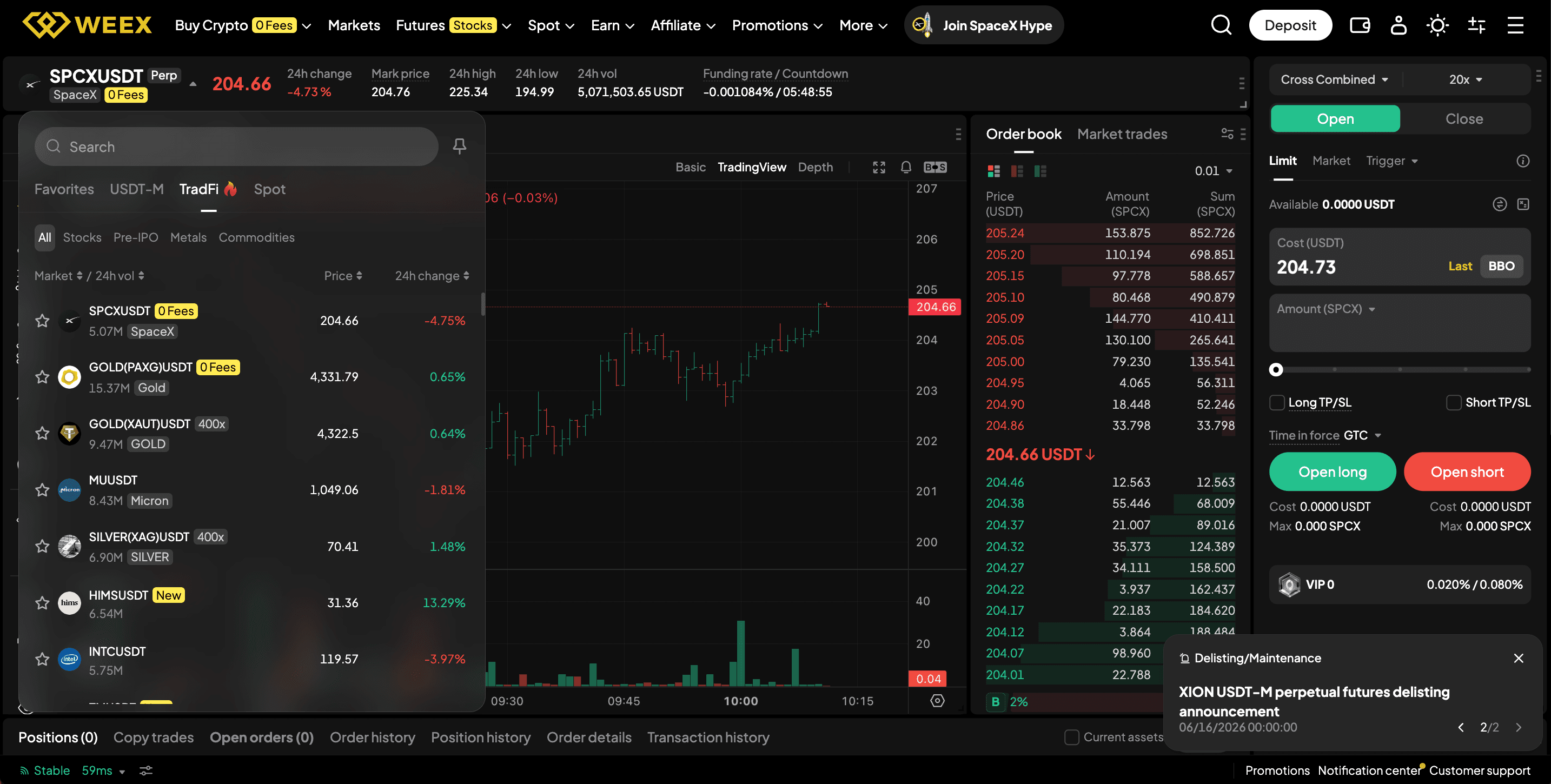
Here's the quick version of what makes WEEX different for people who want to trade stocks with USDT:
- Trade 24/7 – No waiting for the opening bell. Markets move; you move.
- Skip the KYC – Start trading without uploading your passport or utility bills.
- USDT settlement – Use stablecoins instead of fiat. Simple.
- No location blocks – Access from wherever you are. Seriously.
- Fully on-chain – Every trade lives on the blockchain. Transparent by design.
For crypto-native traders, this removes all the friction that traditional brokerages throw at you. No banking hours. No cross-border headaches. No converting back to fiat just to make a move.
Best Platforms for Beginners
New to the game? Keep it simple. Here's what actually matters when you're starting out:
- Paper trading or demo accounts: Practice with fake money first. It's the safest way to learn how orders work, test strategies, and build confidence without sweating over losses.
- Educational content: Look for built-in tutorials, explainers, and walkthroughs. If the platform doesn't teach you anything, you're on your own—and that's a rough way to start.
- Fractional shares: Don't have $500 to buy one expensive stock? Fractional shares let you buy pieces of it with whatever you've got. Huge for beginners with smaller budgets.
- Clean interface: Too many buttons and flashing numbers = confusion. A simple layout that helps you search, buy, and track is worth more than a hundred fancy features you'll never use.
- Customer support: When money's on the line, good support matters. Test their chat. Call their number. Check app reviews for complaints. You'll learn a lot about a platform by how they treat their users.
Your needs will change as you get more experience. Most traders start basic and graduate to bigger tools as they figure out their style.
What Advanced Traders Look For
Once you've been around the block, you notice what's missing. Experienced traders usually care about:
- Better technical analysis – More indicators, drawing tools, and customizable charts.
- Automation – API access for bots, custom scripts, and algorithmic strategies.
- Advanced order types – Conditional orders, trailing stops, and OCO for tighter risk control.
- Market depth and Level 2 data – Seeing beyond the surface price.
If that sounds like you, ask yourself: can your current platform grow with you? If not, maybe it's time to shop around.
Final Thoughts
At the end of the day, the right stock trading platform comes down to your skill level, your strategy, and what you actually want to accomplish. Beginners need simplicity, education, and a demo account. Experienced traders need power, speed, and flexibility.
But here's something worth thinking about—especially if you're already in crypto. WEEX gives you 24/7 access, no KYC, USDT settlement, and global reach, all on-chain. For anyone tired of traditional brokerages and their endless restrictions, it's a fresh alternative.
Ready to trade? Sign up on WEEX Now and Start Trading!
Disclaimer: This content is provided for general branding and informational purposes only and doesn't constitute financial, investment, legal, or tax advice. Any events, rewards, online events, or related information mentioned herein should not be considered a recommendation, solicitation, or invitation to purchase, sell, trade, or otherwise deal in any crypto assets or to use any services. Crypto assets are highly volatile and may result in loss. WEEX services and online events may not be available in all regions and are subject to applicable laws, regulations, and eligibility requirements. You are responsible for ensuring that your use of WEEX services complies with local laws and for carefully assessing the risks before participating in any crypto-related activities.
You may also like
Tesla Stock Is Down 17% in 2026: What Q2 Earnings Need to Deliver to Turn the Story Around
What Is Mark Cuban's Stock Options Philosophy? How SpaceX Turned Welders Into Millionaires
SPCX Stock Price and the $25 Billion Short Position: Is a Short Squeeze Coming?
Is SPCX Stock Price a Buy? What Uber, Airbnb and Rivian's IPO Crashes Tell Investors
SPCX Stock Price Hits All Time Low: What Investors Should Do Right Now

How Will the CLARITY Act and Bank-Grade Stablecoin KYC Rules Change Crypto Trading in 2026
Why Is BitMine Buying Millions of Ethereum Tokens and Staking $9 Billion in ETH in 2026
How to Protect Your Bitcoin from Physical Attacks: Lessons From the NYC Crypto Torture Case in 2026
What Is the NYC Crypto Kidnapping Case? The Soho Bitcoin Attack Explained — 2026 Case Analysis
SpaceX Stock (SPCX): Now Public, and Back Where It Started
USA Rare Earth (USAR): What It Is and How to Trade the Token
NVIDIA Stock in 2026: Real Shares, Tokenized NVDA, and Perpetuals Compared
How to Buy USAR Coin: Buying Tokenized USA Rare Earth Stock the Right Way
WEEX Poker Party Series 4: Draw Cards to Split a $1M USDT Pool
Can TENDIES Coin Recover After the Pullback? Price Outlook Explained
Who Really Makes Money on Prediction Markets? Smart Money vs Retail Traders
The Hidden Problem With Prediction Markets: Who Pays the Winners?
Prediction Markets Are the Future of Finance or Just Gambling?
How Polymarket and Kalshi Turned Predictions Into a Billion-Dollar Business
Why Prediction Markets Are So Hard to Regulate: The CFTC vs SEC Debate
Are Prediction Markets Legal? CFTC vs SEC Regulation Explained
Why Is TSMC Stock Down After a 77% Profit Jump? What Wall Street Is Actually Worried About
Is Samsung Stock a Buy at Its Lowest Level Since the AI Boom Began?
Samsung Stock and the KOSPI Bear Market: What the 30% Decline From Peak Tells Investors
Oil Price Above $90: What the US-Iran War Means for Your Portfolio Right Now
Iran War and Bitcoin: Why Crypto Is Not Acting Like a Safe Haven at $90 Oil
KOSPI Stock Market Enters Bear Market: What a 25% Drop From the Peak Means for Investors
KOSPI Stock Bear Market: What It Means for Samsung, SK Hynix and Korean Chip Stocks
Is the KOSPI Stock Market a Buy After Entering Bear Market Territory?
SK Hynix Leveraged ETFs SKHL SKHX SKHZ: What Each One Does and Who Should Use Them
Tesla Stock Is Down 17% in 2026: What Q2 Earnings Need to Deliver to Turn the Story Around
What Is Mark Cuban's Stock Options Philosophy? How SpaceX Turned Welders Into Millionaires
SPCX Stock Price and the $25 Billion Short Position: Is a Short Squeeze Coming?
Is SPCX Stock Price a Buy? What Uber, Airbnb and Rivian's IPO Crashes Tell Investors
SPCX Stock Price Hits All Time Low: What Investors Should Do Right Now
How Will the CLARITY Act and Bank-Grade Stablecoin KYC Rules Change Crypto Trading in 2026
Contents
Popular coins
Latest articles





