
Found a "meme coin" that skyrocketed in just a few days. Any tips?

 Prefer us on Google
This year in the crypto world, there is a concept that cannot be ignored, which is the "Meme Coin." Over the past week, the price of $RAVE has been continuously rising, reaching a peak of about 40 times its value from a week ago. Today, $RAVE's market cap has reached the 41st position in the market.
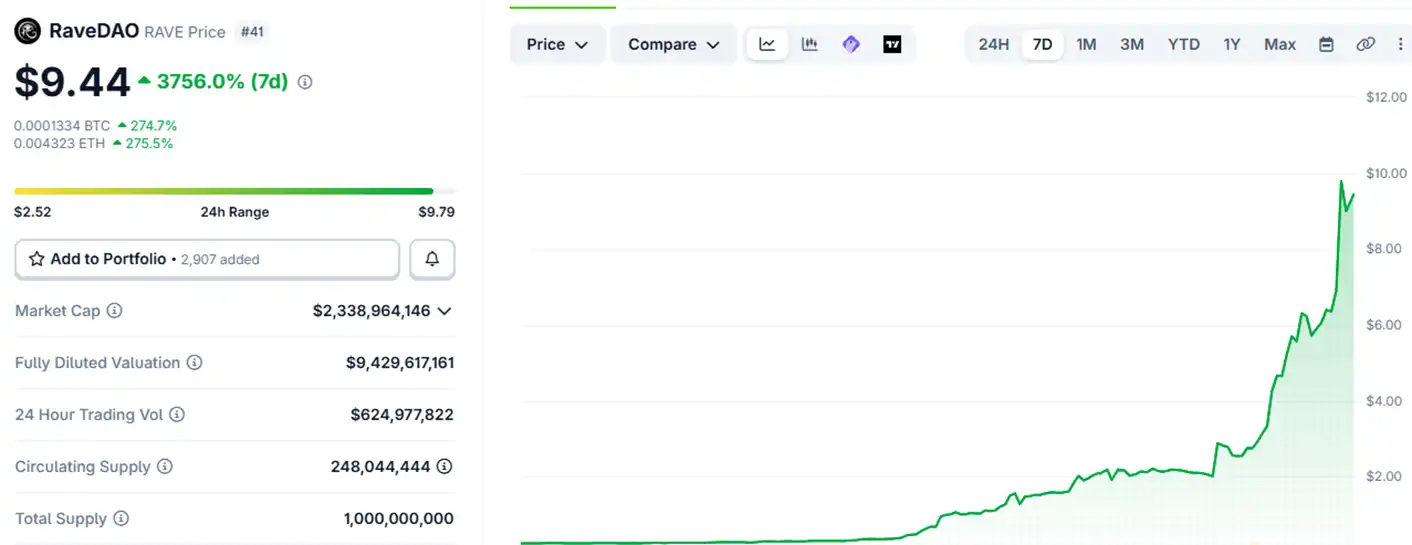
From the recent $SIREN, $STO, to the earlier $PIPPIN, $RIVER, $BEAT, $MYX, and others. Regardless of how the market is performing, although the "Meme Coin" is seen as an asymmetric information game between retail traders and whales, there are always players who, in the pursuit of volatility, diligently analyze and try to capture the logic behind the "Meme Coin" to find the path to success.
Even in the Chinese community, there has gradually emerged a complete study of "Meme Coin."
What is a "Meme Coin"?
If the definition of a "Meme Coin" is simply "rising fast and rising sharply," then the study of "Meme Coin" would not exist. The essence of retail traders playing with "Meme Coins" is a direct game against whales, trying to carve out a piece from the whale's manipulation.
Based on this essence, KOL Crypto Skanda (@thecryptoskanda) has provided a detailed definition of "Meme Coin," outlining the foundation of "Meme Coin" study:
- Spot control rate is basically above 96%
- Has a Binance contract, with the presence of spot trading being less important
- Usually funded through off-exchange margin trading, creating violent up and down price swings in a short period, accumulating significant liquidity and counterparty positions
- Whales profit by triggering long and short liquidations, taking advantage of taker fees, and ultimately completing the liquidation process to exit their spot positions
How to Identify a "Meme Coin"?
On this issue, different players have provided excellent reference points from different perspectives.
Anomalies in open interest of futures contracts can be reflected in various ways, primarily through "data manipulation." On April 11, @Arya_web3 found that the 24-hour open interest data of $RAVE on that day was $60 million on Binance, Bitget, BingX, OKX, and Bybit, respectively. Based on this data and the overall open interest data of each exchange, she speculated that there were anomalies in the data of BingX and Bitget when horizontally compared, indicating a possible manipulation of open interest data.
In addition, the 24-hour trading volume of the $RAVE contract on the day reached $6.9 billion, with a contract holding of $300 million. The whale manipulated the price up by 10x from the bottom, yet there wasn't a single large liquidation order, further deepening the possibility of contract data manipulation. She also mentioned that by observing where liquidation contract orders are concentrated, it can also serve as evidence of whether the open interest data on some exchanges is being manipulated.
@thecryptoskanda summarized and added to the above observations:
- The lower the median percentage of open interest on Binance's contracts, the higher the degree of manipulation by whales.
- A high contract volume/open interest ratio indicates a high likelihood of open interest data manipulation.
- This means that any strategy solely monitoring contract trading volume or open interest volume is inappropriate, as it is highly likely that whales are intentionally ceasing to manipulate open interest data to lure retail investors into the market.
You might say, this analysis of "meme coins" is based on data that has already occurred or is currently happening. Is there a way to analyze them before a "meme coin" pumps?
No. In the words of @thecryptoskanda:
"Meme coins do not become meme coins because they meet certain criteria. It's because they were always meant to be meme coins that they exhibit those criteria. Meme coins never play by the rules of the overall market; they only have one concern—does it have a whale?"
How to Identify an Impending "Meme Coin" Collapse
The first perspective was proposed by @wuk_Bitcoin, the "Divergence between Price and Open Interest," which can be used to determine if a "meme coin" is nearing a collapse. @wuk_Bitcoin stated that a rising price coupled with continuously decreasing open interest is a sign of an imminent collapse.
"The main players close out all long positions at the top, then support the price to attract more counterparty trades, allowing retail or electronic trades to perform long arbitrage. With counterparties in place, they can quietly add short positions. Once the short layout is complete, they remove the support price orders, strategically crash the market, simultaneously adding more short positions, continuing to plummet the price until a complete collapse occurs."
He also emphasized that it is necessary to look at the hourly data, as smaller timeframes may not reveal the intentions of the main players.
This perspective also has certain flaws, as mentioned earlier regarding "data manipulation." However, by narrowing the observation timeframe for open interest volume, another perspective arises: "a large-scale liquidation causing a sudden drop in open interest leading to the whale's exit."
This angle was proposed by @CryptoRounder and elaborated on by @thecryptoskanda:
"The price at a certain level triggered a large number of liquidations, leading to a sharp drop in open interest in futures contracts, the disappearance of sell pressure from short positions, and the unwillingness of whales to sustain the high price, signaling a more precise market top."
While the above two angles emphasize "how to escape before the rug pull," this is also the most rational decision retail players can make in the extremely asymmetric game of "rug pull" — finding the point at which whales decide to exit, and designing trades around that point. After all, before the "rug pull," whales can repeatedly perform long and short squeezes, and once whales truly exit and stop supporting the price, the downtrend of the "rug pull" becomes irreversible.
-- Price
Closing Thoughts
Although various experts are working hard to find a stable path to profit on "rug pulls," and we have seen many sharp angles, we must always remember that the reason why it can be called a "rug pull" is because its whale control rate is as high as 95% or even more.
Although we can discover traces of whale manipulation from many perspectives and even achieve victory in the "rug pull" game through data analysis, each "rug pull" situation is difficult to summarize through analysis and replicate in every game.
The whale behind the "rug pull" is the one who holds the script, they can deceive retail players through data manipulation or harvest profits from retail players in various ways.
According to @Arya_web3's speculation, the cost of manipulating open interest data for whales is not high. Based on a $70 billion 24-hour contract trading volume, calculated at a 0.005% fee rate, the 24-hour cost is only $350,000.
If the core of trading "rug pulls" lies in "anticipating whale actions," the difficulty is akin to gambling with someone holding the script, betting on the next scene in the script. Such difficulty, like opening the divine eye, can be called "superhuman-level."
This content is provided for general informational purposes only and doesn't constitute financial, investment, legal, or tax advice. Any events, rewards, online promotions, or related information mentioned herein should not be considered a recommendation, solicitation, or invitation to purchase, sell, trade, or otherwise deal in any crypto assets. Crypto assets are highly volatile and may result in loss. The availability of WEEX services, products, and related events may vary by region. You are responsible for ensuring that your participation is in accordance with applicable local laws and regulations.
You may also like

RootData: BEAT will unlock tokens worth approximately 13.18 million dollars in one week
Tom Lee Did It Again. Bitmine Spent $24 Million on Ethereum, but Purchases Are Decreasing
Bitcoin Threatened by a Fragile American Economy and Persistent Inflation

Why Prediction Markets Got the Brazilian Election So Wrong

Crypto Scam from a Wrong Number: $140,000 Vanished in Canada
Key Week for Central Banks: The Fed, ECB, and BoJ Decide on Their Rates

Ethereum Foundation backs default wallet privacy as Kohaku work advances

Manus quietly released its 2.0 declaration

Justin Sun Prize Partners With MathDB, Led by Caltech Professor Tony Yue Yu, on 50-Problem Pilot

CFTC advances voluntary crypto exchange registration as Congress stalls

Crypto: Over 10,000 Claims Against Restrictions by British Banks

AI agents are launching memecoins. MemeToro’s agent answers to open code

Crypto: The Tokenization of RWA Concerns American Conservatives

Pump.fun 'optimized for addiction': what the internal messages cited in court really say

Anthony Pompliano: The State Will Never Stop Printing Money! Bitcoin, Gold, and Land Will Benefit for 20 Years

Blocked Stablecoin: Your Private Key Is Not Enough

Cryptocurrencies Seek to Integrate into Finance
Introducing the Best Meme Coins on the Ripple Network: A Review of 5 Popular XRPL Tokens

Bitcoin's next Fed test comes with a hidden problem in America's inflation data
The crypto market loses altitude, patience becomes a habit – Steady Lads

Stablecoin Payments in Europe: How Do CASP, PI, and EMI Fit Together?
Why 22 Trillion-Dollar Giants Refuse to be 'Tokenized'?

Rayls Bridges Traditional Finance and Decentralized Finance
Is 24/7 Trading a Necessity? Analyzing the Real Trading Rhythm of RWA Perpetual Contracts
Cyberattack on GMO in Japan: Trading Accounts Compromised, GMO Coin Claims to be Unaffected

Elon Musk's Grand Scheme to Undermine New Cloud Providers
Google Earnings on Oct 28: Will the Fed Decision Move GOOGL Stock?
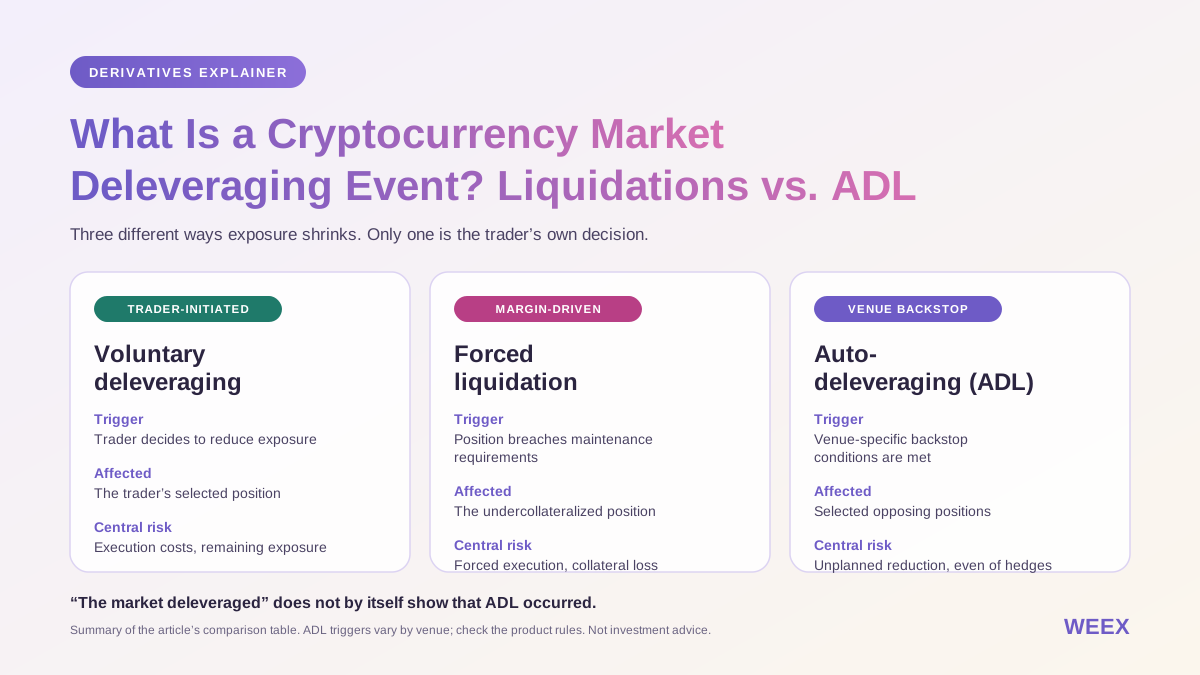
What Is a Cryptocurrency Market Deleveraging Event? Liquidations vs. ADL
Understand a cryptocurrency market deleveraging event: liquidation vs. ADL, misleading open-interest declines, hedge risks, and checks before trading.
The Week Ahead: 4 Key Moments for the Crypto Market
Do Prediction Markets Actually Bring Utility? – Tiger Research
RootData: BEAT will unlock tokens worth approximately 13.18 million dollars in one week
Tom Lee Did It Again. Bitmine Spent $24 Million on Ethereum, but Purchases Are Decreasing
Bitcoin Threatened by a Fragile American Economy and Persistent Inflation
Why Prediction Markets Got the Brazilian Election So Wrong
Crypto Scam from a Wrong Number: $140,000 Vanished in Canada
Key Week for Central Banks: The Fed, ECB, and BoJ Decide on Their Rates


