
Why Is ICP Crypto Surging Today? Tokenomics and Price Outlook

 Prefer us on Google


Internet Computer (ICP) is surging today on a technical breakout above key resistance combined with rising network usage, as traders position ahead of a major tokenomics reform designed to cut new token issuance. The move has pushed ICP back into a price zone it hasn't held in weeks, reviving interest in a token that spent most of 2026 deep in a drawdown.
At A Glance:
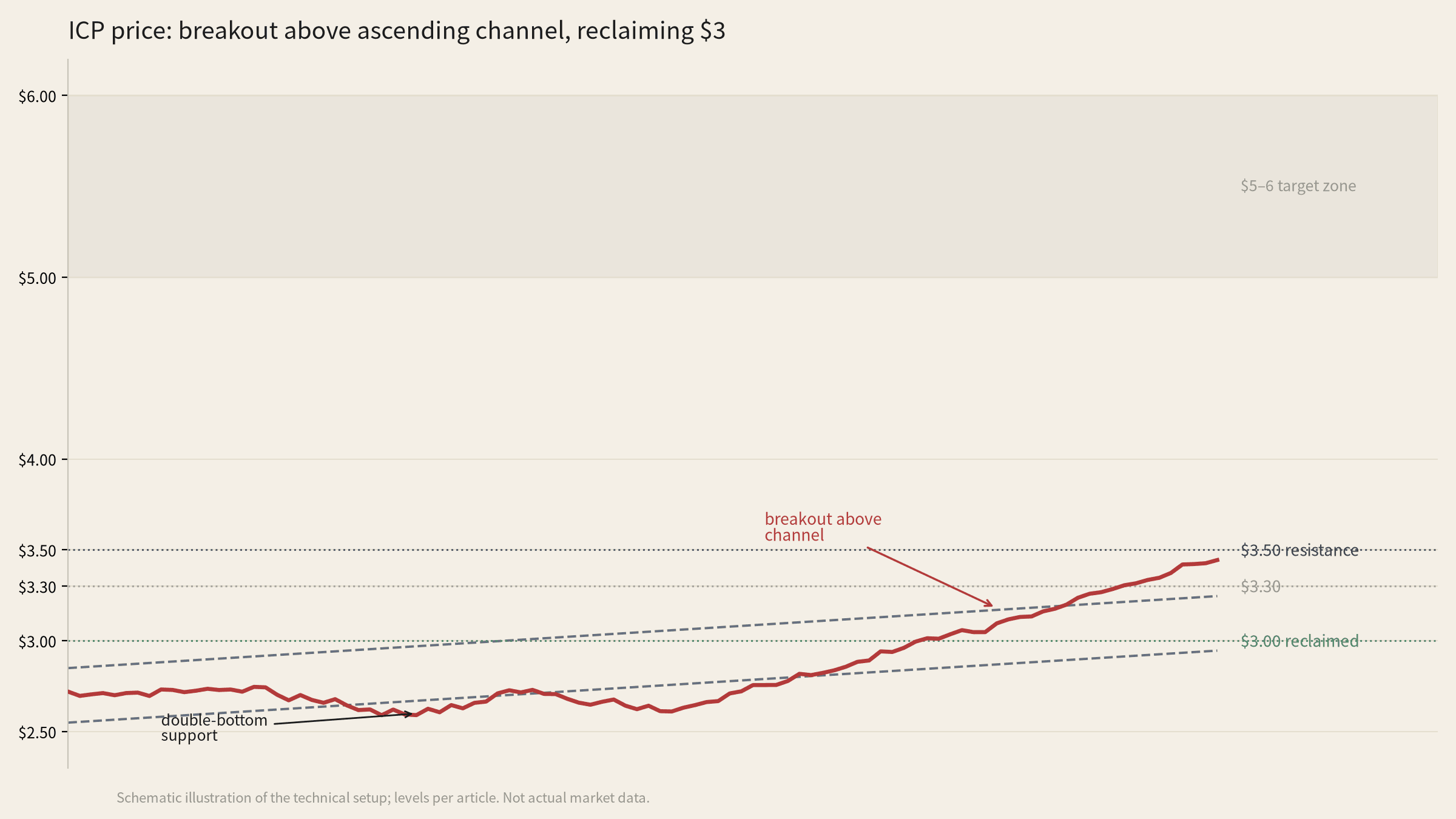
- ICP gained roughly 12–13% over 24 hours, breaking above its ascending channel and reclaiming the $3 level after defending a double-bottom support structure.
- Network activity is a core driver: daily transactions have surpassed 133 million, making Internet Computer one of the more active blockchains by that metric.
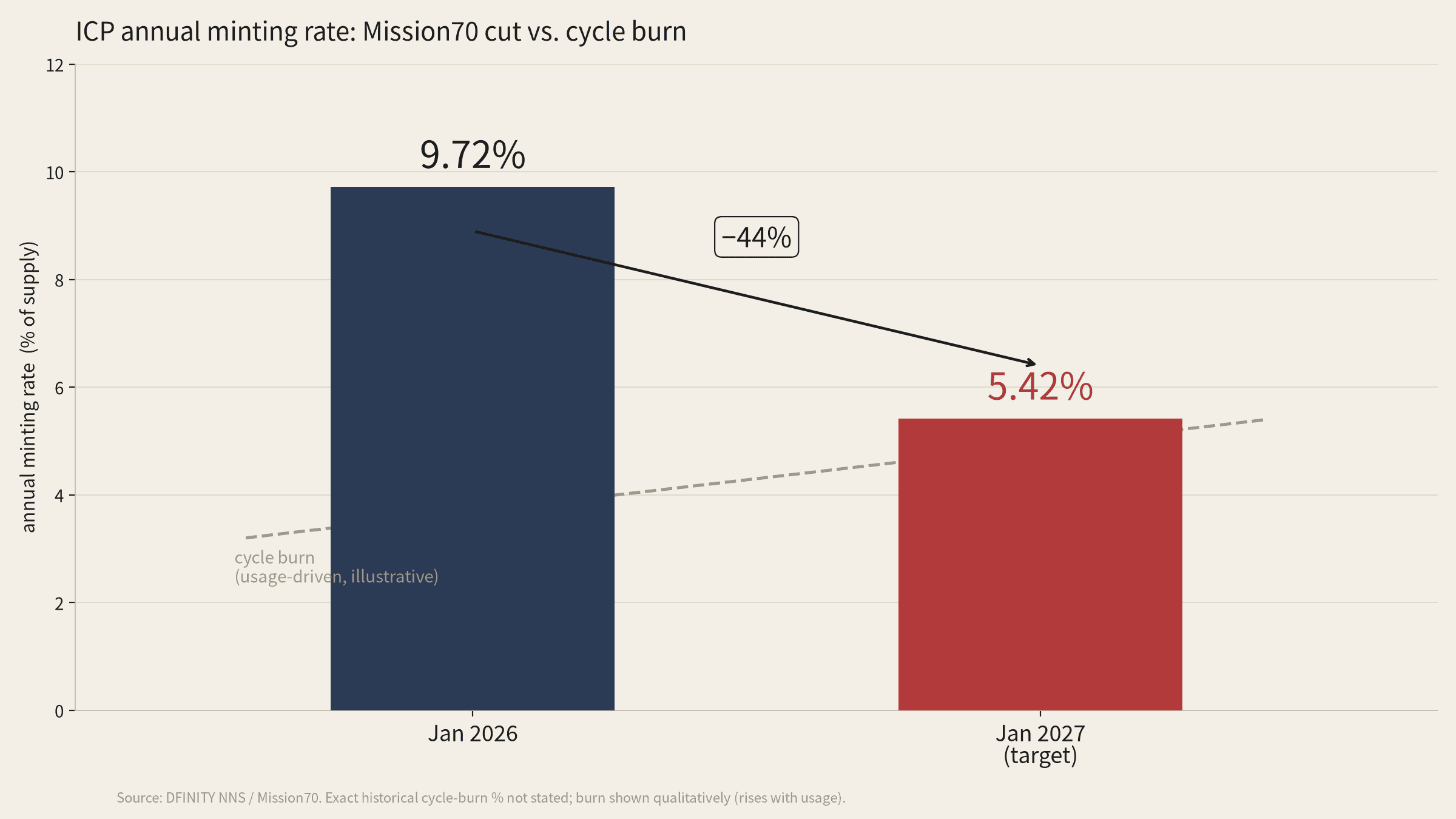
- The DFINITY-led Mission70 proposal aims to cut ICP's annual minting rate from about 9.72% toward 5.42% by January 2027, tightening supply growth.
- Trading volume reached roughly $169 million with a market capitalization near $1.67 billion, though ICP remains far below its 2021 all-time high near $700.
Written by: Crypto Market Analyst | Reviewed by: Senior Financial Editor | Last Updated: September 8, 2026
What Is Driving the ICP Price Surge Today
The immediate catalyst is technical: ICP broke out of a multi-week ascending channel after buyers repeatedly defended support, a pattern chart watchers frame as a double bottom. That breakout came with a real jump in participation rather than thin, low-volume drift — trading volume and open interest both rose alongside the price move, which technical analysts generally treat as confirmation that a breakout has real buying behind it rather than a false spike.
Underneath the chart pattern, network fundamentals are giving traders a reason to stay interested beyond the candle itself. Internet Computer's daily transaction count has pushed past 133 million, a level that put it among the most active blockchains globally earlier in 2026 by industry data trackers. Traders on X widely noted the combination of a technical breakout with strengthening on-chain usage as the kind of setup that tends to attract short-term momentum capital, even though ICP's broader multi-year trend remains a steep drawdown from its all-time high.
There's also a forward-looking element. Market sentiment across social channels has been building around Mission70, DFINITY's proposal to meaningfully reduce how many new ICP tokens enter circulation. Positioning ahead of a supply-side change like this is a familiar pattern in altcoin markets, where traders try to front-run an anticipated shift in issuance economics rather than waiting for it to show up in the data.
ICP Tokenomics Explained
Understanding why the Mission70 narrative matters requires understanding how ICP's token economy actually works, because it is structurally different from a fixed-supply asset like Bitcoin.
ICP has no hard-capped maximum supply. Circulating and total supply currently sit in the range of roughly 550–552 million tokens, with market cap and fully diluted valuation close together as a result. Instead of a hard cap, ICP relies on protocol-level governance through the Network Nervous System (NNS) to manage issuance and burning.
The token has three primary functions:
- Governance — ICP holders stake tokens to vote on NNS proposals and earn voting rewards, which historically started around 10% of total supply annually and are designed to decline toward roughly 5% over an eight-year schedule.
- Cycles conversion (the burn mechanism) — Developers convert ICP into "cycles," a computation unit pegged to fiat value (roughly one trillion cycles per dollar), to pay for the compute, storage, and bandwidth their applications consume on-chain. Consumed cycles are destroyed, permanently removing that ICP from supply.
- Node-provider rewards — Node operators who run the network's physical infrastructure are compensated in newly issued ICP, which adds to circulating supply on the other side of the ledger.
That last point is the key nuance many surface-level explainers miss: ICP is not automatically deflationary. Whether supply shrinks or grows depends on the balance between staking-driven issuance and node rewards on one side, and cycle-burn from actual application usage on the other. Historically, issuance from voting and node rewards has outpaced burns, creating net inflation even as usage grew.
Mission70 is DFINITY's attempt to shift that balance. According to the proposal's stated targets, it seeks to cut ICP's annual minting rate from roughly 9.72% in January 2026 to about 5.42% by January 2027 — a reduction of close to 44% — through a mix of supply-side governance changes and demand-side burn growth. If usage keeps climbing while issuance is throttled, the network moves closer to a genuinely deflationary state; if adoption stalls, the tightening alone may not be enough to offset dilution.

ICP Tokenomics Snapshot
| Metric | Approximate Value |
|---|---|
| Circulating / total supply | ~550–552 million ICP (no fixed cap) |
| Market capitalization | ~$1.67 billion |
| 24-hour trading volume | ~$169 million |
| Current annual minting rate | ~9.72% (targeted to fall to ~5.42% by Jan 2027) |
| Daily network transactions | 133 million+ |
| Cycle-to-dollar peg | 1 trillion cycles ≈ $1 |
Source: DFINITY Foundation NNS data; CoinGecko, CoinMarketCap, and CoinEx Academy market data, 2026.
An Analyst's Take: Why This Rally Deserves Skepticism, Not Just Excitement
From where I sit, ICP's setup right now is genuinely more interesting than most altcoin bounces, but the market is at real risk of pricing Mission70 as if it were already delivering results rather than a proposal still working through governance and execution. A 44% cut to minting is meaningful on paper, but it only tightens supply — it doesn't create demand. The token has spent most of 2026 down roughly 99% from its 2021 peak precisely because strong technology and improving fundamentals haven't reliably translated into sustained price appreciation before.
In my view, the more durable signal here isn't the 24-hour candle, it's the 133 million daily transactions. Usage that shows up consistently, quarter after quarter, is much harder to fake than a breakout that momentum traders can chase and then abandon within days. If that usage keeps climbing and cycle-burn genuinely accelerates alongside it, the deflationary case gets real teeth. If it doesn't, this breakout risks becoming another failed retest of the $3.50 resistance zone that technical analysts have flagged as the level needed to open a path toward $5–6.
-- Price
Where ICP Could Go From Here
Technical analysts generally frame the near-term picture around a handful of levels. Holding above the $3 breakout zone keeps the recovery structure intact; a sustained move through it opens the door toward $3.30, and a confirmed break of the broader $3.50 resistance is the level most commonly cited as the trigger for a move toward the $5–6 range. On the downside, losing the recently reclaimed support would put the prior multi-week base back in play.
Longer-term forecasts across market data providers vary widely — a reflection of how much ICP's trajectory depends on whether Mission70 executes as designed and whether sovereign-cloud, AI-agent, and Bitcoin-integration use cases (via Chain Fusion) convert into sustained developer and enterprise adoption rather than speculative attention. Investors comparing ICP against other large-cap infrastructure tokens can find it listed on major venues including Binance, Coinbase, and Bybit, while traders looking to manage cross-asset exposure alongside crypto positions sometimes route liquidity through platforms like WEEX TradFi as part of a broader portfolio approach.
Risk Considerations for ICP Traders
Altcoins with uncapped supply and governance-driven issuance changes like ICP can be more volatile than large-cap, fixed-supply assets, and technical breakouts on rising volume can reverse just as quickly as they form. Anyone considering a position should size it deliberately, understand that Mission70 remains a proposal subject to governance execution rather than a guaranteed outcome, and verify current network data directly through the official NNS dashboard rather than relying solely on price-prediction aggregators. Nothing in this article constitutes financial advice.
FAQ
1. Why Is ICP Price Up Today?
ICP is up today primarily on a technical breakout above its ascending channel, confirmed by rising trading volume, combined with strong network usage above 133 million daily transactions and market anticipation of the Mission70 tokenomics reform.
2. Does ICP Have a Maximum Supply?
No. ICP has no fixed hard cap. Supply is managed dynamically through NNS governance, balancing staking and node-provider issuance against cycle-burn from network usage.
3. What Is the Mission70 Proposal?
Mission70 is a DFINITY-led initiative aiming to cut ICP's annual minting rate from roughly 9.72% to about 5.42% by January 2027, reducing new token issuance by close to 44%.
4. Is ICP a Deflationary Token?
Not automatically. ICP becomes deflationary only when cycle-burn from actual application usage exceeds new issuance from staking and node-provider rewards, which has not consistently been the case historically.
5. What Price Level Would Confirm a Stronger ICP Recovery?
Technical analysts generally point to a sustained break above the $3.50 resistance zone as the level that could open a path toward the $5–6 range, while losing recently reclaimed support around $3 would put the prior base back in play.
This content is provided for general informational purposes only and doesn't constitute financial, investment, legal, or tax advice. Any events, rewards, online promotions, or related information mentioned herein should not be considered a recommendation, solicitation, or invitation to purchase, sell, trade, or otherwise deal in any crypto assets. Crypto assets are highly volatile and may result in loss. The availability of WEEX services, products, and related events may vary by region. You are responsible for ensuring that your participation is in accordance with applicable local laws and regulations.
You may also like
28 Mysterious Poetry Messages Detected on the Bitcoin Network in 12 Days

Hacker Launders 75 Million Dollars
North Korea-linked SquidSquad suspected in $2.84M BNB Chain theft

Hacker Transfers 55 Million Euros Worth of Ethereum to Tornado Cash

Google Quantum Computing Breakthrough: Error Rate Reduced by 40 Times, Overcoming Key Resource Bottleneck

Lido DAO exposes token flaw and forces a budget review

Crypto Hacks: $2.81 Billion Stolen in 2026, October Already at $116 Million

NSE Stock Price Hits a New Low After IPO: Can National Stock Exchange Shares Recover?
National Stock Exchange of India shares traded near ₹1,741 on October 5, close to a post-listing low of about ₹1,735 and roughly 2.5% below the ₹1,785 IPO price. The stock has now spent more than a week under its issue price, and a recovery depends on retail demand, derivatives volumes and the broader Indian market.

Drift Hacker Incident Victims Initiate Payout, $3.11 Million Recovery Pool Payouts at Approximately $0.01 per Dollar

Drift Opens Compensation Claims for Theft, Payout Rate Approximately 1%

Crypto hackers have taken $2.7 billion in 2026 and the losses are alarmingly concentrated

$295 million in user assets stolen, Drift Foundation launches DFX claims and redemptions
$9.2 Million of the $295.4 Million Stolen from Drift Has Been Frozen

Cindy Leow Steps Down as Co-Founder of Velocity, Team Continues to Operate the Protocol

QQQ Price Prediction for October 2026: Can It Break $750?

ONDO Price Prediction: Is $0.60 the Next Target After BlackRock News?

Cryptocurrency Exchanges Lost Hundreds of Millions of Dollars in 2026. Which Ones to Choose for Peace of Mind?

North Korea's Fake Job Interviews Drained $11M From 7,000 Crypto Wallets

Uniswap (UNI) Price Jumps Toward $10 as CME Futures Launch Nears: What Traders Need to Know

SOXL Stock Jumped 12% Yesterday: Three Companies Explain the Entire Move

RKLB Stock: Why Simply Wall St Sees It 43% Undervalued After a $1.9 Billion Raise
When AI Agents Accelerate into Intranets: The Main Battlefield of Cybersecurity Has Changed

$680 Million Warning: Most DeFi Attacks Fall Outside Audit Scope

Audited DeFi protocols lost $885M to attacks that occurred completely outside their audit scopes

Bitcoin just hit a decade-low S&P 500 correlation, but the daily data tells a different story
The fight over Ethereum’s supply is forcing a choice between high staking yields and the value of your ETH

Bitcoin’s faces a weird new macro reality as the Fed turns off the tap and Treasury opens the floodgates

Atomic Time Faces Historic Change to Avoid Negative Leap Second
What is Delta Hedging: A Method to Neutralize the Risks of Spot Holdings

Connecticut Attorney General Issues Crypto Warning, Investors Lose $200,000
28 Mysterious Poetry Messages Detected on the Bitcoin Network in 12 Days
Hacker Launders 75 Million Dollars
North Korea-linked SquidSquad suspected in $2.84M BNB Chain theft
Hacker Transfers 55 Million Euros Worth of Ethereum to Tornado Cash
Google Quantum Computing Breakthrough: Error Rate Reduced by 40 Times, Overcoming Key Resource Bottleneck
Lido DAO exposes token flaw and forces a budget review
Contents
Latest articles


Latest coin listings on WEEX


