
Atomic Time Faces Historic Change to Avoid Negative Leap Second

 Prefer us on Google


International time measurement organizations are preparing to vote on a reform that would effectively end leap seconds and allow UTC to drift up to one hour from the Earth's rotational time.
- The General Conference on Weights and Measures plans to vote in October on a resolution to make UTC continuous starting May 20, 2027.
- The Earth's faster rotation has increased the risk of needing a negative leap second, an operation for which many systems are unprepared.
- Experts estimate that the one-hour difference could take at least a thousand years to achieve if the proposal is approved.
International time organizations are preparing to decide whether the world should effectively abandon a tool that has kept atomic clocks synchronized with the Earth's irregular rotation for decades. The General Conference on Weights and Measures plans to vote in October on a draft resolution that would convert Coordinated Universal Time, known as UTC, into a continuous scale starting May 20, 2027.
The proposal would not immediately eliminate the relationship between official clocks and the planet's movement, but it would change the allowed margin between the two systems. Instead of requiring UTC to remain within 0.9 seconds of the Earth's rotational time, the reform would allow the difference to grow up to one hour, thus eliminating the need to periodically add or subtract seconds.
A Problem Born from Earth's Rotation
UTC is constructed from atomic clocks, whose stability allows for extremely precise time measurement and maintains a common reference for telecommunications, navigation, and computer systems. Universal time based on rotation, known as UT1, responds to a planet whose movement does not maintain a perfectly constant speed, due to physical variations that slightly alter the length of days.
Leap seconds arose to correct that difference and prevent civil time from drifting too far from solar noon. Since the introduction of the system in 1972, 27 leap seconds have been added to UTC, always under the logic of adding a fraction of time when the Earth's rotation lags behind atomic clocks.
The situation began to take on an unexpected nuance in recent years, as the Earth recorded a slight increase in its rotational speed. If this trend were to require the elimination of a second instead of adding one, officials would have to execute an unprecedented negative adjustment in the history of the system.
This possibility does not pose a threat to the daily lives of most people, who would likely not perceive the loss of a second. The risk is concentrated in digital infrastructures that rely on exact timestamps and whose programs, protocols, or servers were designed under the assumption that leap seconds are always added, as explained by Setnam Shemar, chief scientist at the UK's National Physical Laboratory.
The Fear of a Disappearing Second
Shemar warned that many digital architectures and network time servers do not properly account for the removal of a second. In his view, such an operation could cause severe disruptions in critical national infrastructures, including telecommunications, power grids, and satellite navigation systems, sectors where an unexpected timestamp can affect coordination among multiple devices.
The difficulty lies not only in a clock showing an incorrect time for an instant. Distributed systems can compare records, order transactions, coordinate signals, or validate events based on time sequences, so an absent second could generate different behaviors among servers that receive the adjustment unevenly.
The possibility of a negative leap second before 2035 has been highlighted in the debate about the future of UTC, although it does not imply that the adjustment will occur. The potential risk helps explain why a possibility that once seemed remote has begun to influence the international agenda.
The problem also affects positive leap seconds, although those adjustments already have precedents and known procedures. The combination of a practice that is difficult to implement, heterogeneous technological systems, and a possible negative correction has led experts to seek a solution that reduces the frequency of interventions rather than perfecting each individual adjustment.
The Proposal to Allow UTC to Drift
The draft that will be put to a vote proposes that UTC be continuous starting May 20, 2027, and that the difference with UT1 can gradually widen. If approved, the change would maintain a stable atomic reference for digital infrastructure, although it would allow civil time to drift further from the exact position of the Sun compared to the time used today.
According to Shemar, this decision would eliminate for many years the risks associated with new leap seconds. The international debate reflects the interest of various national bodies in ending a practice they perceive as dangerous or difficult to manage for their critical infrastructures.
The proposal reflects an increasingly visible priority in modern timekeeping: to protect the continuity of technological systems, even if that means accepting a greater separation between atomic time and the planet's rotation. For users, the difference would be imperceptible for generations, but for network operators, laboratories, and navigation systems, it would mean removing a periodic source of operational uncertainty.
The debate does not suggest that UTC will lose its function as an international reference or that each country can define its own time without coordination. The resolution seeks to maintain a common and predictable scale while changing the threshold at which bodies must intervene to correct the distance with rotational time.
A Slow Change with Technological Impact
The difference of one hour would not appear immediately nor constitute the expected outcome for the coming decades. Shemar calculated that UTC will likely not separate from rotational time by a full hour for at least a thousand years, a horizon so distant that the systems and needs of civilization could be completely different.
This timeframe explains why the proposal should not be interpreted as a warning that everyday clocks will soon be out of sync with the Sun. The immediate goal is to avoid a correction of a single second that could produce errors in connected infrastructures, while granting future generations the task of deciding how to manage a much larger difference.
The discussion has a technical dimension and an institutional one, as the decision will depend on a vote by national delegates from different countries. The pressure to abandon leap seconds mainly comes from accumulated concerns about their effects on national infrastructure.
The change also reveals a familiar tension for any global system: a rule created to maintain physical accuracy can become a source of vulnerability when applied to digital networks designed with different assumptions. In this case, timekeepers prefer to tolerate a slow and predictable deviation rather than risk an instantaneous modification that numerous systems may not be able to process.
The vote in October will therefore be the next decisive step in redefining the relationship between UTC and Earth's rotation. If the resolution receives support, leap seconds could be relegated to history long before the difference between the two clocks becomes a visible problem for society.
-- Price
This content is provided for general informational purposes only and doesn't constitute financial, investment, legal, or tax advice. Any events, rewards, online promotions, or related information mentioned herein should not be considered a recommendation, solicitation, or invitation to purchase, sell, trade, or otherwise deal in any crypto assets. Crypto assets are highly volatile and may result in loss. The availability of WEEX services, products, and related events may vary by region. You are responsible for ensuring that your participation is in accordance with applicable local laws and regulations.
You may also like
Pump.fun 'optimized for addiction': what the internal messages cited in court really say

Rayls Bridges Traditional Finance and Decentralized Finance
The Week Ahead: 4 Key Moments for the Crypto Market
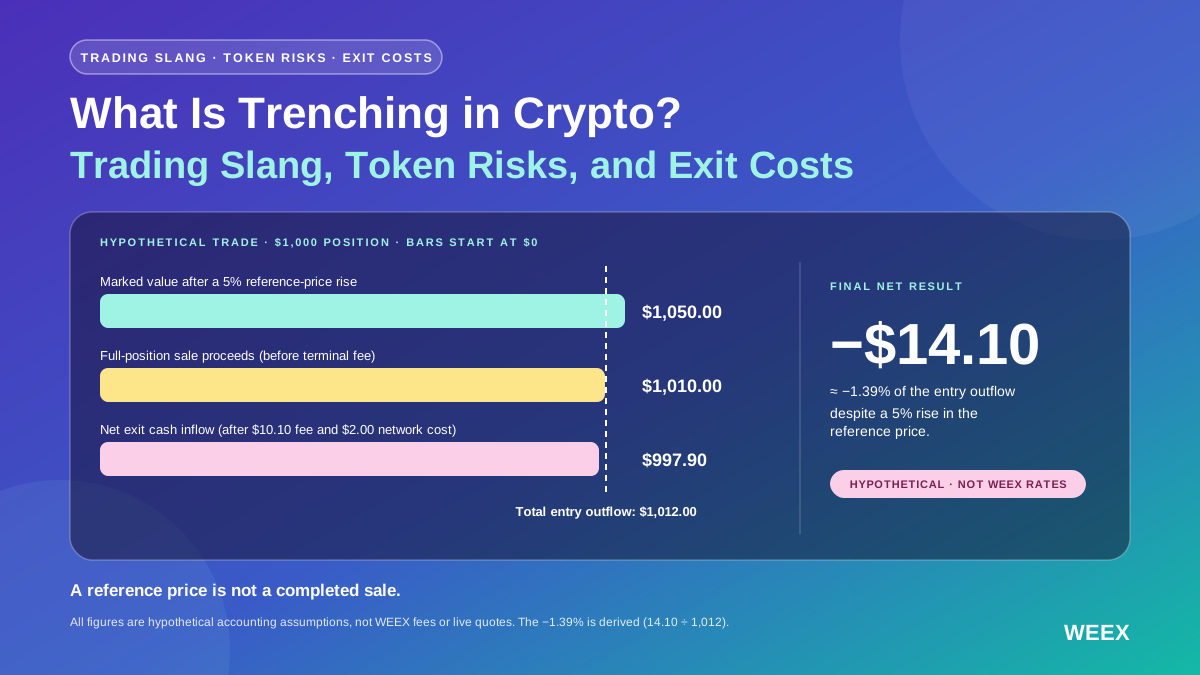
What Is Trenching in Crypto? Trading Slang, Token Risks, and Exit Costs
What is trenching in crypto? Learn the slang, token checks, liquidity risks, and how a rising token can still produce a loss after trading costs.
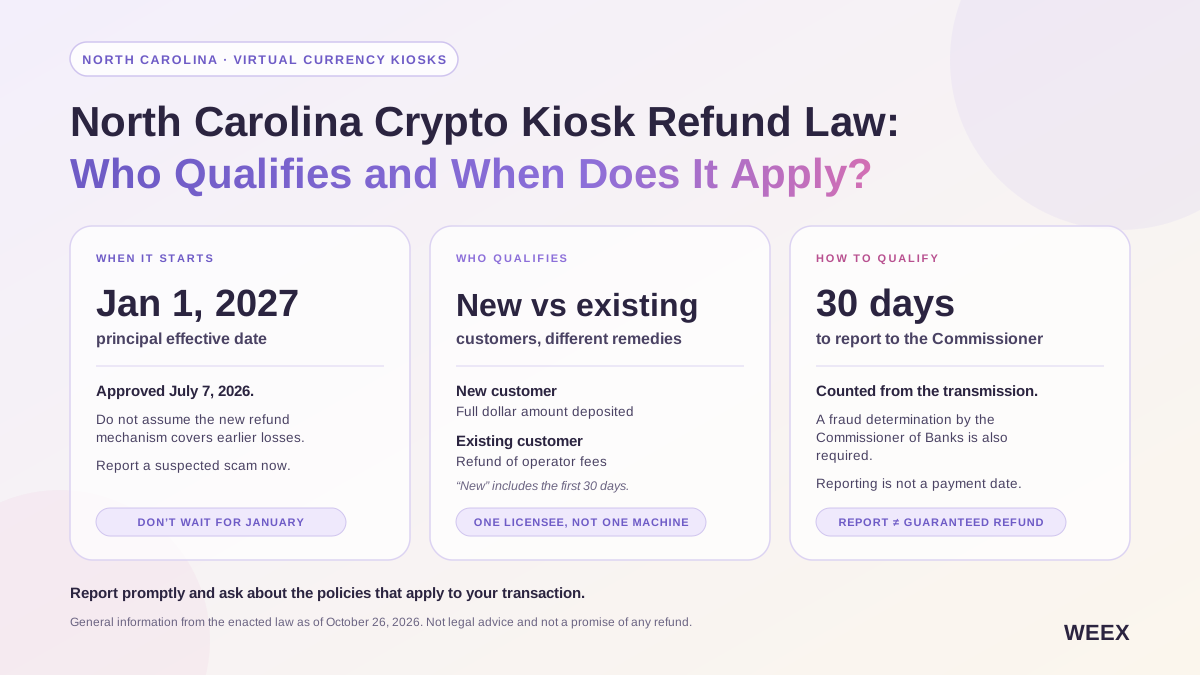
North Carolina Crypto Kiosk Refund Law: Who Qualifies and When Does It Apply?
Understand North Carolina’s crypto kiosk refund law: the January 2027 start date, who qualifies, reporting deadlines, and documents victims should keep.
![[Bitcoin $0 Controversy②] "$0 is an Exaggeration"... Reasons Wall Street Disagrees](/public-static/20_9098579959.png?format=avif)
[Bitcoin $0 Controversy②] "$0 is an Exaggeration"... Reasons Wall Street Disagrees
![[ETH Letter] Meritz Securities Reviews Tokenization of Korean Securities Based on OP Stack](/public-static/31_556776148b.png?format=avif)
[ETH Letter] Meritz Securities Reviews Tokenization of Korean Securities Based on OP Stack

Progressive Party Opposes Further Delay of Cryptocurrency Income Tax

JPMorgan's Tokenized Fund on Solana: What MONY and JLTXX Mean for Institutional Adoption of RWA
Real and Fake Cryptocurrency Market Makers: What Makes a Market Maker Legitimate?

Michaël van de Poppe sees four crypto trends: AI, Ethereum, Sui, and digital assets

Coppock Curve and Crypto Trading: How to Use the Trend Reversal Indicator

Bitcoin Records U.S. Constitution Again... This Time with a Mysterious Code

Hedge funds hold $2 trillion in US debt, but their next trade could require fewer bonds
Weekly: $68,000 Theft from Ukrainian in Trust Wallet, Circle's Lawsuit Against Trump Over $2 Billion in UAE, and Historic Solana Update

ZachXBT Accuses CoinDCX of Losing $16 Million in Client Funds

NYSE’s owner is backing 24/7 stock tokens without Wall Street’s usual price rules
JPMorgan Now Offers Two Tokenized Money Market Funds on Solana
Follow the Money: $630 Million for Strive, Tether Activity and Attention to CeFi
HTX Research Analyst Chloe: Despite Significant Net Inflows into Bitcoin Spot ETFs, Macroeconomic Data Suppresses Rebound Potential
Killa: Frequent Short-term Trading Risks Missing Major Market Movements, Patience in Holding Positions is Important
China's fiscal revenue rose 5.1% by September, but land sales continue to decline
90% of Revenue from Meme Coins, Yet Valuation Rivals Pump: What Should Meteora Be Worth?
Former FTX Executive Slams Netflix's New Series: Turning Financial Fraud into a 'Romantic Film' is Absurd
Ripple teams up with $10B payments firm Arf to expand RLUSD use on XRPL

One billion dollars in three days is not enough. Bitcoin faces a significant challenge
WEEX Exclusive:Major Indexes Close Higher; Focus on TSLA, META Stock Earnings | WEEX TradFi Daily(October 22, 2026)
Major Indexes Close Higher; Focus on TSLA, META Stock Earnings | WEEX TradFi Daily(October 22, 2026)
The three major indexes closed higher on October 21, led by the Nasdaq. SpaceX beat earnings expectations and disclosed AI-business revenue; merger discussions with Tesla also helped lift AI and crypto-related stocks. Bitcoin traded near $84,000 and Ethereum near $2,470. LIT led majors on compliance-license expectations. On October 22, investors will watch Procter & Gamble, Southern Copper and Union Pacific before the open, followed by Western Digital and Newmont after the close.

Irish drug lord’s lost Bitcoin fortune comes back to life as $41 million moves to Coinbase

ZachXBT Reports on Cryptocurrency Laundering via FreedomXMR on Hyperliquid
Pump.fun 'optimized for addiction': what the internal messages cited in court really say
Rayls Bridges Traditional Finance and Decentralized Finance
The Week Ahead: 4 Key Moments for the Crypto Market
What Is Trenching in Crypto? Trading Slang, Token Risks, and Exit Costs
What is trenching in crypto? Learn the slang, token checks, liquidity risks, and how a rising token can still produce a loss after trading costs.
North Carolina Crypto Kiosk Refund Law: Who Qualifies and When Does It Apply?
Understand North Carolina’s crypto kiosk refund law: the January 2027 start date, who qualifies, reporting deadlines, and documents victims should keep.
[Bitcoin $0 Controversy②] "$0 is an Exaggeration"... Reasons Wall Street Disagrees





