
Interview: Erald Ghoos (OKX) on MiCA, the Dollar, and the Future of EU Payments

 Prefer us on Google


Stablecoins are increasingly being presented as a bridge between crypto and everyday payments, but the path to adoption in Europe is determined by regulation, the dominance of the dollar, and the limitations of existing payment systems.
The EU's Regulation on Crypto-Asset Markets (MiCA) provides a common framework for multiple markets; however, compliance rules can also limit access to widely used tokens.
Meanwhile, euro-backed stablecoins remain significantly smaller than their dollar counterparts, raising questions about European monetary autonomy and the competitiveness of its digital finance sector.
In this interview, Erald Ghoos, CEO of OKX Europe, explains how regulation is shaping the market, where stablecoins can offer advantages over traditional payments, and what real adoption should look like.
He also shares insights on the use of the OKX Card and the company's vision for stablecoins in Europe's financial future.

Invezz: Europe is tightening rules on stablecoins just as the sector seeks to expand into payments. Does MiCA make Europe a more attractive market for stablecoin businesses, or does it make the region less competitive?
Europe has a structural advantage in that a single set of rules covers 30 markets with over 450 million people, and the rules are already in place rather than still under discussion.
This can make the European market attractive for companies that can meet regulatory demands and offer a good product.
The problem is that we also need to be able to welcome globally competitive services and not consider Europe a closed market.
Europe must ensure it remains globally relevant before stifling it with excessive regulation and losing opportunities.
For example, the largest stablecoin in the world is not available in Europe.
Currently having no plans to apply for a license, many new stablecoins have been launched in an attempt to fill that liquidity gap.
However, they still have a long way to go to catch up.
The challenge for regulators is to find the right balance between consumer protection, freedom of choice, and providing businesses the opportunity to compete.
What Jensen Huang, CEO of NVIDIA, said about AI regulation applies here as well: "There is nothing to regulate if the sector is not thriving."
Invezz: Europe desires greater monetary and financial autonomy, yet dollar-backed stablecoins dominate the global market. Why has the euro so far failed to establish a significant stablecoin alternative?
Dollar-backed stablecoins enjoy a well-established advantage over other currencies.
When cryptocurrencies began to emerge, prices were almost always quoted in USD, leading to greater liquidity that attracts further liquidity, pushing dollar stablecoins to become the de facto standard for how people think and talk about crypto prices.
However, there is still room for new entrants and stablecoins backed by other currencies, such as the euro.
A euro-based stablecoin offers advantages to customers who use it as a domestic currency, for example.
It can be much simpler to manage investments and finances if one does not have to constantly calculate another exchange rate between deposit and purchase.
Anything that reduces friction is generally positive. I would like to see more EUR-backed options in the market, and there are interesting projects that will bring greater choice to Europeans.
Invezz: Europe already has increasingly accessible instant transfers and established card networks. What specific payment problem do stablecoins solve that the existing infrastructure cannot manage?
Stablecoins earn a role where SEPA stops. Sending euros from Paris to Lisbon? An instant transfer works.
But if you pay a supplier in Turkey or send money to family outside Europe, you revert to relying on correspondent banks, FX spreads, and settlement that halts during the weekend.
A stablecoin settles transactions in seconds, even on Sundays if necessary.
The second problem is closer to our customers. More and more aspects of people's financial lives reside on platforms like OKX: crypto, tokenized stocks, balances in stablecoins.
Spending those funds meant selling, withdrawing to a bank account, and waiting for the money to be available.
Stablecoins eliminate that step and become a natural extension for payments when this is your primary financial ecosystem.
Invezz: The adoption of stablecoins is often measured through transaction volumes and market capitalization, but these figures do not necessarily indicate how much economic activity is taking place. What metrics should the industry use to distinguish true adoption for payments from crypto trading and transfers between wallets?
Transaction volume and market capitalization are useful metrics for monitoring overall adoption and use when granular data is not accessible, such as in P2P payments and direct wallet remittances, but the industry can go beyond that and focus more on whether stablecoins are being used to purchase real goods and services.
This can be measured by observing merchant payment volumes, recurring active users for stablecoin payments, and the context of the transaction, i.e., what the real-world use is for that payment.
The distinction is useful because the movement of stablecoins does not equate to the adoption of stablecoins.
Real adoption means that people and businesses use stablecoins as a payment tool, not just as liquidity for trading.
Invezz: OKX is bringing stablecoins into everyday spending through Mastercard's existing payment network. What has been the main obstacle to card adoption among European consumers: regulatory restrictions, customer trust, the complexity of holding stablecoins, or simply the lack of compelling financial incentives?
Adoption has surprisingly encountered few obstacles. Usage is growing rapidly because the card is easy to use and offers a strong value proposition, particularly through Pay Boost, which offers 3.5% on idle balances, and cashback.
Invezz: What is the share of card volume attributable to everyday recurring expenses compared to users who reload and withdraw?
About one-third of card volume, and nearly half of card transactions, now show recurring weekly purchasing behaviors.
For example, Germany and Poland lead in everyday and recurring spending.
Meanwhile, Dutch users repeat purchases just as often, but they also use the card for occasional larger purchases, which skews the volume.
Invezz: Looking three to five years ahead, what needs to happen for stablecoins to become a significant part of the European financial infrastructure instead of just another way to spend crypto?
We are already seeing a convergence between crypto and traditional finance.
Crypto platforms are becoming full financial services, and more banks and asset managers are adding crypto to their offerings.
For stablecoins to become part of the European financial infrastructure, this convergence must continue, with more banks issuing and holding them and more businesses settling in stablecoins.
This also means that regulators will need to find the right balance between consumer protection and choice; otherwise, they risk falling behind other jurisdictions.
I expect this to happen, but the speed will depend on the regulatory environment.
-- Price
This content is provided for general informational purposes only and doesn't constitute financial, investment, legal, or tax advice. Any events, rewards, online promotions, or related information mentioned herein should not be considered a recommendation, solicitation, or invitation to purchase, sell, trade, or otherwise deal in any crypto assets. Crypto assets are highly volatile and may result in loss. The availability of WEEX services, products, and related events may vary by region. You are responsible for ensuring that your participation is in accordance with applicable local laws and regulations.
You may also like
Fidelity: Fed deemed too lenient, bond yields at highest in 20 years
Why JPMorgan Raised the Target Price for Yushu Technology to 995 Yuan
Standard Chartered Launches RLUSD Custody, Plans Collateral Model

Solana Launches Delivery-Versus-Payment Tool for Atomic Securities Settlement

Solana Leads Euro Stablecoin Issuances: The Circle Effect Behind the Numbers

Bitcoin at $90,000: The $68 Million Bet on the U.S. Midterm Elections
Pump.fun 'optimized for addiction': what the internal messages cited in court really say

Rayls Bridges Traditional Finance and Decentralized Finance
The Week Ahead: 4 Key Moments for the Crypto Market
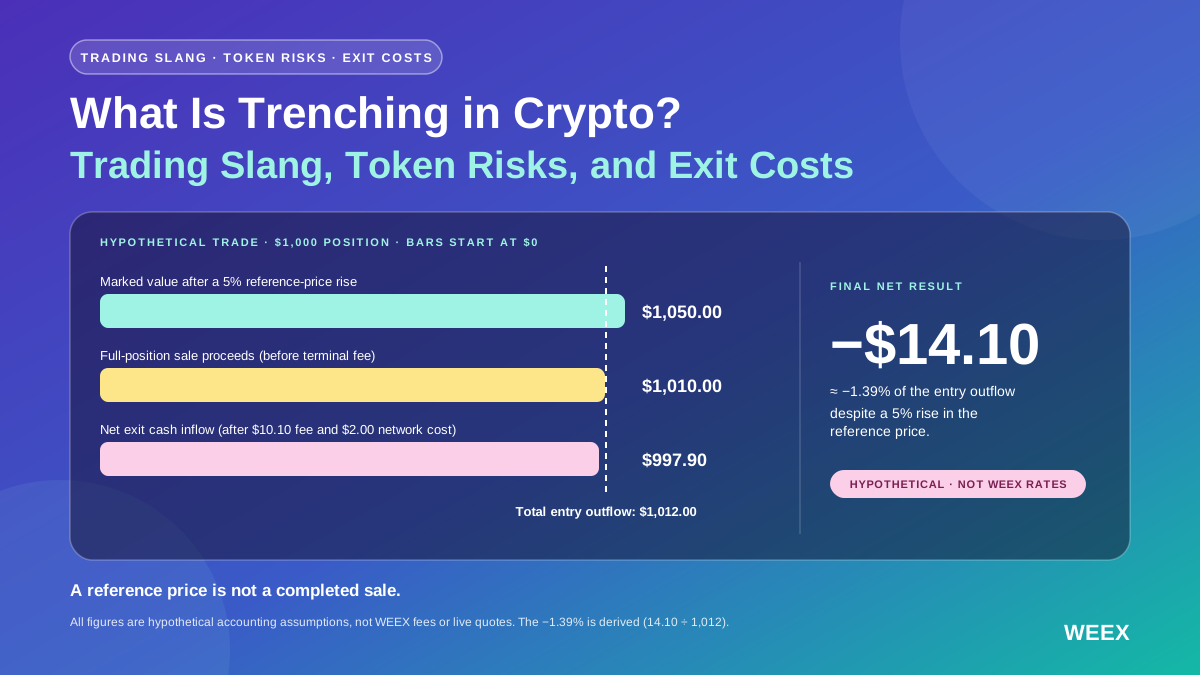
What Is Trenching in Crypto? Trading Slang, Token Risks, and Exit Costs
What is trenching in crypto? Learn the slang, token checks, liquidity risks, and how a rising token can still produce a loss after trading costs.
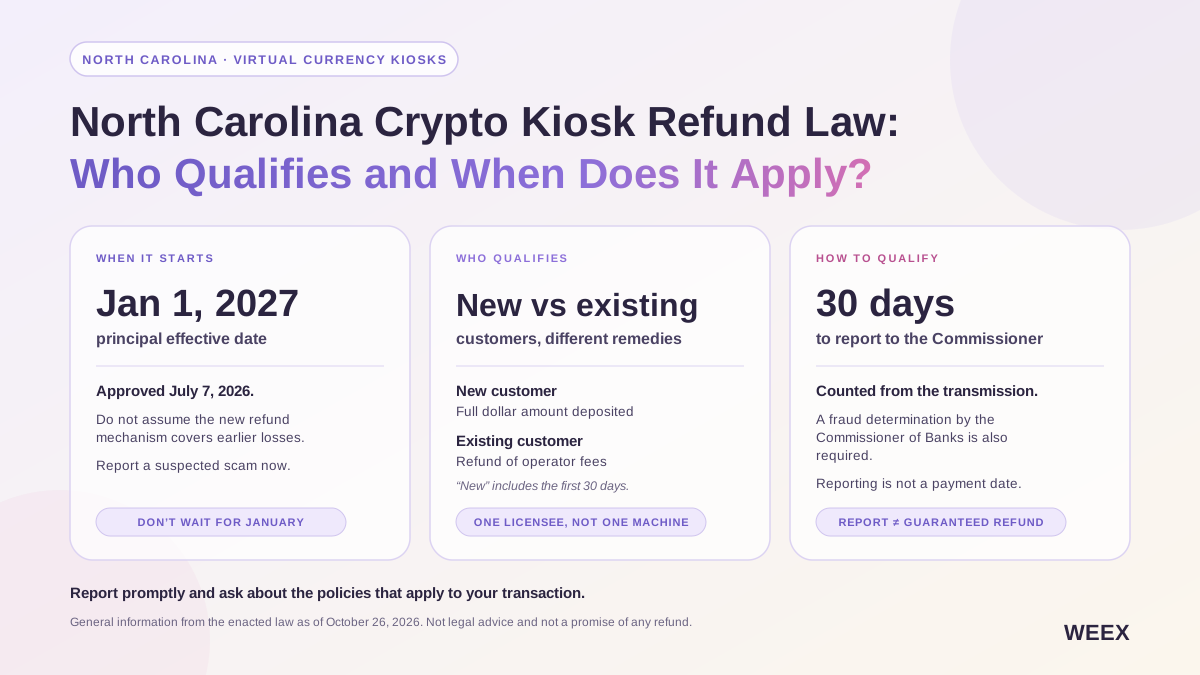
North Carolina Crypto Kiosk Refund Law: Who Qualifies and When Does It Apply?
Understand North Carolina’s crypto kiosk refund law: the January 2027 start date, who qualifies, reporting deadlines, and documents victims should keep.

[Bitcoin $0 Controversy②] "$0 is an Exaggeration"... Reasons Wall Street Disagrees
[ETH Letter] Meritz Securities Reviews Tokenization of Korean Securities Based on OP Stack

Progressive Party Opposes Further Delay of Cryptocurrency Income Tax

JPMorgan's Tokenized Fund on Solana: What MONY and JLTXX Mean for Institutional Adoption of RWA
Real and Fake Cryptocurrency Market Makers: What Makes a Market Maker Legitimate?
Michaël van de Poppe sees four crypto trends: AI, Ethereum, Sui, and digital assets

Coppock Curve and Crypto Trading: How to Use the Trend Reversal Indicator

Bitcoin Records U.S. Constitution Again... This Time with a Mysterious Code

Hedge funds hold $2 trillion in US debt, but their next trade could require fewer bonds
Weekly: $68,000 Theft from Ukrainian in Trust Wallet, Circle's Lawsuit Against Trump Over $2 Billion in UAE, and Historic Solana Update

ZachXBT Accuses CoinDCX of Losing $16 Million in Client Funds

NYSE’s owner is backing 24/7 stock tokens without Wall Street’s usual price rules
JPMorgan Now Offers Two Tokenized Money Market Funds on Solana
Follow the Money: $630 Million for Strive, Tether Activity and Attention to CeFi
HTX Research Analyst Chloe: Despite Significant Net Inflows into Bitcoin Spot ETFs, Macroeconomic Data Suppresses Rebound Potential

Killa: Frequent Short-term Trading Risks Missing Major Market Movements, Patience in Holding Positions is Important
China's fiscal revenue rose 5.1% by September, but land sales continue to decline

90% of Revenue from Meme Coins, Yet Valuation Rivals Pump: What Should Meteora Be Worth?
Former FTX Executive Slams Netflix's New Series: Turning Financial Fraud into a 'Romantic Film' is Absurd
Fidelity: Fed deemed too lenient, bond yields at highest in 20 years
Why JPMorgan Raised the Target Price for Yushu Technology to 995 Yuan
Standard Chartered Launches RLUSD Custody, Plans Collateral Model
Solana Launches Delivery-Versus-Payment Tool for Atomic Securities Settlement
Solana Leads Euro Stablecoin Issuances: The Circle Effect Behind the Numbers
Bitcoin at $90,000: The $68 Million Bet on the U.S. Midterm Elections





