
Withdrawal of Cardano ETF: Why is Grayscale stepping back right now?

 Prefer us on Google


Cardano remains stuck just below $0.20, five days after a 10% surge that reignited interest in the token. But it's a document filed with the Securities and Exchange Commission that steals the spotlight: the withdrawal of the Cardano ETF announced by Grayscale casts a shadow just as ADA had recently met a crucial regulatory requirement for entry into the market for listed instruments.
Grayscale filed with the SEC on August 7, the formal notice of withdrawal of its application for a spot ETF on Cardano. The news emerged unexpectedly, practically coinciding with a development that many observers had interpreted as preparatory for the arrival of a listed fund on ADA.
The temporal paradox weighs heavily on sentiment. After 75 days of regulated trading in futures derivatives on the Chicago Mercantile Exchange, ADA had indeed become eligible for a spot ETF on cryptocurrencies starting from August 9. This is a technical process outlined by SEC rules for the approval of spot products linked to digital assets: surpassing a period of regulated trading on a recognized derivatives market is considered a prerequisite for the maturity of the underlying market. ADA had achieved this milestone just 48 hours before Grayscale's withdrawal became public, nullifying what seemed like an imminent catalyst.
The Grayscale ETF application was not isolated. The same filing revealed that the company has also, at least for the moment, abandoned two other crypto spot ETF projects: one on Polkadot (DOT) and one on Hedera (HBAR). A three-way exit, not an isolated incident related solely to Cardano.
Those expecting an immediate collapse were disappointed, at least until Monday, August 10. ADA continued to hover around $0.20, even showing a +4.54% on the weekly chart. None of the three cryptocurrencies involved in the withdrawal of applications showed decisive movements: DOT recorded a +0.69% weekly, while HBAR remained practically flat, at +0.06%.
This absence of immediate reaction is significant in itself for those assessing the ADA price impact in the short term: the market has not yet sharply priced in the news, which could mean either that the information was already somewhat anticipated, or that traders are waiting for further signals before positioning themselves. In such a delicate ETF regulatory phase, this apparent calm can prove as deceptive as a sudden movement.
Complicating the reading of the episode is a second institutional event, also postponed within the same timeframe. The Congressional vote on the CLARITY Act, highly anticipated by the sector, has been delayed by at least a month. This is the regulation that should provide a clearer regulatory framework for the classification of digital assets in the United States.
The combination of these two developments, Grayscale's withdrawal of applications and the postponement of the legislative vote, immediately reduces visibility on when and how the market for spot ETFs on cryptocurrencies alternative to Bitcoin can truly take off. For institutional investors looking at these instruments as a regulated gateway to crypto, the combination of regulatory uncertainty and steps back from issuers represents a tangible, not just perceptual, brake.
Despite the setback on the ETF front, some on-chain observers continue to read signs of strength beneath the surface. Several analysts claim to observe a gradual weakening of the upward resistance on Cardano and other digital assets, a technical hint that could precede new price movements.
It remains to be seen whether these technical signals will be enough to offset the regulatory blow suffered by Cardano. The mix of factors at play, from Grayscale's withdrawal to the legislative postponement to the conflicting on-chain signals, leaves open the possibility of a broader bullish market, but the path to a new spot ETF on ADA appears today longer than it seemed just a week ago.
-- Price
This content is provided for general informational purposes only and doesn't constitute financial, investment, legal, or tax advice. Any events, rewards, online promotions, or related information mentioned herein should not be considered a recommendation, solicitation, or invitation to purchase, sell, trade, or otherwise deal in any crypto assets. Crypto assets are highly volatile and may result in loss. The availability of WEEX services, products, and related events may vary by region. You are responsible for ensuring that your participation is in accordance with applicable local laws and regulations.
You may also like

Pump.fun 'optimized for addiction': what the internal messages cited in court really say

Rayls Bridges Traditional Finance and Decentralized Finance

The Week Ahead: 4 Key Moments for the Crypto Market
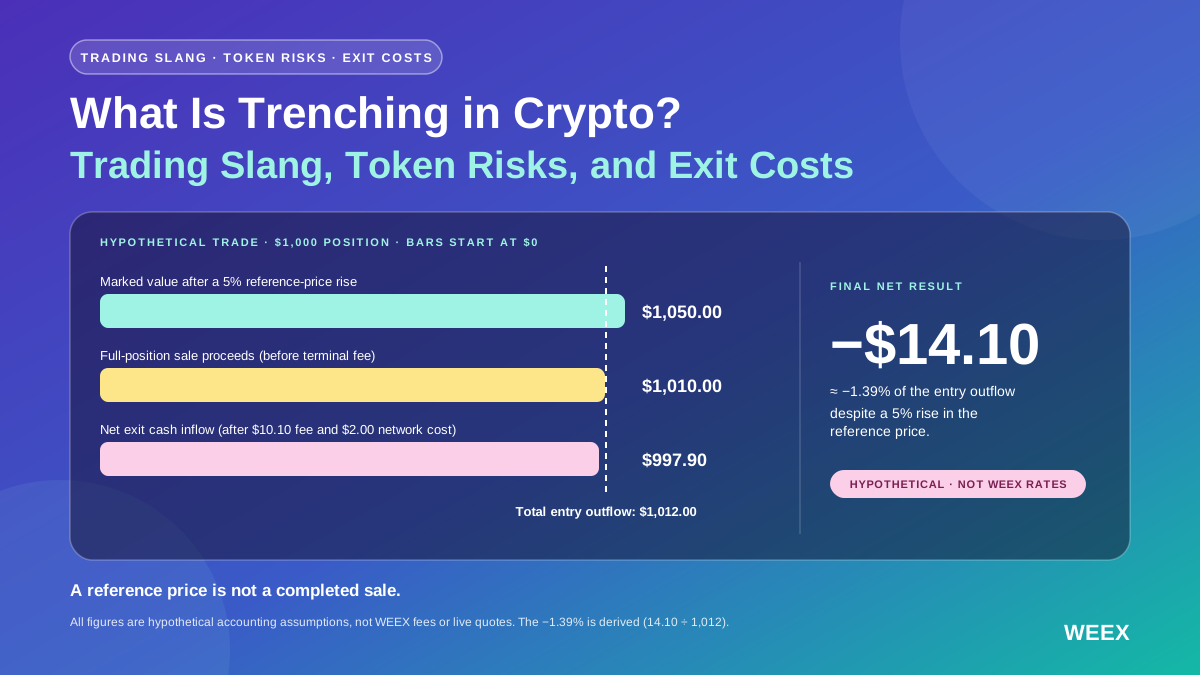
What Is Trenching in Crypto? Trading Slang, Token Risks, and Exit Costs
What is trenching in crypto? Learn the slang, token checks, liquidity risks, and how a rising token can still produce a loss after trading costs.
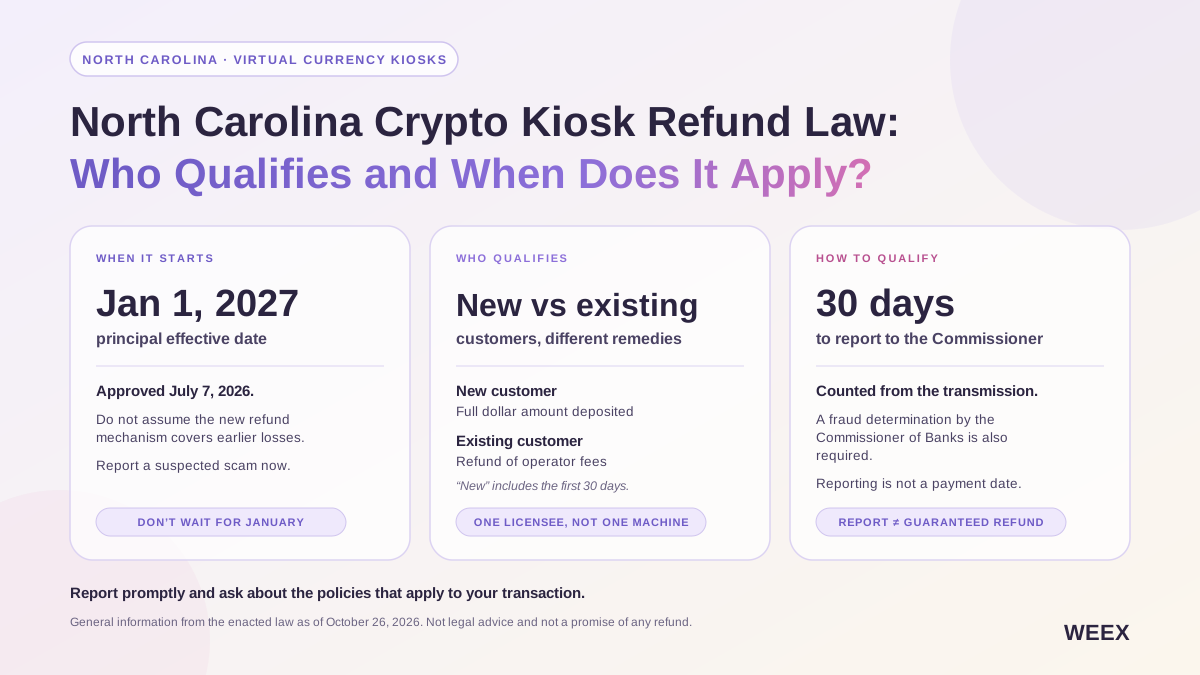
North Carolina Crypto Kiosk Refund Law: Who Qualifies and When Does It Apply?
Understand North Carolina’s crypto kiosk refund law: the January 2027 start date, who qualifies, reporting deadlines, and documents victims should keep.

[Bitcoin $0 Controversy②] "$0 is an Exaggeration"... Reasons Wall Street Disagrees

[ETH Letter] Meritz Securities Reviews Tokenization of Korean Securities Based on OP Stack

Progressive Party Opposes Further Delay of Cryptocurrency Income Tax

JPMorgan's Tokenized Fund on Solana: What MONY and JLTXX Mean for Institutional Adoption of RWA
Real and Fake Cryptocurrency Market Makers: What Makes a Market Maker Legitimate?

Michaël van de Poppe sees four crypto trends: AI, Ethereum, Sui, and digital assets

Coppock Curve and Crypto Trading: How to Use the Trend Reversal Indicator

Bitcoin Records U.S. Constitution Again... This Time with a Mysterious Code

Hedge funds hold $2 trillion in US debt, but their next trade could require fewer bonds
Weekly: $68,000 Theft from Ukrainian in Trust Wallet, Circle's Lawsuit Against Trump Over $2 Billion in UAE, and Historic Solana Update

ZachXBT Accuses CoinDCX of Losing $16 Million in Client Funds

NYSE’s owner is backing 24/7 stock tokens without Wall Street’s usual price rules

JPMorgan Now Offers Two Tokenized Money Market Funds on Solana

Follow the Money: $630 Million for Strive, Tether Activity and Attention to CeFi
HTX Research Analyst Chloe: Despite Significant Net Inflows into Bitcoin Spot ETFs, Macroeconomic Data Suppresses Rebound Potential

Killa: Frequent Short-term Trading Risks Missing Major Market Movements, Patience in Holding Positions is Important

China's fiscal revenue rose 5.1% by September, but land sales continue to decline

90% of Revenue from Meme Coins, Yet Valuation Rivals Pump: What Should Meteora Be Worth?

Former FTX Executive Slams Netflix's New Series: Turning Financial Fraud into a 'Romantic Film' is Absurd

Ripple teams up with $10B payments firm Arf to expand RLUSD use on XRPL

One billion dollars in three days is not enough. Bitcoin faces a significant challenge

WEEX Exclusive:Major Indexes Close Higher; Focus on TSLA, META Stock Earnings | WEEX TradFi Daily(October 22, 2026)

Major Indexes Close Higher; Focus on TSLA, META Stock Earnings | WEEX TradFi Daily(October 22, 2026)
The three major indexes closed higher on October 21, led by the Nasdaq. SpaceX beat earnings expectations and disclosed AI-business revenue; merger discussions with Tesla also helped lift AI and crypto-related stocks. Bitcoin traded near $84,000 and Ethereum near $2,470. LIT led majors on compliance-license expectations. On October 22, investors will watch Procter & Gamble, Southern Copper and Union Pacific before the open, followed by Western Digital and Newmont after the close.

Irish drug lord’s lost Bitcoin fortune comes back to life as $41 million moves to Coinbase

ZachXBT Reports on Cryptocurrency Laundering via FreedomXMR on Hyperliquid
Pump.fun 'optimized for addiction': what the internal messages cited in court really say
Rayls Bridges Traditional Finance and Decentralized Finance
The Week Ahead: 4 Key Moments for the Crypto Market
What Is Trenching in Crypto? Trading Slang, Token Risks, and Exit Costs
What is trenching in crypto? Learn the slang, token checks, liquidity risks, and how a rising token can still produce a loss after trading costs.
North Carolina Crypto Kiosk Refund Law: Who Qualifies and When Does It Apply?
Understand North Carolina’s crypto kiosk refund law: the January 2027 start date, who qualifies, reporting deadlines, and documents victims should keep.
[Bitcoin $0 Controversy②] "$0 is an Exaggeration"... Reasons Wall Street Disagrees





