
US Moves $470 Million in Crypto: What Does This Signal?

 Prefer us on Google


The United States government moved approximately $470 million in cryptocurrencies on Wednesday (7), directing Bitcoin, wrapped Bitcoin (wBTC), BNB, and USDT to new addresses that, according to on-chain data from Arkham Intelligence, likely belong to Coinbase Prime. The assets are linked to judicial seizures in the cases of Bitfinex and Alameda Research, the financial arm of the bankrupt FTX.
The transfer was not accompanied by any official statement from American authorities. However, the market did not need a note to react: the trading volume of USDT on Binance surged to 6.47 million in the following 60 minutes, six times above the hourly average of 1.07 million.
This episode raises a practical question for crypto investors: is the U.S. government preparing to sell these assets or merely reorganizing custody?
What Exactly Was Moved by the U.S. Government
The movement involved multiple assets and can be traced to different legal processes. The largest portion includes about 750 wBTC (approximately $62 million) and 567 bitcoins ($54.6 million) linked to the Alameda Research case. This is supplemented by 40,200 BNB, equivalent to $30.7 million, and a transfer of $24.88 million in USDT also linked to Alameda, sent directly to a Coinbase Prime wallet.
In addition to the assets linked to FTX, the transaction history reveals movements of bitcoins seized from Sergei Potapenko and Ivan Turõgin, operators of a fake mining operation, and from the hackers responsible for the 2016 Bitfinex exchange attack. As we explained in our coverage of the crypto sector, this hack resulted in the theft of about 120,000 BTC, a significant portion of which was recovered by the U.S. Department of Justice in 2022.
The choice of Coinbase Prime as the likely destination is not random. Coinbase's institutional platform already acts as a custodian for various Bitcoin ETFs in the United States and has contracts with federal agencies for the custody of seized digital assets.
Imminent Sale or Custody Reorganization?
The big question in the market is whether these transfers represent the prelude to a liquidation. The recent history of the U.S. government offers clues.
In March 2024, the Department of Justice sold about 9,800 BTC seized in the Silk Road case, a movement that generated temporary selling pressure. In January of the same year, a transfer of 2,000 BTC from government wallets had already caused a 3% drop in price within hours, before it was confirmed that the assets were merely redistributed among custody wallets.
Arkham analysts point out that the transaction can be interpreted as a possible conversion to fiat currency or secure custody. The distinction is crucial: sending to Coinbase Prime does not necessarily mean selling. The platform offers both trading and institutional cold custody services.
Still, it is worth noting that the U.S. government holds one of the largest Bitcoin stockpiles in the world. According to estimates compiled from on-chain data, federal wallets accumulate over 200,000 BTC, valued at about $19 billion at current prices. Any sign of liquidation, even partial, tends to impact market sentiment.
How the Market Reacted to the Movements
Bitcoin was trading down on Wednesday, but Arkham did not attribute the correction directly to government transfers. The most interesting data appears in the derivatives markets: the funding rates of BNB on Bybit showed unusual changes shortly after the movement of the 40,200 BNB, suggesting that derivatives traders adjusted positions quickly.
The volume of USDT on Binance recorded the clearest pattern of reaction. The jump from 1.07 million to 6.47 million in one hour indicates that market participants interpreted the transfer as a potential liquidity event and anticipated movements.
For those following financial markets more broadly, this type of government movement serves as a reminder: unlike traditional assets, transactions from large crypto holders are visible in real-time. This on-chain transparency is a double-edged sword. It allows for monitoring but also amplifies emotional reactions.
-- Price
What This Means for Crypto Investors
The practical question for investors is calibrating the real relevance of this event. $470 million represents less than 0.03% of Bitcoin's total market cap. In terms of daily volume, BTC trades over $30 billion per day on major exchanges. Even if the entire amount were liquidated at once, the direct impact would be limited.
The real risk is not in the volume itself but in the psychological effect. Government movements act as narrative triggers. Short-term traders tend to react to the headline before analyzing the data. This creates temporary volatility that, historically, dissipates within hours or days.
Another relevant point: the increasing sophistication of on-chain monitoring tools, such as those from Arkham, means that these movements are detected almost instantly. This has reduced the informational advantage that large players had in the past but also accelerated cycles of panic and recovery.
For medium- and long-term investors, this episode reinforces an old lesson from the crypto market: government custody events generate noise, not trend. The direction of Bitcoin continues to be determined by macroeconomic factors, ETF flows, and halving cycles, not by isolated transfers between wallets.
This content is informative and educational and does not constitute investment advice. Past performance is not indicative of future results.
This content is provided for general informational purposes only and doesn't constitute financial, investment, legal, or tax advice. Any events, rewards, online promotions, or related information mentioned herein should not be considered a recommendation, solicitation, or invitation to purchase, sell, trade, or otherwise deal in any crypto assets. Crypto assets are highly volatile and may result in loss. The availability of WEEX services, products, and related events may vary by region. You are responsible for ensuring that your participation is in accordance with applicable local laws and regulations.
You may also like

Pump.fun 'optimized for addiction': what the internal messages cited in court really say

Rayls Bridges Traditional Finance and Decentralized Finance

The Week Ahead: 4 Key Moments for the Crypto Market
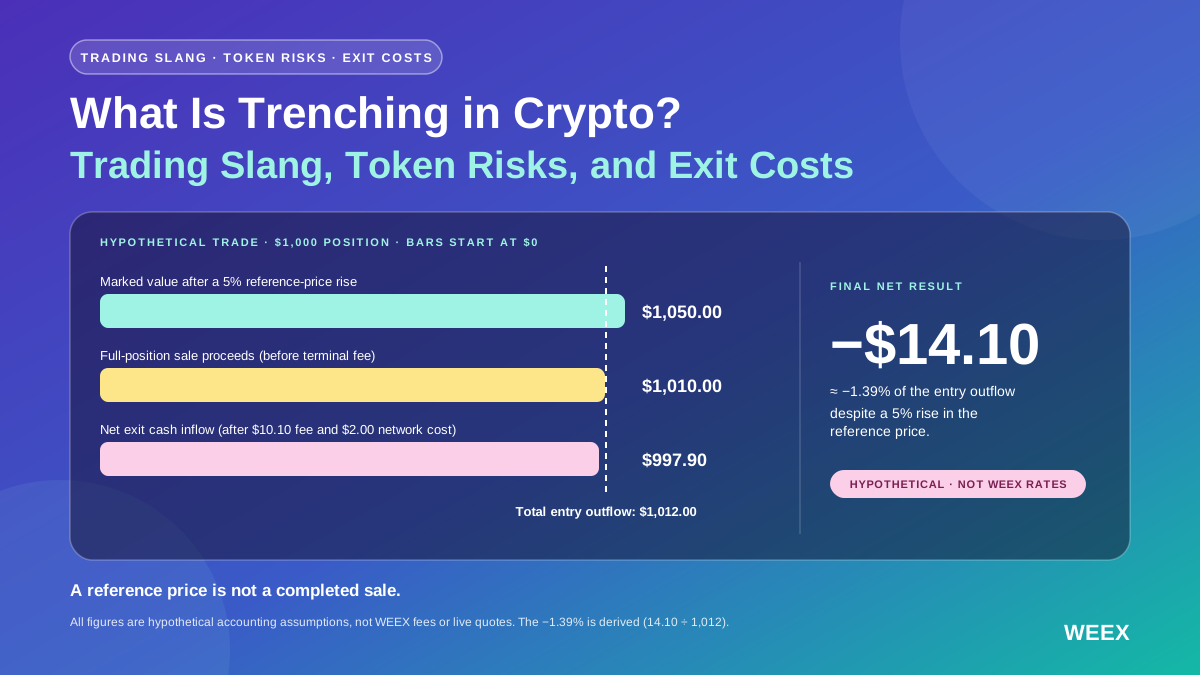
What Is Trenching in Crypto? Trading Slang, Token Risks, and Exit Costs
What is trenching in crypto? Learn the slang, token checks, liquidity risks, and how a rising token can still produce a loss after trading costs.
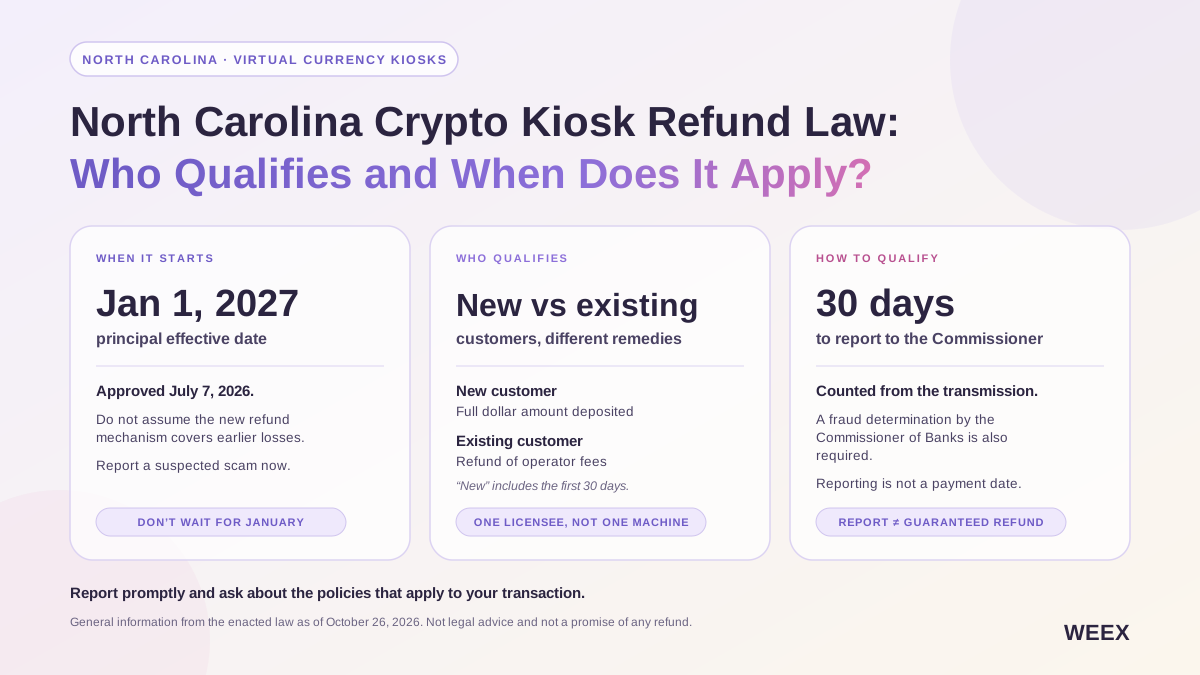
North Carolina Crypto Kiosk Refund Law: Who Qualifies and When Does It Apply?
Understand North Carolina’s crypto kiosk refund law: the January 2027 start date, who qualifies, reporting deadlines, and documents victims should keep.

[Bitcoin $0 Controversy②] "$0 is an Exaggeration"... Reasons Wall Street Disagrees

[ETH Letter] Meritz Securities Reviews Tokenization of Korean Securities Based on OP Stack

Progressive Party Opposes Further Delay of Cryptocurrency Income Tax

JPMorgan's Tokenized Fund on Solana: What MONY and JLTXX Mean for Institutional Adoption of RWA
Real and Fake Cryptocurrency Market Makers: What Makes a Market Maker Legitimate?

Michaël van de Poppe sees four crypto trends: AI, Ethereum, Sui, and digital assets

Coppock Curve and Crypto Trading: How to Use the Trend Reversal Indicator

Bitcoin Records U.S. Constitution Again... This Time with a Mysterious Code

Hedge funds hold $2 trillion in US debt, but their next trade could require fewer bonds
Weekly: $68,000 Theft from Ukrainian in Trust Wallet, Circle's Lawsuit Against Trump Over $2 Billion in UAE, and Historic Solana Update

ZachXBT Accuses CoinDCX of Losing $16 Million in Client Funds

NYSE’s owner is backing 24/7 stock tokens without Wall Street’s usual price rules

JPMorgan Now Offers Two Tokenized Money Market Funds on Solana

Follow the Money: $630 Million for Strive, Tether Activity and Attention to CeFi
HTX Research Analyst Chloe: Despite Significant Net Inflows into Bitcoin Spot ETFs, Macroeconomic Data Suppresses Rebound Potential

Killa: Frequent Short-term Trading Risks Missing Major Market Movements, Patience in Holding Positions is Important

China's fiscal revenue rose 5.1% by September, but land sales continue to decline

90% of Revenue from Meme Coins, Yet Valuation Rivals Pump: What Should Meteora Be Worth?

Former FTX Executive Slams Netflix's New Series: Turning Financial Fraud into a 'Romantic Film' is Absurd

Ripple teams up with $10B payments firm Arf to expand RLUSD use on XRPL

One billion dollars in three days is not enough. Bitcoin faces a significant challenge

WEEX Exclusive:Major Indexes Close Higher; Focus on TSLA, META Stock Earnings | WEEX TradFi Daily(October 22, 2026)

Major Indexes Close Higher; Focus on TSLA, META Stock Earnings | WEEX TradFi Daily(October 22, 2026)
The three major indexes closed higher on October 21, led by the Nasdaq. SpaceX beat earnings expectations and disclosed AI-business revenue; merger discussions with Tesla also helped lift AI and crypto-related stocks. Bitcoin traded near $84,000 and Ethereum near $2,470. LIT led majors on compliance-license expectations. On October 22, investors will watch Procter & Gamble, Southern Copper and Union Pacific before the open, followed by Western Digital and Newmont after the close.

Irish drug lord’s lost Bitcoin fortune comes back to life as $41 million moves to Coinbase

ZachXBT Reports on Cryptocurrency Laundering via FreedomXMR on Hyperliquid
Pump.fun 'optimized for addiction': what the internal messages cited in court really say
Rayls Bridges Traditional Finance and Decentralized Finance
The Week Ahead: 4 Key Moments for the Crypto Market
What Is Trenching in Crypto? Trading Slang, Token Risks, and Exit Costs
What is trenching in crypto? Learn the slang, token checks, liquidity risks, and how a rising token can still produce a loss after trading costs.
North Carolina Crypto Kiosk Refund Law: Who Qualifies and When Does It Apply?
Understand North Carolina’s crypto kiosk refund law: the January 2027 start date, who qualifies, reporting deadlines, and documents victims should keep.
[Bitcoin $0 Controversy②] "$0 is an Exaggeration"... Reasons Wall Street Disagrees





