
The turnover of the cryptocurrency market in Russia is estimated at $376 billion

 Prefer us on Google


The turnover of the cryptocurrency market in Russia, according to one estimate from participants of the Moscow Financial Forum, reaches $376 billion per year, while Russian users hold assets worth approximately 720 billion rubles on foreign cryptocurrency exchanges.
New rules for the cryptocurrency market were discussed at the panel session "New Rules of the Game: Regulation of Cryptocurrencies in Russia," held at the end of September as part of the Moscow Financial Forum. The main topic of discussion was the launch of regulation, which the market has been striving for nearly 10 years, and the expectation of subordinate legislation that should outline the practical details of the law's application.
Cryptocurrency has received property status
Ivan Chebeskov, Deputy Minister of Finance of the Russian Federation, reminded that from September 1, 2026, a new regulatory regime for cryptocurrencies will come into effect in Russia. Cryptocurrency is officially recognized as property, and a national crypto infrastructure is being created under the control of the Bank of Russia.
This infrastructure is to be built on the basis of exchanges, brokers, and trust managers. Market participants will become subjects of AML/CFT - the system for combating money laundering and financing of terrorism.
The ban on using cryptocurrencies for domestic payments remains in place. However, operations with digital currencies in foreign economic activity, on the contrary, receive support. A separate procedure is provided for non-qualified investors: access to operations is possible only after testing and within a limit of 300,000 rubles.
The Bank of Russia is preparing the regulatory framework
Vladimir Chistyukhin, First Deputy Chairman of the Bank of Russia, reported that by the end of October, the regulator is expected to adopt 27 regulatory acts. Seven first-tier documents have already been sent to the Ministry of Justice.
Changes to the Tax Code, as well as legislation on administrative and criminal liability, are planned to be considered in the autumn session of 2026 or in the spring session of 2027. Given these timelines, the first legal transactions with cryptocurrencies may take place by the end of the current year.
After including market participants in the register, as the Bank of Russia expects, they will be able to create self-regulatory organizations or expand the powers of existing SROs to new types of crypto activities. The practice of the first transactions will show which elements of regulation will need to be adjusted further. A separate block of unresolved issues is related to stablecoins.
Banks are waiting for new products for clients
Vladimir Verkhoshinsky, Chief Managing Director of Alfa-Bank, estimated the number of Russians already using crypto assets at 7 million people. According to him, the annual turnover of the Russian cryptocurrency market could be around $200 billion.
Verkhoshinsky noted that full-fledged regulation looks more preferable than temporary regimes and non-standard experimental schemes. In his assessment, Russia has now entered the ranks of countries that can be called friendly to the crypto industry.
In the coming year, the market will actively restructure. Banking products will begin to follow client requests: in the crypto sphere, this includes savings, investments, and cross-border payments. Digital depositories, exchange operations, and new capital market instruments should emerge in the market.
-- Price
Russian wallets and mining abroad
Ivan Chebeskov also referred to estimates from Sergey Shvetsov, Chairman of the Supervisory Board of the Moscow Exchange. According to this data, there are at least 10 million cryptocurrency wallets belonging to Russian citizens in foreign infrastructure. The potential volume of commission income that the national infrastructure could bring back to the country is estimated at $15 billion.
Shvetsov added that the Russian Federation accounts for more than 15% of global mining. According to him, Russia is among the top three countries facilitating Bitcoin turnover and supporting public blockchain.
Russian producers should also have the opportunity to buy and sell their products within the national infrastructure.
At the same time, Shvetsov warned that tax and sanctions restrictions could hinder the development of the law. However, in his assessment, regulators are genuinely interested in making the new model work, and the law itself does not appear to be formal.
He emphasized that a different chain of intermediaries operates in the circulation of digital assets, but the role of brokers and their ability to distribute financial instruments remains significant. If brokers are involved from the very beginning, a wide range of financial market participants will be able to work with the new instrument in a familiar logic.
The client journey and custodial features of cryptocurrencies differ from traditional instruments, but many people in Russia already understand what cryptocurrency is, how it works, and why it might be needed.
Shvetsov reminded that the Moscow Exchange has already undergone a competitive path with the New York, London, Frankfurt exchanges, and NASDAQ when it was returning liquidity to Russian instruments. He called unified clearing an important advantage for citizens: it allows trading different instruments in a single position and in real-time.
Revenues from the Crypto Market Could Go to Digital Asset Infrastructure
According to Sergey Shvetsov, the commissions that brokers and the exchange could earn from cryptocurrency trading may become a source of investment in a full-fledged infrastructure for the circulation of digital financial assets. Currently, their distribution is hindered, partly because such instruments are still unfamiliar to the mass market.
Shvetsov linked the development of crypto infrastructure to a broader transition from platform economy to agency. He reminded that the financial market has already experienced a shift from paper forms to digital: bonds and stocks have become dematerialized, creating a new reality.
In his opinion, digital financial assets and blockchain technologies could enhance the efficiency of not only the infrastructure but also the institutions protecting investors' rights in the foreseeable future. Embedded smart contracts should change the quality of such instruments, reduce risks, make the market more efficient, and standardize what currently remains unstandardized.
AI agents that will complement citizens' financial literacy will be able to navigate the new set of tools and choose the most valuable solutions from the emerging variety.
Shvetsov also noted that Russia ranks 10th in the world in terms of engagement in digital financial assets. He believes that the Moscow Exchange and brokers have a direct material interest in launching this market and are ready to make the necessary investments. The next step will be to find a convenient client journey and form a liquidity pool capable of transferring a significant portion of Russian citizens' operations from foreign platforms to the country.
Market Participants Await Subordinate Legislation and Assess Expenses
The head of the Expert Center for Digital Financial Assets and Digital Currencies of the Association of Banks of Russia, Olga Goncharova, described the mood of the current players in the crypto market as tense and competitive.
There is a struggle for future positions in the market. Some hope to become the largest digital depository, while others want to take the place of a leading QIT provider. At the same time, participants are anxious: everyone is waiting for subordinate legislation, trying to understand where profit will be in the model proposed by the state, and assessing future expenses, especially for information security.
Goncharova's ratings turned out to be higher than those of other discussion participants. According to her data, Russia ranks 7th in the world in terms of engagement in digital financial assets, and the annual turnover of the cryptocurrency market in Russia reaches $376 billion. She estimated the volume of Russian users' balances on foreign cryptocurrency exchanges at 720 billion rubles, or approximately $10 billion.
This content is provided for general informational purposes only and doesn't constitute financial, investment, legal, or tax advice. Any events, rewards, online promotions, or related information mentioned herein should not be considered a recommendation, solicitation, or invitation to purchase, sell, trade, or otherwise deal in any crypto assets. Crypto assets are highly volatile and may result in loss. The availability of WEEX services, products, and related events may vary by region. You are responsible for ensuring that your participation is in accordance with applicable local laws and regulations.
You may also like

Circle launches cirBTC for Ethereum and Arc with unified balance

Anthony Pompliano: The State Will Never Stop Printing Money! Bitcoin, Gold, and Land Will Benefit for 20 Years

Ansem is Bearish on Bitcoin and Ethereum, Market May Correct Before Rising

Leon Wankum Predicts Bitcoin Will Outgrow Real Estate Market

Blockstream Executive Peter Bain: Bitcoin Holding $81K Signals Bull Run

Bitcoin-to-Nasdaq Ratio Turns Bullish After 235 Sessions

PHP Exploit Takes Down Government and Hospital Websites

Galaxy Believes Bitcoin Bear Market Ended in June, Recommends Buying and Holding

Empery Invests $65 Million to Acquire 25% Stake in AI Data Center
Bitcoin's next Fed test comes with a hidden problem in America's inflation data
The crypto market loses altitude, patience becomes a habit – Steady Lads

Bitcoin's flat trend vs. S&P 500 signals risk warning, says Bloomberg analyst
Cyberattack on GMO in Japan: Trading Accounts Compromised, GMO Coin Claims to be Unaffected
Mark Cuban compares Bitcoin to meme stocks
Electrum patches Bitcoin vulnerability allowing payment redirection
The Week Ahead: 4 Key Moments for the Crypto Market

Security Researcher Exploits PHP2Shell Vulnerability to Breach Bounty Website, Earns Approximately $2000 in Bitcoin Rewards
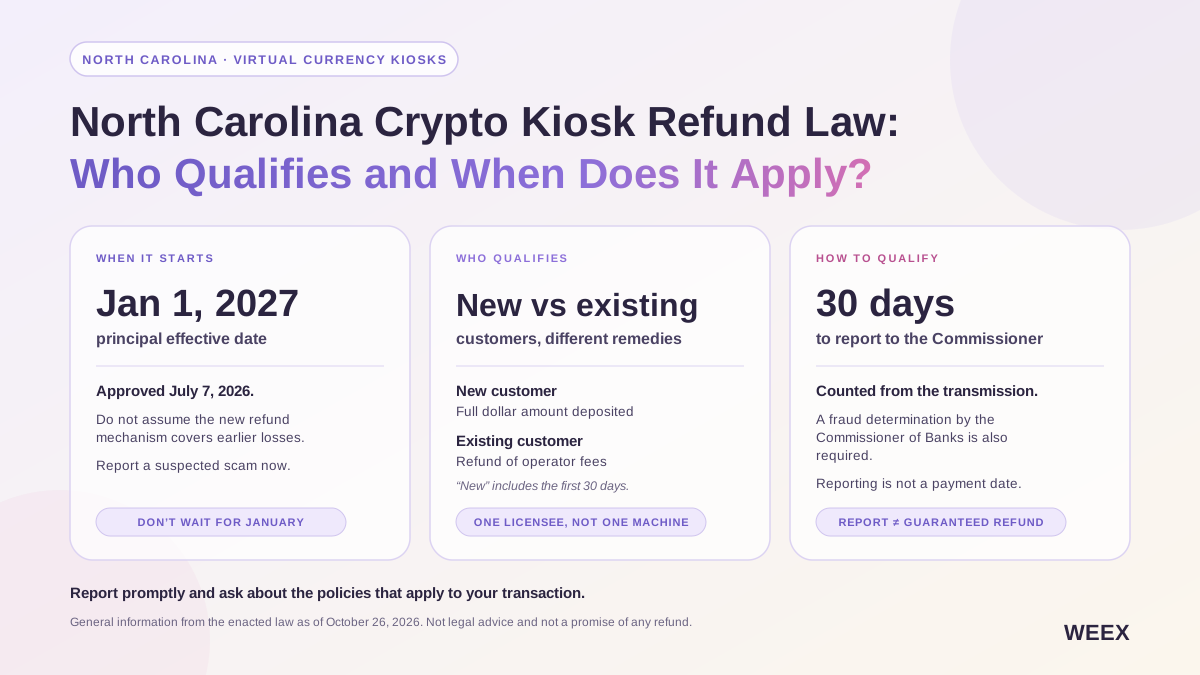
North Carolina Crypto Kiosk Refund Law: Who Qualifies and When Does It Apply?
Understand North Carolina’s crypto kiosk refund law: the January 2027 start date, who qualifies, reporting deadlines, and documents victims should keep.
US Startup Successfully Develops Artificial Gold, Highlighting Bitcoin Scarcity

Sam Price Claims Bitcoin Has Been Declared Dead Multiple Times

Mr&强 Analyzes Bitcoin Support and Resistance Areas

Franklin Templeton Launches Two Dividend Reinvestment Bitcoin ETFs

Interest on U.S. corporate bonds with CCC rating rises to 17.99 percent

LND Releases v0.21.5-beta.rc1 with Fee Estimate Limits

FOUNDATION Faces Spam Attack from Spoofed Domain Names
Bitcoin Core Changes Rules for Disclosing Security Vulnerabilities

New York Man Sentenced to 51 Months in Prison for Telecom Fraud and Money Laundering

[Bitcoin $0 Controversy②] "$0 is an Exaggeration"... Reasons Wall Street Disagrees

WEEX Exclusive:Gold Breaks Below $4,000, Bitcoin Pulls Back Below $80,000 | WEEX TradFi Daily(October 26, 2026)
Gold Breaks Below $4,000, Bitcoin Pulls Back Below $80,000 | WEEX TradFi Daily(October 26, 2026)
At the October 23 close, major indexes were mixed, with the Dow weaker. Brent crude rose to about $116.7, a near six-month high, and energy led; gold briefly fell below $4,000 as Bitcoin pulled back toward $80,000. Cybersecurity stocks strengthened last week, with CrowdStrike up nearly 12%. Markets are watching whether Bitcoin’s correction is nearing its end, along with earnings from Verizon, Cadence, Celestica and Amkor today.
Circle launches cirBTC for Ethereum and Arc with unified balance
Anthony Pompliano: The State Will Never Stop Printing Money! Bitcoin, Gold, and Land Will Benefit for 20 Years
Ansem is Bearish on Bitcoin and Ethereum, Market May Correct Before Rising
Leon Wankum Predicts Bitcoin Will Outgrow Real Estate Market
Blockstream Executive Peter Bain: Bitcoin Holding $81K Signals Bull Run
Bitcoin-to-Nasdaq Ratio Turns Bullish After 235 Sessions
Contents
Latest articles



Latest coin listings on WEEX


