
Tether launches offline AI speech model for smart glasses and robots

 Prefer us on Google



Tether has released a 254 million parameter speech recognition model that can transcribe conversations directly on smartphones, smart glasses and humanoid robots without sending audio to cloud servers.
Summary
- Tether has released TranscribePsy, a 254 million parameter AI model that processes speech locally on smartphones, smart glasses and humanoid robots without cloud access.
- The model transcribed 10 minutes of audio in 1.65 seconds on an iPhone 17 Pro Max and performed faster than several competing speech recognition systems in Tether's tests.
- TranscribePsy supports 25 European languages on laptops and eight on phones, with dedicated versions optimized for Apple's Neural Engine.
- The open source release is part of Tether's QVAC AI project, which focuses on running AI applications directly on consumer devices while keeping user data private.
According to an October 14 announcement from Tether AI Research, the open source model, called QVAC TranscribePsy, supports multilingual speech recognition and is designed to operate on devices with limited computing power.
The company said the model can transcribe 10 minutes of audio in 1.65 seconds on an iPhone 17 Pro Max using Apple's Core ML framework.
TranscribePsy is part of Tether's QVAC AI project, which focuses on running artificial intelligence applications locally. Its release gives developers access to speech recognition software that can operate without an internet connection.
For smart glasses, the model can process audio received over Bluetooth or Wi-Fi with minimal delay. Humanoid robots can run the software on their onboard processors, leaving computing capacity available for functions such as navigation, visual recognition and physical movement.
Tether said local processing could be useful in medical consultations, legal interviews, therapy sessions and journalism, where recordings may contain confidential information.
Tether's TranscribePsy model records strong benchmark results
In performance evaluations released by the company, TranscribePsy recorded an 8.02% word error rate on the Open ASR Leaderboard and 6.58% on Multilingual LibriSpeech.
Its word error rate on Common Voice was 21.56%, with Tether claiming the model outperformed other systems in the same parameter category.
The 254 million parameter model was compared against larger alternatives, including Qwen3-ASR-0.6B, omniASR-CTC-1B-v2, OWSM-CTC-v4 and Whisper-Medium.
Despite having fewer parameters, TranscribePsy performed better on the Multilingual LibriSpeech benchmark than several models three to four times its size, according to the research team's findings.
Tests conducted across six smartphones showed the model was 2.6 times faster than the next fastest system and 5.7 times faster than Whisper-small when running on phone CPUs.
Its iPhone optimized version required less than half the disk space and 1.7 times less memory than a competing Core ML model included in the evaluation.
Speech recognition accuracy was measured using word error rate, which compares the words generated by a transcription system against the original spoken content. Lower scores indicate fewer transcription errors.
Tether published the evaluation configurations alongside the model to allow researchers to reproduce the reported results.
Speech recognition software supports 25 European languages
TranscribePsy has been released in four versions designed for different hardware and language requirements.
One laptop model supports 25 European languages, while a smaller language configuration focuses on eight commonly used languages.
For mobile devices, Tether provides a GGUF version that operates through the parakeet.cpp engine in qvac-fabric-speech.
A separate Core ML version is optimized for Apple's Neural Engine, allowing compatible iPhones to perform transcription using dedicated hardware.
The models are designed to handle continuous audio, producing text shortly after speech is detected. Tether said the system could support voice controlled applications that respond without sending recordings to external servers.
According to the company, local speech processing reduces the need to transmit conversations that may contain personal or confidential information.
Paolo Ardoino, Tether's CEO, said the company wanted users to retain control over their conversations as voice enabled devices become more common.
"The future of AI shouldn't mean giving centralized platforms a front-row seat to our personal lives," Ardoino said.
He described TranscribePsy as an example of speech recognition technology that can operate entirely on personal devices without depending on centralized infrastructure.
TranscribePsy follows several releases under Tether's QVAC project during 2026.
In April, Tether introduced the QVAC SDK, an open source development toolkit for running AI applications on smartphones and computers.
As crypto.news previously reported, the toolkit supports iOS, Android, Windows, macOS and Linux, with functions covering text generation, speech processing, image recognition and translation.
The software uses QVAC Fabric, a customized version of llama.cpp, alongside Holepunch technology for peer to peer model distribution and delegated processing.
Before the SDK release, Tether had integrated BitNet LoRA into QVAC Fabric in March to support training and running large AI models on consumer hardware.
At the time, the company said it had fine tuned models containing up to 3.8 billion parameters on devices including the Pixel 9, Galaxy S25 and iPhone 16.
Its tests covered models with up to 13 billion parameters on the iPhone 16, while GPU processing delivered speed improvements ranging from two to 11 times compared with CPU baselines in the company's evaluations.
Tether's research into decentralized computing has extended beyond AI models.
In September, Ardoin disclosed progress on a peer to peer search engine designed to operate across distributed nodes.
The team had stored the complete Wikipedia archive across 100 nodes and demonstrated search functionality without relying on a centralized search service.
The search engine remains under development, with the team working on an architecture intended to support thousands of interconnected nodes.
Tether's earlier AI work included the QVAC Genesis I dataset, released in October 2025 with 41 billion synthetic tokens intended for training models in mathematics, science and technical reasoning.
Alongside the dataset, the company introduced QVAC Workbench, a consumer application that allows users to run supported AI models locally.
TranscribePsy released with open model weights
The latest TranscribePsy release is available under the Apache 2.0 license, with Tether identifying research and educational use as part of the release.
Developers can access the model weights, mobile GGUF builds, Apple Silicon Core ML versions and evaluation configurations.
Within the QVAC Psy ecosystem, the speech recognition software is intended to work with other specialized models, including VisionPsy, TranslatePsy-Nano and MedPsy.
Tether identified document analysis, translation, navigation and private note taking as possible applications for future integrations. The October release provides the speech recognition component, while those combined applications remain prospective.
The research team, operating under Tether Data, S.A. de C.V., said its continuing work covers compact models for processing audio, text, images and video on consumer devices.
-- Price
This content is provided for general informational purposes only and doesn't constitute financial, investment, legal, or tax advice. Any events, rewards, online promotions, or related information mentioned herein should not be considered a recommendation, solicitation, or invitation to purchase, sell, trade, or otherwise deal in any crypto assets. Crypto assets are highly volatile and may result in loss. The availability of WEEX services, products, and related events may vary by region. You are responsible for ensuring that your participation is in accordance with applicable local laws and regulations.
You may also like
Pump.fun 'optimized for addiction': what the internal messages cited in court really say
Rayls Bridges Traditional Finance and Decentralized Finance
The Week Ahead: 4 Key Moments for the Crypto Market
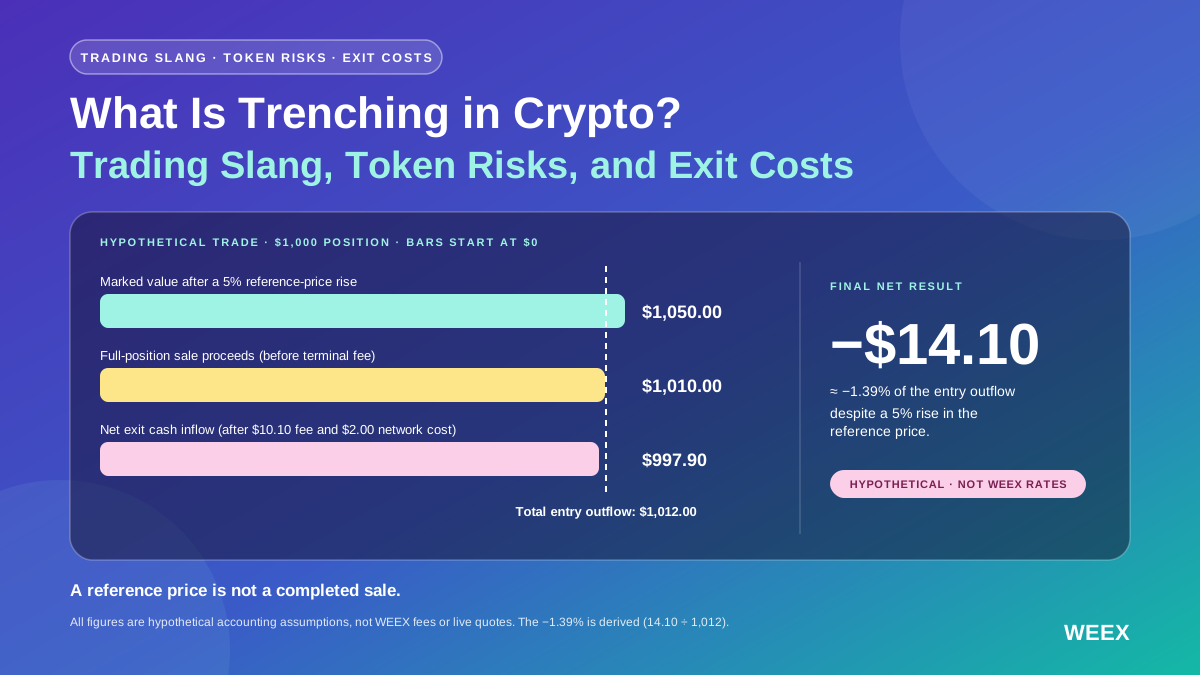
What Is Trenching in Crypto? Trading Slang, Token Risks, and Exit Costs
What is trenching in crypto? Learn the slang, token checks, liquidity risks, and how a rising token can still produce a loss after trading costs.
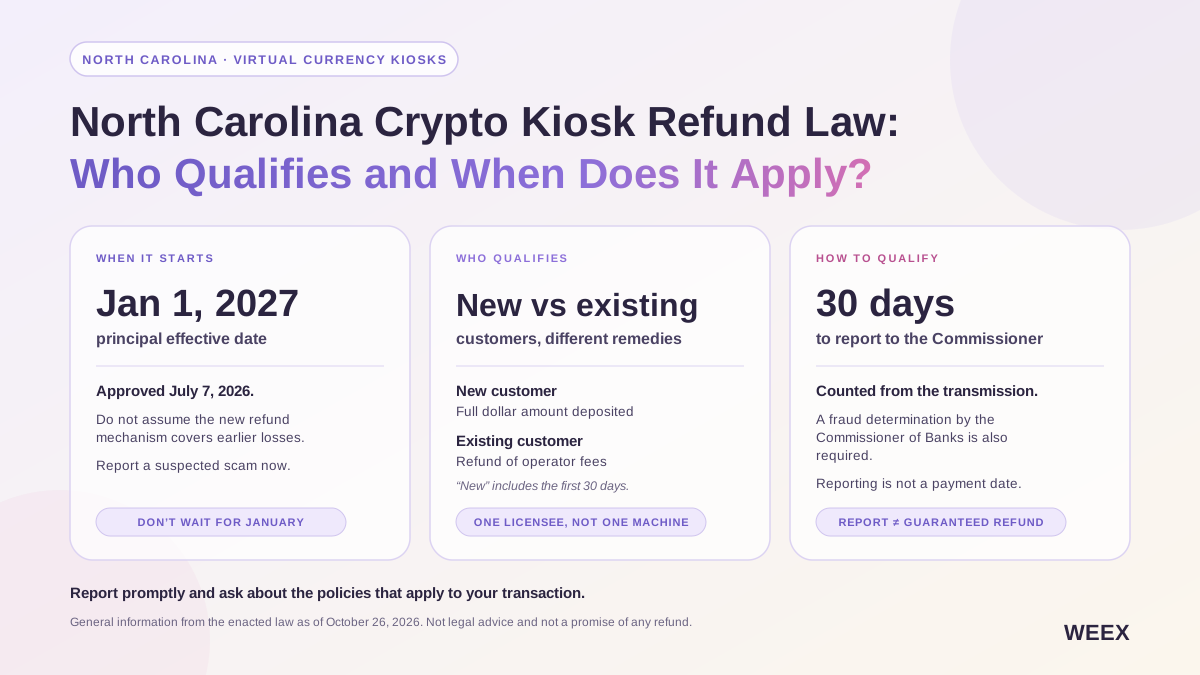
North Carolina Crypto Kiosk Refund Law: Who Qualifies and When Does It Apply?
Understand North Carolina’s crypto kiosk refund law: the January 2027 start date, who qualifies, reporting deadlines, and documents victims should keep.

[Bitcoin $0 Controversy②] "$0 is an Exaggeration"... Reasons Wall Street Disagrees
[ETH Letter] Meritz Securities Reviews Tokenization of Korean Securities Based on OP Stack

Progressive Party Opposes Further Delay of Cryptocurrency Income Tax
JPMorgan's Tokenized Fund on Solana: What MONY and JLTXX Mean for Institutional Adoption of RWA
Real and Fake Cryptocurrency Market Makers: What Makes a Market Maker Legitimate?
Michaël van de Poppe sees four crypto trends: AI, Ethereum, Sui, and digital assets
Coppock Curve and Crypto Trading: How to Use the Trend Reversal Indicator

Bitcoin Records U.S. Constitution Again... This Time with a Mysterious Code

Hedge funds hold $2 trillion in US debt, but their next trade could require fewer bonds
Weekly: $68,000 Theft from Ukrainian in Trust Wallet, Circle's Lawsuit Against Trump Over $2 Billion in UAE, and Historic Solana Update
ZachXBT Accuses CoinDCX of Losing $16 Million in Client Funds
NYSE’s owner is backing 24/7 stock tokens without Wall Street’s usual price rules
JPMorgan Now Offers Two Tokenized Money Market Funds on Solana
Follow the Money: $630 Million for Strive, Tether Activity and Attention to CeFi
HTX Research Analyst Chloe: Despite Significant Net Inflows into Bitcoin Spot ETFs, Macroeconomic Data Suppresses Rebound Potential
Killa: Frequent Short-term Trading Risks Missing Major Market Movements, Patience in Holding Positions is Important
China's fiscal revenue rose 5.1% by September, but land sales continue to decline
90% of Revenue from Meme Coins, Yet Valuation Rivals Pump: What Should Meteora Be Worth?
Former FTX Executive Slams Netflix's New Series: Turning Financial Fraud into a 'Romantic Film' is Absurd

Ripple teams up with $10B payments firm Arf to expand RLUSD use on XRPL

One billion dollars in three days is not enough. Bitcoin faces a significant challenge
WEEX Exclusive:Major Indexes Close Higher; Focus on TSLA, META Stock Earnings | WEEX TradFi Daily(October 22, 2026)
Major Indexes Close Higher; Focus on TSLA, META Stock Earnings | WEEX TradFi Daily(October 22, 2026)
The three major indexes closed higher on October 21, led by the Nasdaq. SpaceX beat earnings expectations and disclosed AI-business revenue; merger discussions with Tesla also helped lift AI and crypto-related stocks. Bitcoin traded near $84,000 and Ethereum near $2,470. LIT led majors on compliance-license expectations. On October 22, investors will watch Procter & Gamble, Southern Copper and Union Pacific before the open, followed by Western Digital and Newmont after the close.
Irish drug lord’s lost Bitcoin fortune comes back to life as $41 million moves to Coinbase
ZachXBT Reports on Cryptocurrency Laundering via FreedomXMR on Hyperliquid
Pump.fun 'optimized for addiction': what the internal messages cited in court really say
Rayls Bridges Traditional Finance and Decentralized Finance
The Week Ahead: 4 Key Moments for the Crypto Market
What Is Trenching in Crypto? Trading Slang, Token Risks, and Exit Costs
What is trenching in crypto? Learn the slang, token checks, liquidity risks, and how a rising token can still produce a loss after trading costs.
North Carolina Crypto Kiosk Refund Law: Who Qualifies and When Does It Apply?
Understand North Carolina’s crypto kiosk refund law: the January 2027 start date, who qualifies, reporting deadlines, and documents victims should keep.
[Bitcoin $0 Controversy②] "$0 is an Exaggeration"... Reasons Wall Street Disagrees





