
Post-Quantum Era Consensus Layer Divergence: Ethereum Maintains Decentralization, Monad Prioritizes Speed

 Prefer us on Google


Monad rushes into the post-quantum era: abandoning signature aggregation and using "vote counting" to maintain a 100-millisecond block time.
Written by: @r2Jamong
Compiled by: AididiaoJP, Foresight News
On October 27, Monad's developer Category Labs released Quantum Cadence—a post-quantum consensus protocol. It is the quantum-resistant version of Cadence, which is Monad's multi-proposer consensus protocol launched in July this year and has yet to go live on the mainnet.
Instead of being a mere product launch, this is more of a preview from Monad: a high-performance L1 chain that plans to embrace the post-quantum era.
Notably, Monad's approach is almost the opposite of Ethereum's. Ethereum aims to rebuild its signature packaging scheme, which is vulnerable to quantum computers, into a quantum-resistant form; Monad, on the other hand, completely removes the signature package from the consensus. Both chains operate in the same execution environment—EVM—so why is the divergence so drastic?
Signature Package: The Key to High-Performance Consensus
Currently, most high-performance blockchain consensus mechanisms rely on a mechanism called "quorum certificate" (QC). A QC is a bundle of signatures proving that at least two-thirds of validators have voted for the same block, with validators passing these signature packages among themselves. BLS signatures make this process inexpensive: hundreds of signatures can be aggregated into a single 96-byte signature.
The problem is that quantum computers can break BLS.
Quantum-resistant signatures are larger and cannot be aggregated. The strength of BLS is to compress hundreds of validators' signatures into a small 96-byte package, regardless of how many people vote, the same small package is transmitted. This does not work with quantum-resistant signatures: the NIST standardized ML-DSA-44 has a signature size of 2420 bytes, and no post-quantum signature can aggregate like BLS. Without the ability to compress into a small package, a "quorum certificate" can only list hundreds of signatures individually, resulting in a large list of several hundred KB. Monad requires a 100-millisecond block time, and broadcasting this for each slot would overwhelm the bandwidth.
Monad's Cadence aims for a block time of 100 milliseconds and allows multiple proposers to submit blocks simultaneously. It cannot afford to have each validator broadcast such certificates in every slot.
Monad's Solution: No Signatures, Just Count Votes
Monad did not wait for a smaller post-quantum aggregation scheme to emerge; instead, it directly removed the heavy signature package from the consensus. Each validator counts the votes they receive themselves and determines whether the quorum is reached. Security and liveness are built on authentication channels and hashes rather than signatures. Post-quantum signatures are retained for one purpose: to identify malicious validators. Each validator can sign votes at most twice per slot.
A paper published on October 23 conducted a simulation: 200 validators, 1Gbps link, fault-free path, and 5000-byte signatures. With 100 proposers, the uplink traffic for each validator actually decreased by 27%, from 772Mbps in the original Cadence to 561Mbps. The final confirmation time was 231 milliseconds, nearly identical to the original's 229 milliseconds.
Ethereum's Challenge is Decentralization, Monad's Challenge is Speed
As of early October, Ethereum had approximately 860,000 active validators. Anyone can join, making it unrealistic for such a decentralized group to count votes directly among themselves. Therefore, Ethereum chose to rebuild the signature package: replacing BLS with a hash-based leanXMSS and using SNARK to compress and aggregate those signatures that cannot be directly merged. Generating proofs takes time, but Ethereum's 12-second slot allows for absorbing this overhead.
Monad, in contrast, has a 100-millisecond slot interval, which cannot afford SNARK aggregation. The small set of 200 validators makes it possible for "everyone to count everyone's votes". In the face of quantum threats, Ethereum chose to preserve decentralization in its design, while Monad chose to prioritize speed.
-- Price
Post-Quantum Signatures are Not a Panacea
NIST has indeed standardized signature algorithms that can withstand quantum computers, but these standards cannot be applied unchanged to every network and scenario. In terms of blockchain consensus, switching to post-quantum signatures does not solve all problems. Each network must prepare for its own issues early, rather than waiting for others to provide solutions.
For Monad, the key to being quantum-resistant lies not in the signature algorithm but in addressing the problem at the consensus structure level—the structure based on exchanging certificates. Other blockchain networks face the same issues. EVM-compatible chains may borrow from Ethereum's results when migrating account signatures; however, the consensus layer is their own homework, and no one will do it for them.
Quantum computers that could threaten blockchain networks do not yet exist, with most predictions suggesting they will not appear until the early to mid-2030s. However, the remaining time is not ample. Even Ethereum anticipates that the transition for L1 alone will extend to 2029, while changes to the consensus structure can take several years from research to mainnet. This likely explains why Monad released the quantum-resistant version before Cadence even went live on the mainnet. The issue of being quantum-resistant cannot wait for others to set standards. It is a task that each network must complete independently within its own architecture.
This content is provided for general informational purposes only and doesn't constitute financial, investment, legal, or tax advice. Any events, rewards, online promotions, or related information mentioned herein should not be considered a recommendation, solicitation, or invitation to purchase, sell, trade, or otherwise deal in any crypto assets. Crypto assets are highly volatile and may result in loss. The availability of WEEX services, products, and related events may vary by region. You are responsible for ensuring that your participation is in accordance with applicable local laws and regulations.
You may also like

The Ghost Behind the Screen: Unveiling the Secret World of North Korean Hackers Lazarus

Bitcoin Miners Turn to AI: Escaping the Crypto Cycle, but Entering New Turbulence

Decoding Variational: How a No-Order-Book Exchange Became the Dragon Behind Hyperliquid?

Creators Speak | The Biggest Risk in the Crypto Industry is Thinking It's Safe
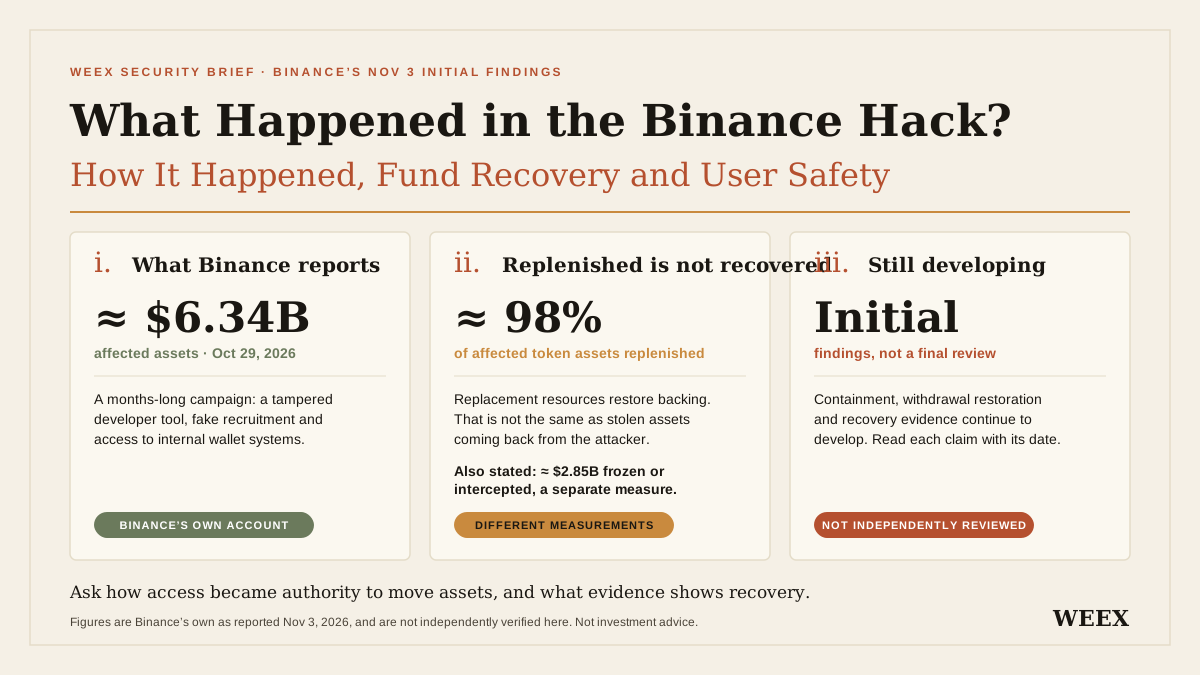
What Happened in the Binance Hack? How It Happened, Fund Recovery and User Safety
What happened in the Binance hack? Review the attack timeline, latest fund replenishment, recovery limits and practical steps to protect your account.

Who really controls a crypto project? Inside the SEC’s new guidance

Reflections After the Binance Heist: Who Should We Trust with Our Crypto Assets?

Solana study finds wider spreads outside aggregators at five of six sampled pools

Is it theft or fraud when the coins in the wallet remain but are changed to multi-signature by someone else?
Anthropic is Frenziedly Competing for Computing Power: $895.4 Billion Commitment, Even Old Coal Plants Are Not Spared

Tom Lee sees Ethereum's 4% drop post-Binance hack as bullish sign

Ornn, a Computing Power Trading Platform, Negotiates Series A Financing, Valuation May Exceed $1 Billion

Vitalik is making private Ethereum payments without a crypto website
Comparison of Security Among Four Perpetual DEXs: Who Can Truly Enable User Self-Rescue?

Is Issuing Tokens Still Necessary for Crypto Projects Focused on Revenue?

Will the Republican Party Lose the Elections? Cryptocurrencies May Benefit...

Nvidia May Guarantee Billion-Dollar AI Data Center Debt

Pi Network rolls out 4 developer updates ahead of November summit
DeFi DNS attack hits 12 sites as Blockaid flags Step Drainer

CDI was the only refuge in October: what this reveals

Binance Attacker Accidentally Transfers $3.5 Million in Tokens to NEWT Contract Address

The Golden Age of Hackers
Polkadot OpenGov #1961: dotUSD Supply Bug and $1.3M Treasury Loss Explained

A Review of Global CEX Theft Incidents from 2014 to 2026

Hackers drain 9,400 SOL from bot wallets, and a copied key is blamed

Google Cloud Previews Institutional Crypto Key-Security Service as Custody Risks Grow

a16z Survey of 100 CISOs: Why is Cybersecurity Budget Experiencing a 'Revenge' Growth in the AI Era?
Collector Crypt CEO: The Real Threshold of Digital Card Drawing Platforms Lies in These Four Aspects

U.S. Treasury Buys $6 Billion in Bonds, Bitcoin Drops Below $80,000

French Sovereign Debt Reaches 5%, Alarming Spread with Germany
The Ghost Behind the Screen: Unveiling the Secret World of North Korean Hackers Lazarus
Bitcoin Miners Turn to AI: Escaping the Crypto Cycle, but Entering New Turbulence
Decoding Variational: How a No-Order-Book Exchange Became the Dragon Behind Hyperliquid?
Creators Speak | The Biggest Risk in the Crypto Industry is Thinking It's Safe
What Happened in the Binance Hack? How It Happened, Fund Recovery and User Safety
What happened in the Binance hack? Review the attack timeline, latest fund replenishment, recovery limits and practical steps to protect your account.
Who really controls a crypto project? Inside the SEC’s new guidance
Contents
Latest articles



Latest coin listings on WEEX


