
Morpho RWA deposits pass $2B as loans approach $900 million

 Prefer us on Google


Morpho has passed $2 billion in deposits across its real-world asset lending markets, with outstanding loans approaching $900 million and tokenized credit and stock-backed borrowing available across its network.
Summary
- Private credit accounted for 58% of RWA deposits in CertiK's September snapshot of Morpho.
- Sentora's October research found substantial borrower concentration in several of Morpho's RWA collateral markets.
- Steakhouse Financial curated five Coinbase stock-token markets when they were examined in September.
- Robinhood Stock Token lending remains unavailable to US persons, according to Morpho's published announcement.
Morpho's RWA dashboard recorded $2.145 billion in total deposits and $894.18 million in outstanding loans in its Oct. 28 snapshot, covering markets that allow borrowers to obtain financing against tokenized assets.
Credit tokens hold large positions in Morpho RWA markets
In an Oct. 13 analysis using data through Sept. 26, blockchain security firm CertiK placed private credit at approximately 58% of Morpho's RWA deposits and 59% of active RWA loans. The firm recorded deposits of $1.58 billion and loans of $641 million at that point, compared with $1.07 billion and $411 million on July 1.
Sentora Research's separate examination of borrower positions on Oct. 1 identified PRIME, a token tied to home-equity lending, as Morpho's largest RWA collateral holding at $270 million. Its dataset placed PT-reUSD at $136 million, syrupUSDG on Robinhood Chain at $128 million, and Huma's payment-financing token PST at $103 million.
Combined, the four holdings represented $637 million, or approximately 57.9%, of the $1.10 billion in Morpho RWA collateral counted by Sentora. The calculation uses collateral values from that report, whose measurement covers pledged assets rather than the dashboard's total market deposits.
Borrower positions were concentrated within individual assets, according to the same research. The ten largest positions held 78% of PRIME collateral and 97% of PST collateral on Morpho, while a single position accounted for 81% of syrupUSDC collateral.
Curators set allocations and collateral pricing
Morpho's Midas customer case study describes how Steakhouse Financial helps structure lending against mF-ONE, a tokenized version of Fasanara's private-credit strategy. Eligible, whitelisted holders can borrow USDC against the token or use borrowed funds to purchase more mF-ONE, according to the case study.
Fasanara produces the strategy's net asset value under the pricing process described by Morpho. Midas then submits the valuation to eOracle for verification and publication, with Steakhouse applying market-level discounts used in setting liquidation parameters and borrowing limits.
In the case study, Midas CEO and co-founder Dennis Dinkelmeyer described the required infrastructure as "secure onchain liquidity and predictable infrastructure."
Steakhouse's role extends to tokenized equities. As crypto.news previously reported, Morpho had opened USDC lending markets for five Coinbase stock tokens by Sept. 18, covering Apple, Alphabet, Nvidia, Meta and SpaceX. Steakhouse curated all five markets and set their collateral requirements.
At that September snapshot, two Steakhouse High Yield USDC vaults supplied 98.9% of the dollars in the largest stock-token market, according to the report. Apple, Nvidia, Meta and SpaceX carried liquidation loan-to-value thresholds of 62.5%, while Alphabet's threshold stood at 77%.
Morpho's risk documentation assigns distinct responsibilities within its V2 vault structure. Curators configure adapters, allocation caps, fees, and gates, while allocators move funds among approved sources within those limits. Sentinels can reduce caps, cancel pending actions, and remove allocations in emergencies.
Liquidation depends on prices and available collateral buyers
According to Morpho's liquidation documentation, a borrowing position becomes eligible for liquidation when its loan-to-value ratio exceeds the market's prescribed threshold. The oracle price determines both the trigger and the exchange rate used when a liquidator repays debt in return for collateral.
The protocol's risk disclosures warn that collateral can fall below the outstanding debt before liquidators close a position. Morpho identifies oracle manipulation and faulty price feeds as potential causes of liquidations or bad debt, and says limited liquidity can prevent lenders from withdrawing supplied assets for a period.
Bitwise's Premium RWA AUSD vault disclosures separately identify valuation, custody, legal enforcement, and redemption risks in tokenized real-world assets. The disclosure says a rapid decline in collateral value can leave liquidation proceeds insufficient to repay loans, with bad debt allocated to depositors.
Stale oracle data can cause improper liquidations or prevent undercollateralized positions from being liquidated, the vault documentation warns. Its published terms tie returns to borrower demand and protocol utilization, with yields variable and potentially zero. The vault carries no FDIC or SIPC insurance.
-- Price
Stock-token loans carry product-specific access rules
Morpho launched Midnight on Base on July 21, introducing fixed-rate, fixed-term lending alongside its variable-rate markets. According to the launch coverage, borrowers and lenders can negotiate interest rates, maturity dates, and counterparties through a peer-to-peer matching system.
On Oct. 22, Robinhood confirmed stock-token borrowing through Morpho, allowing eligible holders to pledge tokens for stablecoin loans. Morpho's accompanying announcement said curators deploy the markets and set their parameters and compliance controls, with access excluded for US persons and people in other restricted jurisdictions.
Robinhood's developer documentation classifies its Stock Tokens as debt securities issued by Robinhood Assets (Jersey) Limited. The products provide economic exposure to underlying shares and exchange-traded funds without granting legal or beneficial rights in the underlying issuers.
Under Robinhood's published operating schedule, market makers can mint and burn Stock Tokens from Monday at 2 a.m. through Saturday at 2 a.m. Central European time, adjusted for daylight saving time. End users may continue buying and selling tokens onchain outside that window, subject to each asset's trading capabilities.
This content is provided for general informational purposes only and doesn't constitute financial, investment, legal, or tax advice. Any events, rewards, online promotions, or related information mentioned herein should not be considered a recommendation, solicitation, or invitation to purchase, sell, trade, or otherwise deal in any crypto assets. Crypto assets are highly volatile and may result in loss. The availability of WEEX services, products, and related events may vary by region. You are responsible for ensuring that your participation is in accordance with applicable local laws and regulations.
You may also like

Birch Hill Completes $4 Million Seed Round Financing Led by Multicoin Capital

A New Wave of TGE? 19 Projects Expected to Launch Intensively in Q4
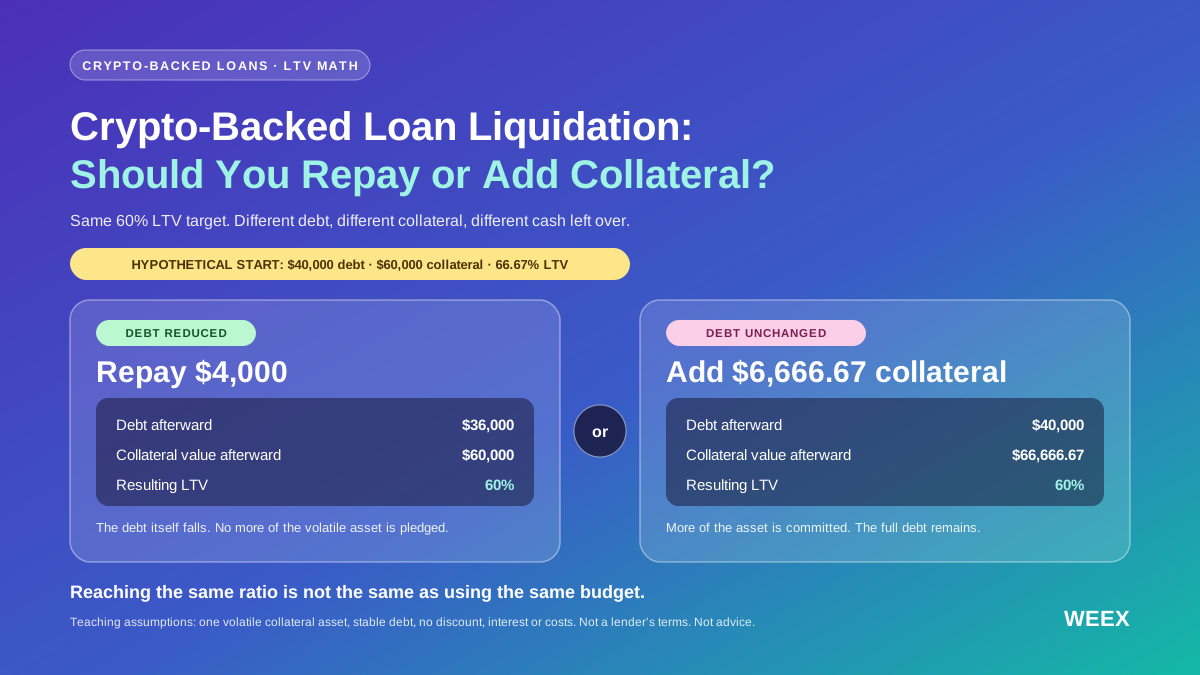
Crypto-Backed Loan Liquidation: Should You Repay or Add Collateral?
Facing crypto-backed loan liquidation? Compare repayment and collateral top-ups using equal budgets, LTV calculations, stress tests and protection limits.

Who Holds Tokenized Stocks? A Large Number of Retail Investors with Highly Concentrated Assets

Stablecoin Deposits in DeFi Grow to $24 Billion

Five DeFi Projects Under Observation: From Tiered Vaults to On-Chain Perpetual Order Books
[Column] Robinhood Chain: The Meme Coin Craze May Be Over, But Growth Continues

Weekly Highlights | Gold Drops Below $4000 During Golden Week, a16z Crypto Renamed to a16z Frontier

Lido Introduces Turbulence Controls Mechanism to Address Extreme Events
$1.2 Billion in Trading Volume Over 5 Days, TVL Only $11 Million: Why Metric is Worth Watching?

Robinhood Stock Tokens Access Morpho Lending Market

DeFi Gold Mining Guide: 5 Potential Projects to Watch

Ledger Wallet Launches Crypto Lending Feature, Supporting cbBTC and wBTC Collateral to Borrow USDC and USDT

Morpho P2P Order Functionality Supports Any Lending Asset
Lido’s proposed exits would pay lenders with borrower collateral

Five DeFi Projects Under Observation: From Tiered Vaults to On-Chain Perpetual Order Books

Institution Loses 973,000 MORPHO in Theft Worth Approximately $2.3 Million
DefiLlama and Trueo Launch Protocol Revenue and Vulnerability Probability Market

$800 Million Raised in Three Weeks, Yet 80% of Funds Are 'Lying Flat': How Much Real Demand Is There in the 'Giant Game' of OUSD?

Can UNI's Valuation Premium Hold Up After the Fee Switch Goes Live?

Bitcoin Holders Reach Record Lending Volume on Base

What Makes Spending on AI Agents Difficult?

Decline in Trading Activity for Robinhood Chain Meme Coins, On-chain Funds Flowing to Stablecoin Lending

Lido Introduces Fallback Exits Mechanism to Support Lenders in Withdrawing Collateral
Crypto wallets expand into DeFi hubs as swaps and yield move in-app
From Institutional Settlement to Open Ecosystem: Can Canton Replicate the Development Path of Robinhood Chain?

We Overestimate the Value of Stablecoin Issuance While Underestimating the Power of Localized Financial Services

10 news stories you need to know today: UK to keep seized BTC, financial privacy, and new AI...

Morpho Appoints Brian Foster to Lead Market Expansion

More than half of Ethena’s USDe backing is allocated to lending
Birch Hill Completes $4 Million Seed Round Financing Led by Multicoin Capital
A New Wave of TGE? 19 Projects Expected to Launch Intensively in Q4
Crypto-Backed Loan Liquidation: Should You Repay or Add Collateral?
Facing crypto-backed loan liquidation? Compare repayment and collateral top-ups using equal budgets, LTV calculations, stress tests and protection limits.
Who Holds Tokenized Stocks? A Large Number of Retail Investors with Highly Concentrated Assets
Stablecoin Deposits in DeFi Grow to $24 Billion
Five DeFi Projects Under Observation: From Tiered Vaults to On-Chain Perpetual Order Books


