
JCBA Organizes 347 Items for Management of Outsourced Cryptocurrency Assets, Establishing Key Management as an Independent Domain

 Prefer us on Google


Key Points of This Article
- JCBA publishes draft of security measures for outsourcing partners
- Five categories for handling private keys
- After soliciting opinions, revisions will consider trends in amended Financial Instruments and Exchange Act
Adapting Existing Guidelines from the Perspective of Outsourcing Partners
On the 20th, the Japan Cryptocurrency Business Association (JCBA) announced the establishment of a working group (WG) focused on managing outsourced operations related to cryptocurrency assets. They also published a draft of a "Practice Collection" summarizing the security measures that outsourcing partners should implement.
The focus is on cases where important systems such as wallets, key management, and transaction signature management are entrusted to external businesses. Existing guidelines, including the "Reoccurrence Prevention Inspection List Concept" from the Japan Virtual Currency Exchange Association (JVCEA), have been written for cryptocurrency exchange operators who outsource. The Practice Collection reinterprets these requirements from the perspective of what the outsourcing partners providing the systems should undertake.
The total number of items is 347. Each item is paired with examples of potential risks, points for verification, and examples of documentation that should be provided, described using vocabulary commonly used in audit practices.
Key Management, Signature Operations, and Five Provision Types
The scope of the organization covers ten areas, including governance, human and physical security, BCP (Business Continuity Planning), and management of subcontractors. Among these, the unique area of "key management and signature operations" is treated as an independent domain, addressing key generation and storage, separation of cold and hot wallets, and verification at the time of withdrawal.
The provision types for outsourcing partners are divided into five categories: "holding type," "intermediary type," "supply type," "reference type," and "other." Whether or not the private key is held and the extent of direct impact on the system serve as the criteria for classification. Guidelines for verification items for each type are provided to prevent excessive demands or omissions in verification. A "self-assessment sheet" that displays applicable items when a partner selects their type, and an "audit trail management ledger" for managing verification documents are included as Excel files.
JCBA points out that general third-party assurance reports like SOC2 cannot adequately evaluate the unique arrangements for managing the lifecycle of private keys. The aim is to create a foundation where stakeholders, including the Financial Services Agency and audit firms, can discuss using the same terminology by aligning the verification items that were previously disparate between exchange operators and outsourcing partners.
Background of Incidents Involving Outsourcing Partners
In the industry, the practice of outsourcing wallet management and signature systems to external specialized businesses has become established. JCBA recognizes that cyberattacks targeting such outsourcing partners and asset leaks have been frequent in recent years, stating that "strengthening the entire supply chain is an urgent task." While JCBA does not mention specific incidents, it notes that in May 2024, approximately 48.2 billion yen worth of Bitcoin (BTC) was leaked from DMM Bitcoin. The National Police Agency has identified the incident as being perpetrated by a North Korean hacker group, revealing that the attackers had contacted employees of a company that develops wallet management software.
The WG is chaired by Mayu Suda, a partner at PwC Japan LLC, and includes participants from wallet operators and audit firms. The draft will solicit opinions from exchange operators, wallet service providers, and audit firms, and will be revised considering the trends in the establishment of ordinances and guidelines under the amended Financial Instruments and Exchange Act. Opinions are accepted through a dedicated form on the JCBA website. The materials are available on the official JCBA website.
-- Price
This content is provided for general informational purposes only and doesn't constitute financial, investment, legal, or tax advice. Any events, rewards, online promotions, or related information mentioned herein should not be considered a recommendation, solicitation, or invitation to purchase, sell, trade, or otherwise deal in any crypto assets. Crypto assets are highly volatile and may result in loss. The availability of WEEX services, products, and related events may vary by region. You are responsible for ensuring that your participation is in accordance with applicable local laws and regulations.
You may also like

Treasury dealers' net bill holdings reach two-year high ahead of October 30
Circle launches cirBTC for Ethereum and Arc with unified balance

Anthony Pompliano: The State Will Never Stop Printing Money! Bitcoin, Gold, and Land Will Benefit for 20 Years

Ansem is Bearish on Bitcoin and Ethereum, Market May Correct Before Rising

Leon Wankum Predicts Bitcoin Will Outgrow Real Estate Market

Blockstream Executive Peter Bain: Bitcoin Holding $81K Signals Bull Run

Bitcoin-to-Nasdaq Ratio Turns Bullish After 235 Sessions

PHP Exploit Takes Down Government and Hospital Websites

Galaxy Believes Bitcoin Bear Market Ended in June, Recommends Buying and Holding

Empery Invests $65 Million to Acquire 25% Stake in AI Data Center
Bitcoin's next Fed test comes with a hidden problem in America's inflation data
The crypto market loses altitude, patience becomes a habit – Steady Lads

Bitcoin's flat trend vs. S&P 500 signals risk warning, says Bloomberg analyst

Cyberattack on GMO in Japan: Trading Accounts Compromised, GMO Coin Claims to be Unaffected

Mark Cuban compares Bitcoin to meme stocks
Electrum patches Bitcoin vulnerability allowing payment redirection
The Week Ahead: 4 Key Moments for the Crypto Market

Security Researcher Exploits PHP2Shell Vulnerability to Breach Bounty Website, Earns Approximately $2000 in Bitcoin Rewards
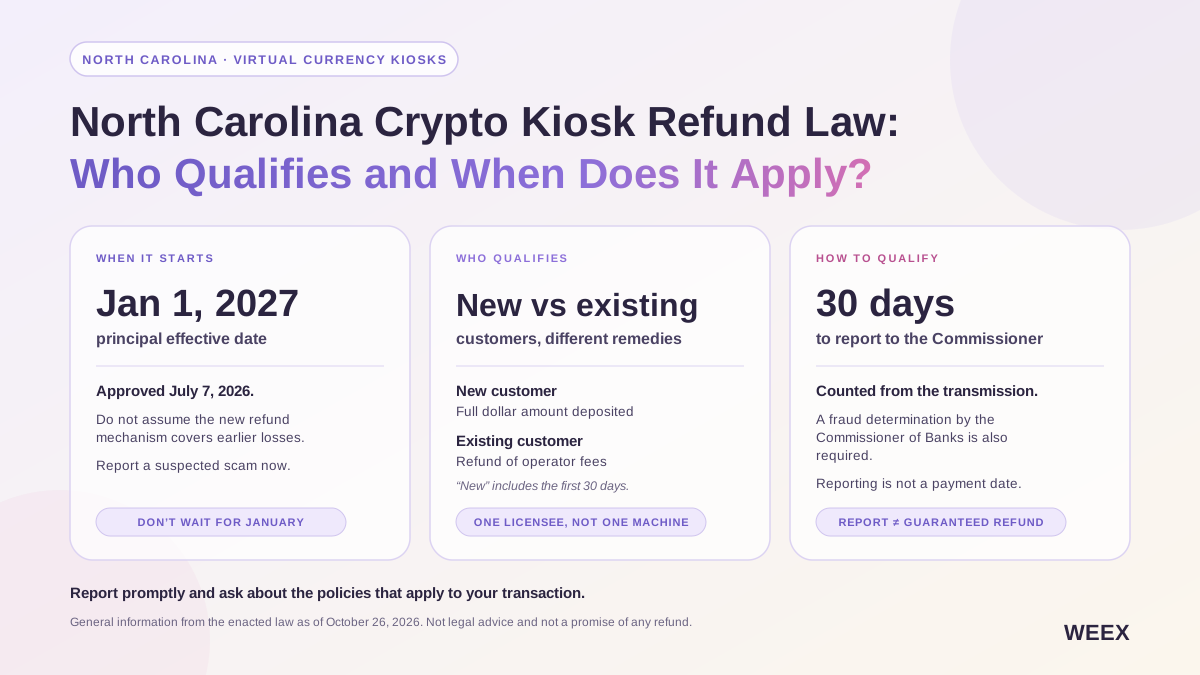
North Carolina Crypto Kiosk Refund Law: Who Qualifies and When Does It Apply?
Understand North Carolina’s crypto kiosk refund law: the January 2027 start date, who qualifies, reporting deadlines, and documents victims should keep.
US Startup Successfully Develops Artificial Gold, Highlighting Bitcoin Scarcity

Sam Price Claims Bitcoin Has Been Declared Dead Multiple Times

Mr&强 Analyzes Bitcoin Support and Resistance Areas

Franklin Templeton Launches Two Dividend Reinvestment Bitcoin ETFs

Interest on U.S. corporate bonds with CCC rating rises to 17.99 percent

LND Releases v0.21.5-beta.rc1 with Fee Estimate Limits

FOUNDATION Faces Spam Attack from Spoofed Domain Names
Bitcoin Core Changes Rules for Disclosing Security Vulnerabilities

New York Man Sentenced to 51 Months in Prison for Telecom Fraud and Money Laundering

[Bitcoin $0 Controversy②] "$0 is an Exaggeration"... Reasons Wall Street Disagrees

WEEX Exclusive:Gold Breaks Below $4,000, Bitcoin Pulls Back Below $80,000 | WEEX TradFi Daily(October 26, 2026)
Treasury dealers' net bill holdings reach two-year high ahead of October 30
Circle launches cirBTC for Ethereum and Arc with unified balance
Anthony Pompliano: The State Will Never Stop Printing Money! Bitcoin, Gold, and Land Will Benefit for 20 Years
Ansem is Bearish on Bitcoin and Ethereum, Market May Correct Before Rising
Leon Wankum Predicts Bitcoin Will Outgrow Real Estate Market
Blockstream Executive Peter Bain: Bitcoin Holding $81K Signals Bull Run
Contents
Latest articles



Latest coin listings on WEEX


