
Increase in Crypto-Backed Lending Amid Bear Market, A Funding Alternative to Selling = CryptoQuant

 Prefer us on Google



Increase in Borrowing During Bear Market
Crypto asset analysis firm CryptoQuant reported on the 2nd that it investigated the actions of whales (large holders) and individual investors during a bear market. They analyzed that there has been an increase in the number of investors who choose to borrow against their assets as collateral rather than selling them.
According to data from the cryptocurrency lending service "CoinRabbit," the average number of borrowings per investor has increased since the onset of the bear market in 2026 compared to the bull market in 2025.
Specifically, individual investors (retail) saw an increase of +74% (from 30.8 times to 53.5 times), while high-net-worth individuals (HNWI) increased by +18% (from 16.5 times to 19.4 times). This indicates a stronger trend of raising funds through borrowing instead of selling.
Additionally, CryptoQuant pointed out that the percentage of repeat borrowers has risen from 61.9% to 65.1%. For individual investors, the borrowing interval (the period from the last borrowing to the next borrowing) has nearly doubled (from 11 days to 21 days).
CryptoQuant analyzed that while individual investors are spacing out their borrowing intervals, there is a growing tendency for users to continue borrowing over a long period.
Changes in Collateral Assets
CryptoQuant also analyzed the assets used as collateral by high-net-worth individuals. The top asset is Bitcoin (BTC), followed by XRP, and third is Zcash (ZEC).
As for changes, the proportion of Bitcoin used as collateral by high-net-worth individuals has decreased from 57.8% to 30.5%, nearly halving. In contrast, the privacy-focused currency Zcash has surged from outside the top 10 to third place with 24.2%. Furthermore, Monero (XMR), Chainlink (LINK), and Cardano (ADA) have also increased. This indicates a diversification of collateral assets during the bear market.
CryptoQuant noted that the increase in Zcash as collateral is due to its price rising from $50 in September 2025 to the current $800. They analyzed that the variety of assets that high-net-worth individuals do not want to sell during a bear market has increased, leading to more assets being used as collateral for funding rather than selling.
On the other hand, the top collateral asset for individual investors remains XRP, followed by Bitcoin, and third is Ethereum (ETH). In 2026, a diverse range of altcoins (BNB, KAS, VELO, and others) have newly entered the top 10, broadening the scope.
CryptoQuant stated that the large proportion of collateral from XRP indicates the high enthusiasm of the individual investor community supporting this asset. The expansion of collateral assets during the bear market reflects the movement to raise cash using a more diverse range of assets without selling tokens while prices are stagnant.
From the above, CryptoQuant concluded that in a declining market, borrowing has become a viable means to continue investing. They stated that cryptocurrency holders are trying to navigate the bear market by using a wide range of assets they do not want to sell at low prices as collateral, avoiding panic selling.
-- Price
This content is provided for general informational purposes only and doesn't constitute financial, investment, legal, or tax advice. Any events, rewards, online promotions, or related information mentioned herein should not be considered a recommendation, solicitation, or invitation to purchase, sell, trade, or otherwise deal in any crypto assets. Crypto assets are highly volatile and may result in loss. The availability of WEEX services, products, and related events may vary by region. You are responsible for ensuring that your participation is in accordance with applicable local laws and regulations.
You may also like

Rayls Bridges Traditional Finance and Decentralized Finance

The Week Ahead: 4 Key Moments for the Crypto Market
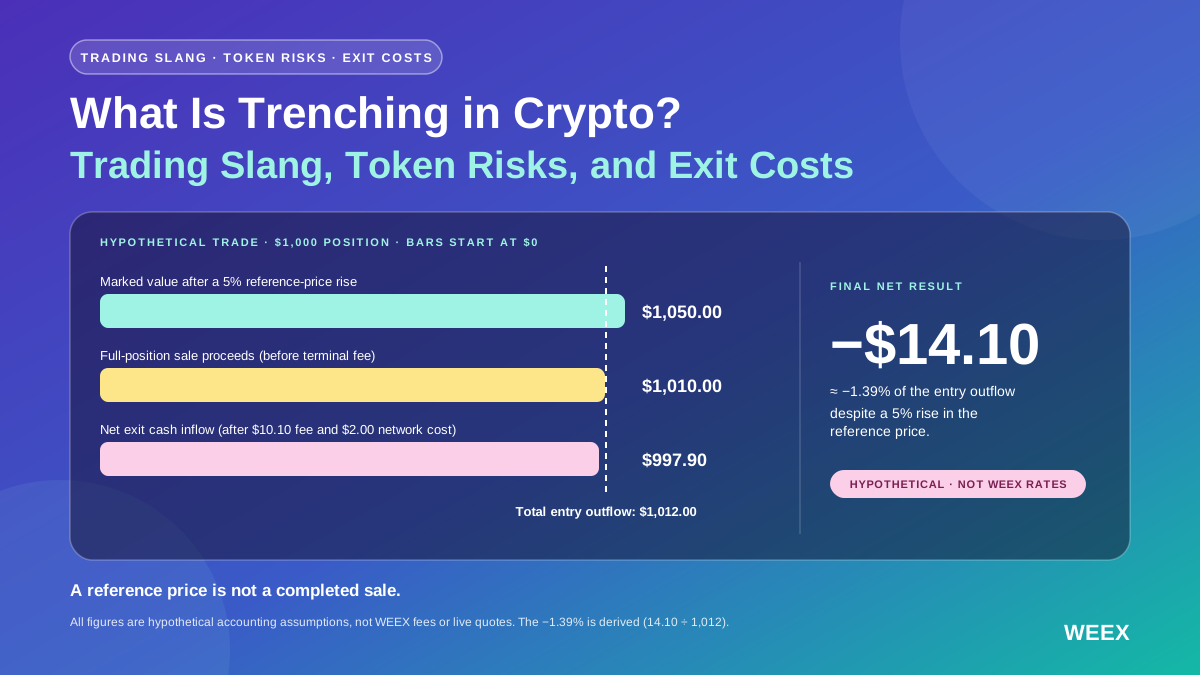
What Is Trenching in Crypto? Trading Slang, Token Risks, and Exit Costs
What is trenching in crypto? Learn the slang, token checks, liquidity risks, and how a rising token can still produce a loss after trading costs.
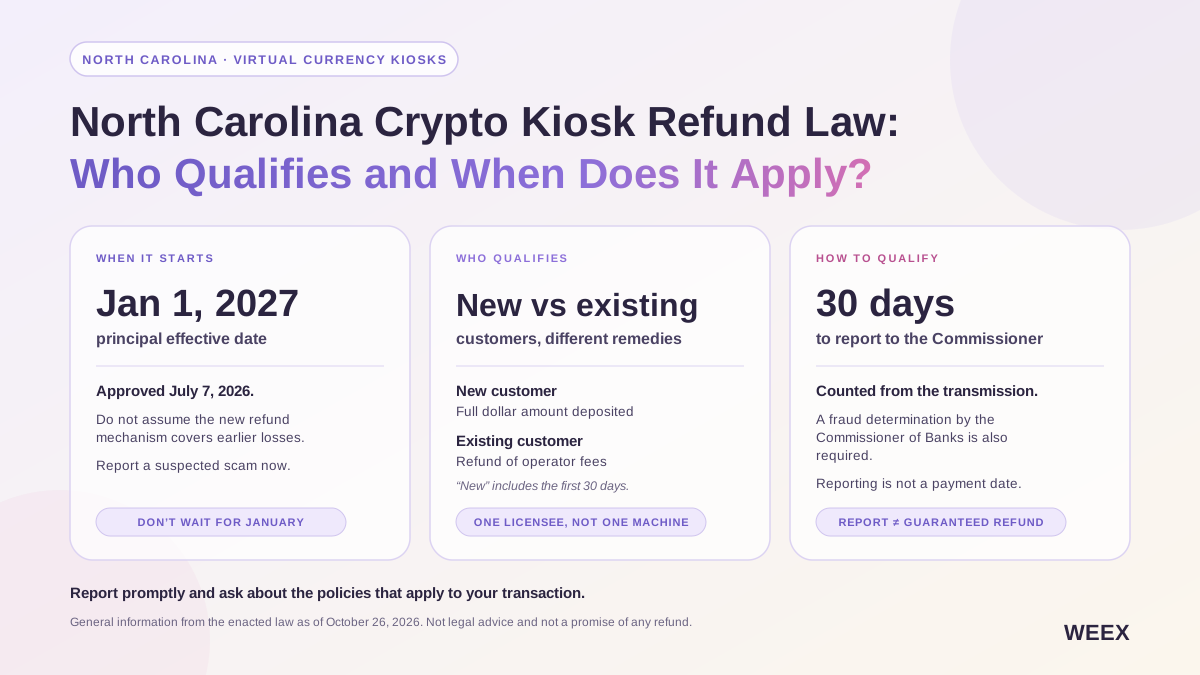
North Carolina Crypto Kiosk Refund Law: Who Qualifies and When Does It Apply?
Understand North Carolina’s crypto kiosk refund law: the January 2027 start date, who qualifies, reporting deadlines, and documents victims should keep.

[Bitcoin $0 Controversy②] "$0 is an Exaggeration"... Reasons Wall Street Disagrees
[ETH Letter] Meritz Securities Reviews Tokenization of Korean Securities Based on OP Stack

Progressive Party Opposes Further Delay of Cryptocurrency Income Tax

JPMorgan's Tokenized Fund on Solana: What MONY and JLTXX Mean for Institutional Adoption of RWA

Real and Fake Cryptocurrency Market Makers: What Makes a Market Maker Legitimate?

Michaël van de Poppe sees four crypto trends: AI, Ethereum, Sui, and digital assets

Coppock Curve and Crypto Trading: How to Use the Trend Reversal Indicator

Bitcoin Records U.S. Constitution Again... This Time with a Mysterious Code

Hedge funds hold $2 trillion in US debt, but their next trade could require fewer bonds
Weekly: $68,000 Theft from Ukrainian in Trust Wallet, Circle's Lawsuit Against Trump Over $2 Billion in UAE, and Historic Solana Update

ZachXBT Accuses CoinDCX of Losing $16 Million in Client Funds

NYSE’s owner is backing 24/7 stock tokens without Wall Street’s usual price rules

JPMorgan Now Offers Two Tokenized Money Market Funds on Solana
Follow the Money: $630 Million for Strive, Tether Activity and Attention to CeFi
HTX Research Analyst Chloe: Despite Significant Net Inflows into Bitcoin Spot ETFs, Macroeconomic Data Suppresses Rebound Potential
Killa: Frequent Short-term Trading Risks Missing Major Market Movements, Patience in Holding Positions is Important
China's fiscal revenue rose 5.1% by September, but land sales continue to decline

90% of Revenue from Meme Coins, Yet Valuation Rivals Pump: What Should Meteora Be Worth?
Former FTX Executive Slams Netflix's New Series: Turning Financial Fraud into a 'Romantic Film' is Absurd

Ripple teams up with $10B payments firm Arf to expand RLUSD use on XRPL

One billion dollars in three days is not enough. Bitcoin faces a significant challenge

WEEX Exclusive:Major Indexes Close Higher; Focus on TSLA, META Stock Earnings | WEEX TradFi Daily(October 22, 2026)
Major Indexes Close Higher; Focus on TSLA, META Stock Earnings | WEEX TradFi Daily(October 22, 2026)
The three major indexes closed higher on October 21, led by the Nasdaq. SpaceX beat earnings expectations and disclosed AI-business revenue; merger discussions with Tesla also helped lift AI and crypto-related stocks. Bitcoin traded near $84,000 and Ethereum near $2,470. LIT led majors on compliance-license expectations. On October 22, investors will watch Procter & Gamble, Southern Copper and Union Pacific before the open, followed by Western Digital and Newmont after the close.

Irish drug lord’s lost Bitcoin fortune comes back to life as $41 million moves to Coinbase

ZachXBT Reports on Cryptocurrency Laundering via FreedomXMR on Hyperliquid

Willy Woo: Good Time to Accumulate Bitcoin
Rayls Bridges Traditional Finance and Decentralized Finance
The Week Ahead: 4 Key Moments for the Crypto Market
What Is Trenching in Crypto? Trading Slang, Token Risks, and Exit Costs
What is trenching in crypto? Learn the slang, token checks, liquidity risks, and how a rising token can still produce a loss after trading costs.
North Carolina Crypto Kiosk Refund Law: Who Qualifies and When Does It Apply?
Understand North Carolina’s crypto kiosk refund law: the January 2027 start date, who qualifies, reporting deadlines, and documents victims should keep.
[Bitcoin $0 Controversy②] "$0 is an Exaggeration"... Reasons Wall Street Disagrees
[ETH Letter] Meritz Securities Reviews Tokenization of Korean Securities Based on OP Stack



