
Cryptocurrency exchanges to pay for losses from hacks? This country prepares penalties of up to 10% of revenue

 Prefer us on Google


South Korea wants to radically change the rules of liability in the cryptocurrency market. Exchange operators will have to compensate customers for losses caused by hacks and system failures, even if no fault is proven. Penalties of up to 10% of revenue may additionally apply for incidents resulting from breaches of security obligations. The project also includes restrictions on the stakes of owners of the largest platforms and new rules for token issuance.
Cryptocurrency exchanges in Korea. Operators will be liable for losses from hacks
The South Korean Financial Services Commission (FSC) presented today a draft law on innovations in the digital asset industry and user protection. The document aims to create a comprehensive legal framework for a market that has so far primarily operated based on regulations concerning the protection of exchange customers and anti-money laundering. In an official statement, the FSC outlined the assumptions of the new regulations.
The most important change is the introduction of a principle of compensatory liability for operators for user losses resulting from hacks, computer system failures, and similar incidents. The exchange will generally have to compensate for lost funds even if it is not proven that it acted intentionally or negligently. This is a significant change compared to the situation where the customer had to demonstrate that the damage was a result of the operator's error or oversight.
However, liability will not be unconditional. FSC materials indicate exceptions concerning, among other things, intentional actions or gross negligence by the user, as well as cases specified in the terms of the agreement. The final scope of these exclusions will depend on the wording of the adopted regulations.
Separate instruments will be additional monetary penalties of up to 10% of sales revenue. These can be imposed if a security incident arises from the operator's breach of obligations regarding the protection of information systems. Thus, the mere theft of funds as a result of an attack does not automatically mean such a sanction will be imposed.
Operators will also be required to implement internal control standards similar to those in traditional financial institutions. The new regulations will also cover monitoring of customer assets, maintaining records, and conducting periodic external audits. Users' funds must be separated from the assets of the exchanges, which is intended to increase their protection in the event of the operator's insolvency.
Upbit and Bithumb under pressure
The project sets a fundamental limit on the stakes of major shareholders of exchanges at 20%. However, the FSC may grant permission to increase the stake to 34%.
The restrictions will also apply to existing platforms, including the largest Korean exchanges Upbit and Bithumb. Operators will receive a three-year transition period, counted from the moment they are formally designated by the FSC as operators of digital asset platforms. For smaller and medium exchanges, this period may be extended by another three years, among other things due to capital acquisition needs.
The project does not provide for an automatic order to sell excess shares. However, the regulator will be able to issue corrective decisions and limit voting rights.
This change may affect the ownership structure of the local market. We wrote more about the problems of one of the largest Korean platforms in an article regarding Bithumb's erroneous settlement of Bitcoins.
Korea opens doors for stablecoins and ICOs
The project provides for the possibility of issuing stablecoins linked to the South Korean won. Initially, they may be created by consortia in which banks hold a majority stake. Technology and fintech companies will also be able to participate in such ventures, even as the largest single shareholder.
Issuers will be required to maintain reserves corresponding to at least 100% of the value of the issued tokens and ensure the possibility of redemption at face value. Foreign stablecoins, such as USDT, will also be able to be offered in the domestic market if they meet the regulator's requirements and are reported to the FSC. Issuers wishing to conduct direct issuance and redemption of tokens in Korea will also need to establish a local branch and obtain registration.
Another change is the allowance for domestic ICO offerings. Companies will be able to issue and sell tokens provided they prepare a whitepaper in advance and submit it to the regulator before starting to offer assets to investors. The document must include, among other things, information about the issuer, the purpose of the funds, the size of the issuance, and the risks of the project. After the submission is accepted and the document is published, a reflection period is provided before the tokens can be offered.
-- Price
Regulator will be able to freeze accounts for up to a year
The FSC also wants to expand oversight over market manipulation and the use of insider information. In the case of justified suspicion of unfair trading, the regulator will be able to suspend operations on the accounts of suspected individuals for up to six months based on a resolution. This measure can be extended once for another six months, meaning a maximum of 12 months of suspension of financial and cryptocurrency transactions.
The project also provides for the possibility of prohibiting individuals suspected of unfair trading from opening cryptocurrency accounts and conducting transactions. Such a restriction may last for up to five years.
However, the draft law does not mean that the new rules will come into force immediately. The document still needs to go through the South Korean parliament, where it may be amended. The final deadline for the entry into force of specific regulations will depend on the adopted text of the law and implementing regulations. Only after the legislative process is completed can the full extent of their impact on exchanges and other companies in the industry be determined.
This content is provided for general informational purposes only and doesn't constitute financial, investment, legal, or tax advice. Any events, rewards, online promotions, or related information mentioned herein should not be considered a recommendation, solicitation, or invitation to purchase, sell, trade, or otherwise deal in any crypto assets. Crypto assets are highly volatile and may result in loss. The availability of WEEX services, products, and related events may vary by region. You are responsible for ensuring that your participation is in accordance with applicable local laws and regulations.
You may also like
Tiger International's Q3 Customer Assets Surpass $64.8 Billion, Setting New Records in Hong Kong Market Net Inflows of Nearly $1 Billion

Submission of Supplementary Reports by 28 Virtual Asset Operators Completed

Former Pharmacist's $875 Million Startup Deal Quickly Goes Sour: Is This 'Acquisition Kill'?

Los Angeles-Long Beach Port Reaches Temporary Labor Agreement to Avert Strike Threat

American Bitcoin Subsidiary Secures $150 Million Credit Line with FalconX
Shenzhen Stock Exchange Introduces New Fee Reduction Measures, Expected to Benefit the Market by 1.39 Billion Yuan

White House Plans to Reduce Use of Special Government Employee Status, Involving Musk and David Sacks

Port Security Personnel at Los Angeles Reach Temporary Agreement to Avert Strike Threat
Follow the Money: Variational Raises $110 Million, Tether Activity and M&A Deals
US Data Center Construction Costs Surge 13% in 2026

South Korean lawmaker says blockchain could be the answer to ‘AI totalitarianism’

Mathematicians Disheartened by OpenAI Are Now Building Their Own AI Models from Scratch

Where is Nvidia Investing Its Money?
Ethereum Glamsterdam Upgrade May Be Delayed Until May 2027

UK Grid Reform Leads to Extended Project Connection Times

SpaceX's Two Major Business Growth Prospects Favorably Viewed by Wall Street! Starship Launch Economic Benefits Are Impressive, AI Data Center Investment Expected to Break Even in One Year
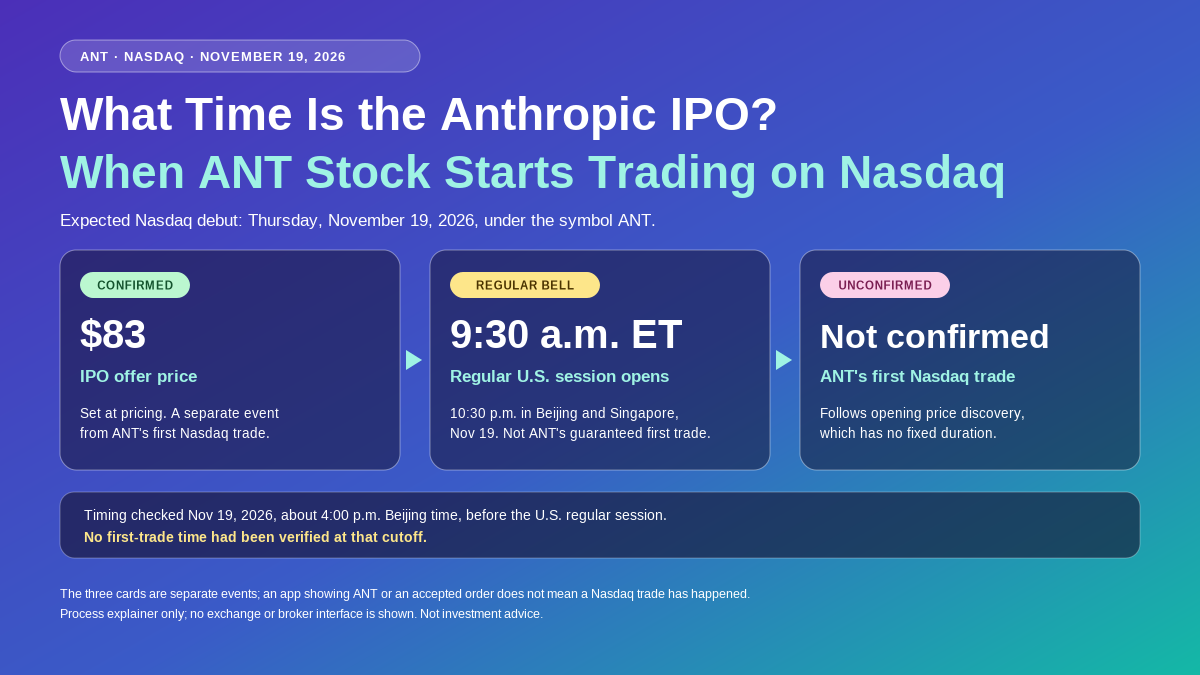
What Time Is the Anthropic IPO? When ANT Stock Starts Trading on Nasdaq
What time is the Anthropic IPO? Check ANT’s November 19 Nasdaq debut, global opening-bell times, the $83 offer price, and why orders may stay pending.
Solana co-founder pitches onchain basket to track global economy

Japan’s yen stablecoin issuer JPYC extends app outage with no recovery date

China Passenger Car Association: Negative Growth in Domestic Retail in November

Axe Compute Reports Q3 Revenue of $7.24 Million, Up 125% Quarter-over-Quarter, Cash Reaches $148 Million
Technical Failures Disrupt Key Systems in the U.S., from Flight Cancellations to Banking Delays

Further Arrests in the Zondacrypto Scandal. Prosecutor Talks About Three Individuals

Service Disruptions at Major U.S. Banks Affecting Customer Accounts and Payments

Shenzhen PCB Leaders Have Orders for High-End Products Until 2028

Orders for Diesel Generators Extended to October 2027
Trezor found implants in reseller wallets. What protects the buyer?

Why is the only spot Bitcoin ETF in continental Europe acquired by an Asian group, BIT?
Samsung Partners with Google to Challenge Meta's Monopoly in the AI Glasses Market
What Licenses Are Needed for Crypto Payments in Hong Kong?
Tiger International's Q3 Customer Assets Surpass $64.8 Billion, Setting New Records in Hong Kong Market Net Inflows of Nearly $1 Billion
Submission of Supplementary Reports by 28 Virtual Asset Operators Completed
Former Pharmacist's $875 Million Startup Deal Quickly Goes Sour: Is This 'Acquisition Kill'?
Los Angeles-Long Beach Port Reaches Temporary Labor Agreement to Avert Strike Threat
American Bitcoin Subsidiary Secures $150 Million Credit Line with FalconX
Shenzhen Stock Exchange Introduces New Fee Reduction Measures, Expected to Benefit the Market by 1.39 Billion Yuan
Latest articles


Latest coin listings on WEEX


