
Crypto rallies point to slower USDC growth and faster USDT growth, study finds

 Prefer us on Google


USDC and USDT supply can grow to meet different kinds of demand for dollar stablecoins, according to Coin Metrics research published Oct. 20. For Bitcoin investors, that complicates treating their combined issuance as a single pool of cash waiting to buy BTC.
The study associates stronger non-stablecoin crypto-market returns with slower USDC growth the following week and faster USDT growth. It also finds a lending-yield association specific to USDC. Those differences matter because a new dollar token can serve a borrower, a lender or someone staying in dollars before it ever reaches a Bitcoin trade.
Aggregate stablecoin supply measures tokens outstanding. The new findings give Bitcoin investors a reason to examine what those balances are doing before interpreting issuance as fresh spot-buying demand.
What USDC and USDT regressions show
The opposing return relationships show why issuer composition matters. Coin Metrics' study uses weekly observations over four years, testing six drivers from the previous week against subsequent supply growth. Higher perpetual-futures funding rates associate with faster growth for both issuers, accounting for about 10% of USDC's weekly supply-growth variation and 4% of USDT's after controls.
A separate analysis starting in 2023 uses the gap between lending protocol Aave v3's annual percentage yield, or APY, and a three-month Treasury yield. This carry spread adds significant explanatory information for USDC, but no meaningful increment for USDT or combined supply beyond funding.
The lagged issuer models account for about 13% of USDC's weekly ups and downs in supply growth and 16% of USDT's. None of the study's models accounts for more than 25%, leaving most movement unexplained. Those historical associations do not establish causation or test future Bitcoin returns.
A positive relationship for one issuer and a negative one for another can coexist inside the same total.
Collateral demand is especially relevant to the inference. A trader needing dollar-denominated collateral and an investor choosing to hold dollar balances can both contribute to demand for stablecoins. The same aggregate reading can therefore sit alongside different investor intentions.
Where new stablecoins can go
Circle's description of USDC minting starts with a customer depositing dollars and receiving newly issued tokens. Redemption takes tokens out of circulation.
Tether describes uses that include payments and exiting market positions. A holder retaining stablecoins after reducing risk has made a different decision from one buying Bitcoin, even if both need the same dollar token.
Lending creates another destination. Aave explains that supplied assets enter liquidity pools, earn interest and can serve as collateral.
Existing tokens can also move between holders without new issuance, separating growth in circulation from trading activity.
That distinction also applies to exchange reserves. CryptoSlate's July 20 analysis used stablecoin balances at Binance and Bybit to assess liquidity available for Bitcoin purchases. Those venue balances are closer to a trading location than total circulation, but an exchange deposit is still an intermediate step, not a completed purchase.
Aave rates show why the timestamp matters
Aavescan's Ethereum v3 USDC and USDT dashboards show how quoted supply annual percentage rates (APRs) vary between live readings and daily snapshots. The historical comparison below uses midnight UTC observations from Oct. 19.
The Aave quotes can be set beside FRED's Treasury observation for the same calendar date:
| Market or benchmark | Annualized quote | Quotation basis |
|---|---|---|
| Aave v3 Ethereum USDC | 11.5% | Supply APR, midnight UTC |
| Aave v3 Ethereum USDT | 3.1% | Supply APR, midnight UTC |
| Three-month Treasury constant maturity | 4.27% | DGS3MO, investment basis |
The Aave rows exclude historical incentives. The Treasury entry is the DGS3MO investment-basis series, distinct from DTB3's 4.1% discount-basis quote. It is a different benchmark, not a direct conversion of the same bill observation.
TreasuryDirect defines investment yield as annualized simple interest without compounding. This puts the comparison alongside Aave's quoted APR without adding compounding to either side. Matching dates still does not synchronize observations, match holding periods or reproduce the study's historical APY-based carry calculation.
USDC's 11.5% midnight snapshot is a point-in-time quote. Aavescan's methodology explains that snapshots can miss intraday changes; interest-index growth measures accrual over an interval.
A yield comparison also leaves the underlying risks intact. Aave documents smart-contract, oracle, collateral and network risks.
The combined USDC and USDT figure describes potential dollar liquidity with several possible jobs. Connecting issuance to destination and execution is what would show how much of it is becoming a Bitcoin bid.
-- Price
This content is provided for general informational purposes only and doesn't constitute financial, investment, legal, or tax advice. Any events, rewards, online promotions, or related information mentioned herein should not be considered a recommendation, solicitation, or invitation to purchase, sell, trade, or otherwise deal in any crypto assets. Crypto assets are highly volatile and may result in loss. The availability of WEEX services, products, and related events may vary by region. You are responsible for ensuring that your participation is in accordance with applicable local laws and regulations.
You may also like

Rayls Bridges Traditional Finance and Decentralized Finance
The Week Ahead: 4 Key Moments for the Crypto Market
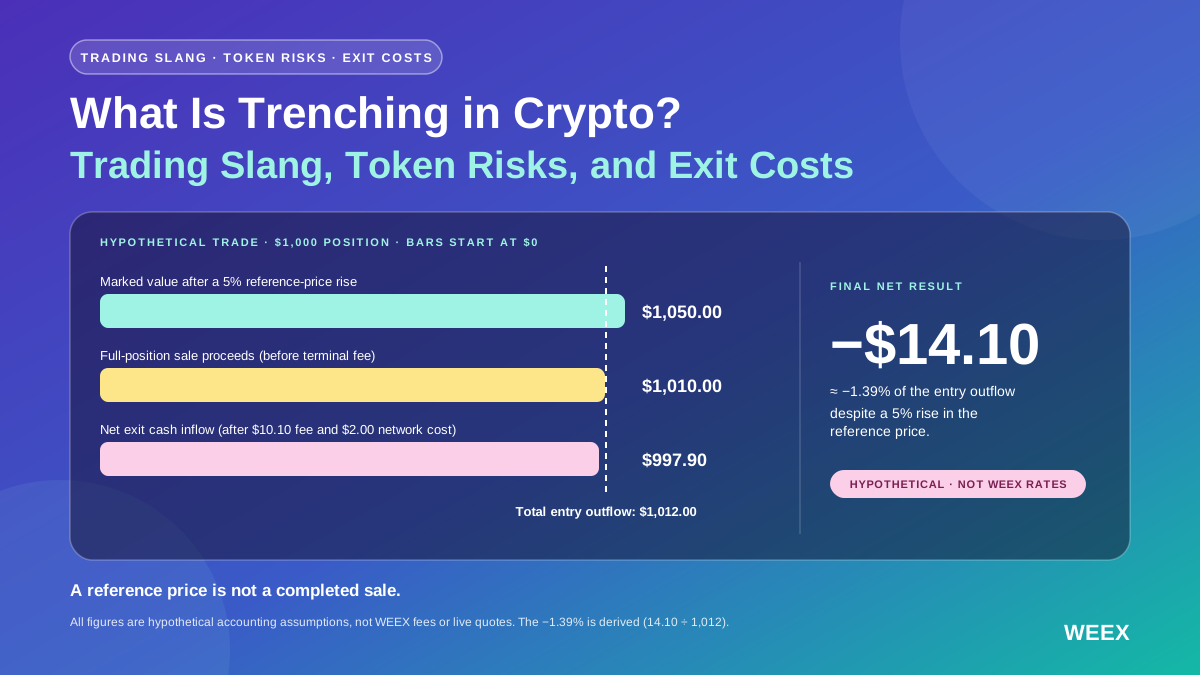
What Is Trenching in Crypto? Trading Slang, Token Risks, and Exit Costs
What is trenching in crypto? Learn the slang, token checks, liquidity risks, and how a rising token can still produce a loss after trading costs.
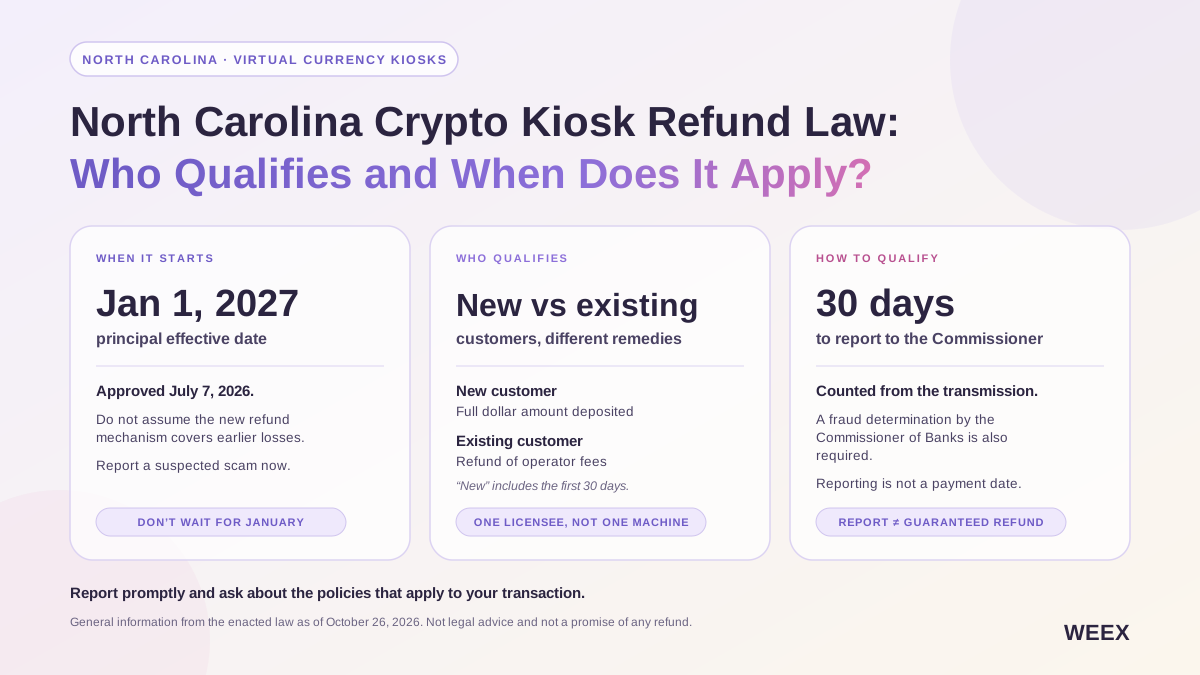
North Carolina Crypto Kiosk Refund Law: Who Qualifies and When Does It Apply?
Understand North Carolina’s crypto kiosk refund law: the January 2027 start date, who qualifies, reporting deadlines, and documents victims should keep.

[Bitcoin $0 Controversy②] "$0 is an Exaggeration"... Reasons Wall Street Disagrees

[ETH Letter] Meritz Securities Reviews Tokenization of Korean Securities Based on OP Stack

Progressive Party Opposes Further Delay of Cryptocurrency Income Tax

JPMorgan's Tokenized Fund on Solana: What MONY and JLTXX Mean for Institutional Adoption of RWA

Real and Fake Cryptocurrency Market Makers: What Makes a Market Maker Legitimate?

Michaël van de Poppe sees four crypto trends: AI, Ethereum, Sui, and digital assets

Coppock Curve and Crypto Trading: How to Use the Trend Reversal Indicator

Bitcoin Records U.S. Constitution Again... This Time with a Mysterious Code

Hedge funds hold $2 trillion in US debt, but their next trade could require fewer bonds
Weekly: $68,000 Theft from Ukrainian in Trust Wallet, Circle's Lawsuit Against Trump Over $2 Billion in UAE, and Historic Solana Update

ZachXBT Accuses CoinDCX of Losing $16 Million in Client Funds

NYSE’s owner is backing 24/7 stock tokens without Wall Street’s usual price rules

JPMorgan Now Offers Two Tokenized Money Market Funds on Solana
Follow the Money: $630 Million for Strive, Tether Activity and Attention to CeFi
HTX Research Analyst Chloe: Despite Significant Net Inflows into Bitcoin Spot ETFs, Macroeconomic Data Suppresses Rebound Potential
Killa: Frequent Short-term Trading Risks Missing Major Market Movements, Patience in Holding Positions is Important
China's fiscal revenue rose 5.1% by September, but land sales continue to decline

90% of Revenue from Meme Coins, Yet Valuation Rivals Pump: What Should Meteora Be Worth?

Former FTX Executive Slams Netflix's New Series: Turning Financial Fraud into a 'Romantic Film' is Absurd

Ripple teams up with $10B payments firm Arf to expand RLUSD use on XRPL

One billion dollars in three days is not enough. Bitcoin faces a significant challenge

WEEX Exclusive:Major Indexes Close Higher; Focus on TSLA, META Stock Earnings | WEEX TradFi Daily(October 22, 2026)

Major Indexes Close Higher; Focus on TSLA, META Stock Earnings | WEEX TradFi Daily(October 22, 2026)
The three major indexes closed higher on October 21, led by the Nasdaq. SpaceX beat earnings expectations and disclosed AI-business revenue; merger discussions with Tesla also helped lift AI and crypto-related stocks. Bitcoin traded near $84,000 and Ethereum near $2,470. LIT led majors on compliance-license expectations. On October 22, investors will watch Procter & Gamble, Southern Copper and Union Pacific before the open, followed by Western Digital and Newmont after the close.

Irish drug lord’s lost Bitcoin fortune comes back to life as $41 million moves to Coinbase

ZachXBT Reports on Cryptocurrency Laundering via FreedomXMR on Hyperliquid

Willy Woo: Good Time to Accumulate Bitcoin
Rayls Bridges Traditional Finance and Decentralized Finance
The Week Ahead: 4 Key Moments for the Crypto Market
What Is Trenching in Crypto? Trading Slang, Token Risks, and Exit Costs
What is trenching in crypto? Learn the slang, token checks, liquidity risks, and how a rising token can still produce a loss after trading costs.
North Carolina Crypto Kiosk Refund Law: Who Qualifies and When Does It Apply?
Understand North Carolina’s crypto kiosk refund law: the January 2027 start date, who qualifies, reporting deadlines, and documents victims should keep.
[Bitcoin $0 Controversy②] "$0 is an Exaggeration"... Reasons Wall Street Disagrees
[ETH Letter] Meritz Securities Reviews Tokenization of Korean Securities Based on OP Stack



