
BTC Only 1.5% Monetized, Expanding Native Financial Experiments

 Prefer us on Google


The discussion around monetizing Bitcoin (BTC) holdings is shifting from centralized lending to on-chain finance. However, BTC itself lacks a fundamental staking yield structure like Ethereum (ETH), leading to different trust assumptions for wrapped assets, Layer 2, and staking protocols.
Castle Labs defined BTC as an asset focused on price exposure in an analysis published on August 7. At that time, Castle Labs estimated BTC's market capitalization at approximately $1.3 trillion, with 311,000 BTC generating revenue, accounting for about 1.5% of the total active supply.
According to CoinMarketCap on the 30th, BTC's market capitalization was reported at $1.582 trillion. Although the asset size has increased since the benchmark period set by Castle Labs, the concern remains that the monetization structure has not kept pace with this growth.
Castle Labs outlined the monetization pathways for BTC as follows: centralized lending, expression assets like WBTC, cbBTC, tBTC, LBTC, BTC Layer 2, and BTC native finance. Centralized lending carries risks associated with custodianship and counterparty risk. Expression assets involve custodians, bridge signers, and smart contracts to use BTC on other chains.
In this structure, users gain revenue opportunities but must accept risks different from directly holding BTC. The conservative design of the Bitcoin network enhances security and censorship resistance but makes it challenging to layer Ethereum-style DeFi functionalities directly.
Bitcoin Layer 2 and staking protocols are attempts to bridge this gap. Castle Labs believes that due to Bitcoin's proof-of-work (PoW), UTXO structure, limited scripting, and long block intervals, it is difficult to directly embed complex DeFi state machines into BTC L1. The market is moving in a way that keeps BTC as close to a single chain as possible while attaching separate execution environments or staking structures.
DeFiLlama reported the total TVL of the Bitcoin chain at $4.075 billion as of the 30th. On the same screen, the TVL for Babylon Protocol was $3.049 billion, while Lombard was reported at $688.14 million. This differs from Castle Labs' reported BTC-related DeFi TVL of about $5.2 billion, which has different aggregation scopes and timings.
Stacks (STX) is cited as a representative case of BTC native finance. Stacks announced the completion of the PoX-5 hard fork on July 30. This upgrade opened a structure that locks BTC into the Bitcoin main chain and receives BTC-denominated yields through protocol bonds combined with STX.
Stacks describes this structure as Bitcoin staking that operates without bridges, wrapping, or slashing. The first genesis bond will start at Bitcoin block 966,350. Stacks indicated in an announcement on August 11 that the target date for reaching this block is around September 10, and the first cycle will be a restricted structure involving only pre-approved institutions.
This is not an immediate public opening but a phase to validate a bonding cycle with actual capital. Stacks has also issued related announcements regarding Fordefi, BitGo, and HashKey Cloud at the end of August. This is interpreted as a trend to move BTC native finance into practical use by attaching institutional custody and operational infrastructure.
Other solutions are also being pursued. The Babylon document explains that BTC can be staked natively without bridging to other chains. At the same time, it noted that if validators act maliciously, some BTC may be slashed.
Lombard's document stated that $3 billion worth of BTC has been onboarded. LBTC yields come from a covered call strategy managed by Bitwise Investment Managers, with a target net APY of 2.5% described as a variable target rather than a guarantee.
In comparison, Ethereum's official staking page indicated that as of the 30th, 34% of the total ETH is staked, with the current APR at 2.5%. BTC does not have a similar basic yield structure.
This difference aligns with the previous trend where the focus of blockchain revenue models is shifting towards application fees and user flows. As chains face pressure to explain revenue structures beyond simple processing infrastructure, the BTC ecosystem seeks financial utilization methods that do not significantly undermine its security model.
Market reactions have not flowed in one direction. Discussions on the Stacks forum regarding SIP-045 included positive opinions about significant opportunities, alongside counterarguments expressing concerns about increased issuance, inflation burdens, and undermining trust among long-term holders. While the demand to transform BTC from a speculative asset into a usable asset has been confirmed, the acceptance of what trust structures and token designs will be adopted remains a topic of debate.
The first genesis bond of Stacks is expected to start at Bitcoin block 966,350, projected to be reached around September 10. The first cycle will proceed with a structure involving only pre-approved institutions.
-- Price
This content is provided for general informational purposes only and doesn't constitute financial, investment, legal, or tax advice. Any events, rewards, online promotions, or related information mentioned herein should not be considered a recommendation, solicitation, or invitation to purchase, sell, trade, or otherwise deal in any crypto assets. Crypto assets are highly volatile and may result in loss. The availability of WEEX services, products, and related events may vary by region. You are responsible for ensuring that your participation is in accordance with applicable local laws and regulations.
You may also like

Aave Advances Native Bitcoin Collateral Proposal

Native Bitcoin collateral on Aave triggers WBTC pool deficit

Babylon Labs Proposes Adding Native Bitcoin as Collateral in Aave V4

Best Bitcoin staking platforms in 2026: BTC yield compared

Rialo eyes South Korea as institutions look to move financial services onchain

Solv Raises $25 Million, Stuck with 50 Bitcoins

The End of an Ideal: Why the Crypto Industry is Heading Towards Homogenization?

How Stacks plans to build the home of Bitcoin-native finance

The generation that grew up with cryptocurrencies is investing like their grandparents

HashKey Cloud and Cactus Custody Form Strategic Partnership to Create Institutional-Grade Staking Services

What is restaking and how EigenLayer turns staked ETH into shared security

HSBC: 45% of wealthy investors to increase crypto exposure in 12 months
2-Year-Old Girl Dies in Villa Gesell, Investigation Underway: Her Mother Had Been Acquitted in the Deaths of Two Other Daughters

UPBIT will list Babylon (BABY) and support the KRW market
Babylon Foundation: Will deposit 3 million USDT into Aave to show support for DeFi

Bitcoin's next Fed test comes with a hidden problem in America's inflation data
The crypto market loses altitude, patience becomes a habit – Steady Lads

Stablecoin Payments in Europe: How Do CASP, PI, and EMI Fit Together?
Why 22 Trillion-Dollar Giants Refuse to be 'Tokenized'?

Rayls Bridges Traditional Finance and Decentralized Finance

Is 24/7 Trading a Necessity? Analyzing the Real Trading Rhythm of RWA Perpetual Contracts

Cyberattack on GMO in Japan: Trading Accounts Compromised, GMO Coin Claims to be Unaffected

Elon Musk's Grand Scheme to Undermine New Cloud Providers

Google Earnings on Oct 28: Will the Fed Decision Move GOOGL Stock?
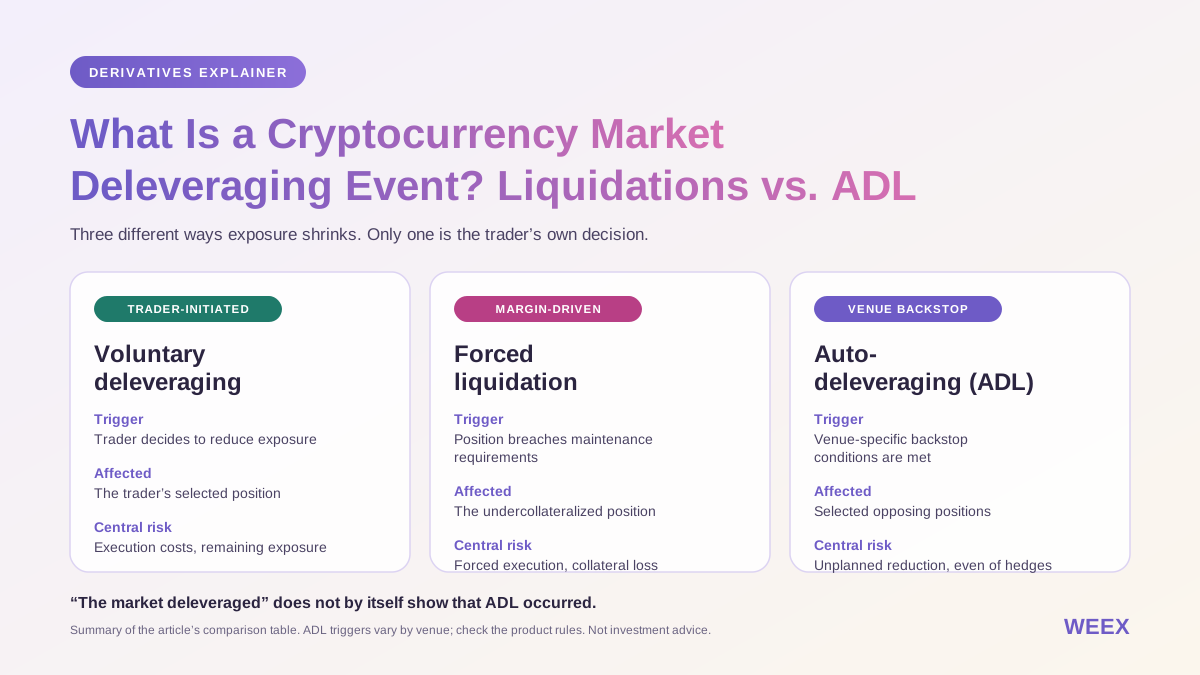
What Is a Cryptocurrency Market Deleveraging Event? Liquidations vs. ADL
Understand a cryptocurrency market deleveraging event: liquidation vs. ADL, misleading open-interest declines, hedge risks, and checks before trading.

The Week Ahead: 4 Key Moments for the Crypto Market

Do Prediction Markets Actually Bring Utility? – Tiger Research

Who Holds Tokenized Stocks? A Large Number of Retail Investors with Highly Concentrated Assets
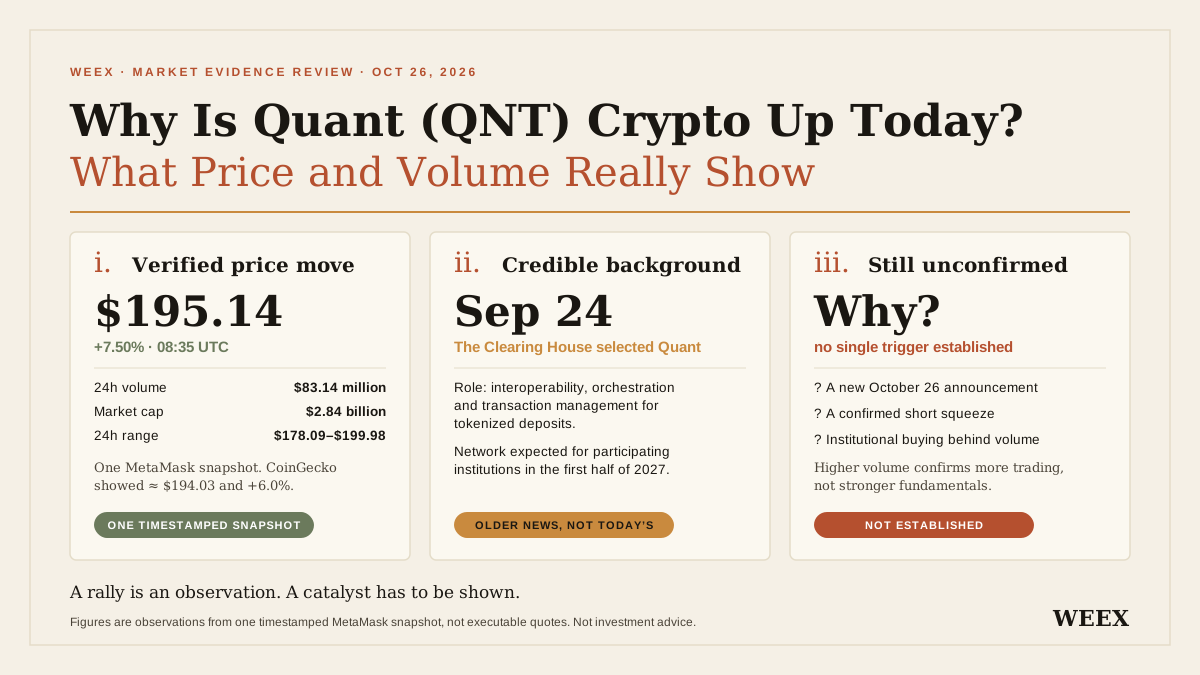
Why Is Quant (QNT) Crypto Up Today? What Price and Volume Really Show
Why is Quant (QNT) up today? Review price and volume evidence, the banking partnership timeline, token-demand assumptions, and risks before trading.
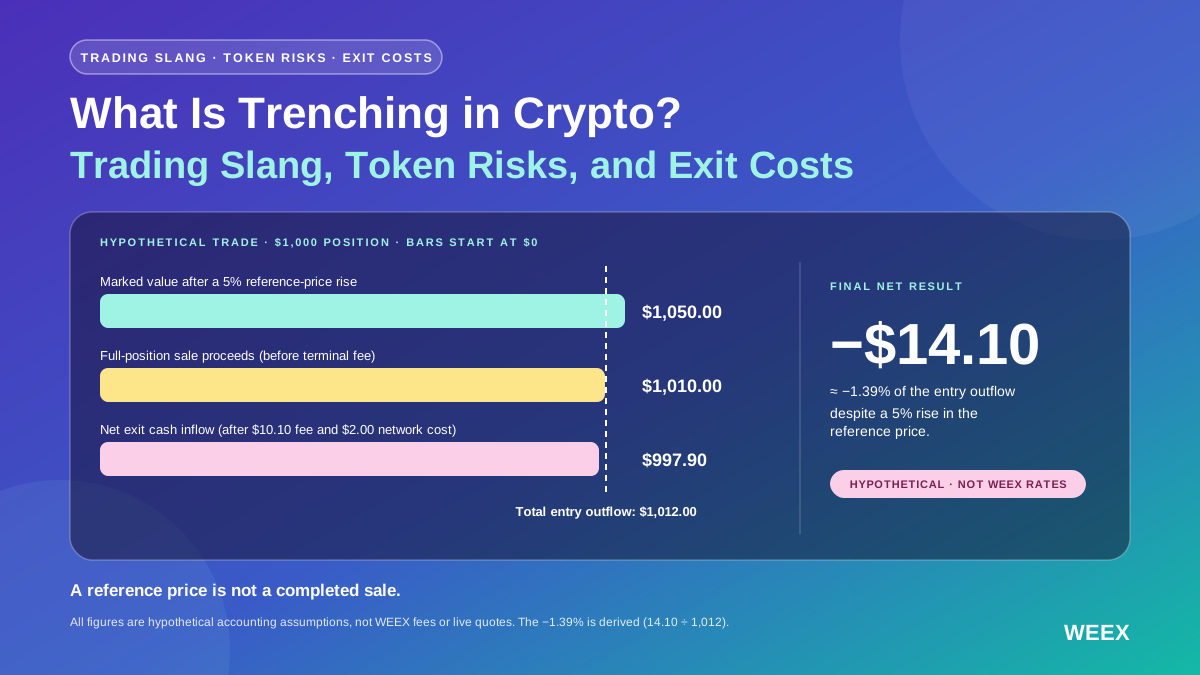
What Is Trenching in Crypto? Trading Slang, Token Risks, and Exit Costs
What is trenching in crypto? Learn the slang, token checks, liquidity risks, and how a rising token can still produce a loss after trading costs.
Aave Advances Native Bitcoin Collateral Proposal
Native Bitcoin collateral on Aave triggers WBTC pool deficit
Babylon Labs Proposes Adding Native Bitcoin as Collateral in Aave V4
Best Bitcoin staking platforms in 2026: BTC yield compared
Rialo eyes South Korea as institutions look to move financial services onchain
Solv Raises $25 Million, Stuck with 50 Bitcoins


