
10-Year Yield Plummets 17 Basis Points in a Week! AI Trading Turmoil Rekindles Safe-Haven Attributes of U.S. Treasuries

 Prefer us on Google


Last week, the 10-year yield dropped 17 basis points in a single week, marking the first such decline since the tariff storm in April 2025, coinciding with a drop in tech stocks.
Written by: Long Yue, Wall Street Insights
Last week, as market concerns about the prospects of leading AI companies intensified, the 10-year U.S. Treasury yield fell approximately 17 basis points, while the Nasdaq 100 index plummeted 5.5% during the same period. The last time yields and the tech stock benchmark index experienced such a synchronized decline in the same week was during the tariff storm in April 2025.
In recent months, U.S. Treasuries have nearly lost their traditional hedging function during periods of stock market pressure. Now, the turmoil in AI trading has brought a turning point to this situation.
Cracks in AI Emerge, Changing Debt Market Logic
The core narrative driving this round of debt market rebound comes from the loosening of AI trading itself.
Signs of slowing revenue growth at Anthropic and the continued decline in bond prices of AI cloud computing provider CoreWeave have led the market to question whether the AI boom that drove the significant drop in the debt market is showing cracks.
In recent months, the AI investment frenzy has suppressed U.S. Treasuries from two directions: on one hand, large-scale AI infrastructure construction has boosted the economy, and increased chip demand has intensified inflationary pressures; on the other hand, companies have flooded into the credit bond market to finance AI projects, competing for funds with U.S. Treasuries. According to Bloomberg data, the issuance of investment-grade corporate bonds has increased by about 29% compared to the same period last year, with tech giants being the main issuers.
Afonso Borges, a fixed income strategist at Julius Baer, wrote in a report: "An AI-led economic downturn will be closer to a traditional negative demand shock," and will serve as a catalyst for declining inflation. He pointed out that in such scenarios, "mid-term U.S. Treasuries should be able to once again play an effective portfolio hedging role." The bank thus recommends an overweight position on mid-term durations, citing data that shows 10-year U.S. Treasuries consistently recorded positive returns during stock market corrections from 2000 to 2020.
John Briggs, head of North American interest rate strategy at Natixis, explained this logic from a supply perspective: "If investors find that the AI-related bonds they hold are depreciating, their willingness to purchase new bonds will decrease. This reduces the short-term impact of AI issuances on the market, resulting in more funds flowing into long-end U.S. Treasuries and alleviating concerns about supply crowding out."
Short Covering Amplifies the Rally
This round of debt market rebound is not solely driven by safe-haven demand; the positioning structure also plays a significant role.
According to Bloomberg, last week’s rally in the debt market was boosted by a large-scale short covering by CTA (Commodity Trading Advisor) funds—these funds previously held exceptionally aggressive short positions in U.S. Treasuries. The buying pressure from short covering further amplified the downward movement of yields and significantly increased the bidirectional risk in the debt market.
James Athey, a portfolio manager at Marlborough Investment Management, quoted Mark Twain’s famous saying: "To paraphrase Mark Twain, the rumors of the death of U.S. Treasuries have been greatly exaggerated."
Rate Hike Expectations Cool, but Discrepancies Remain
The influx of safe-haven funds has also somewhat offset the pressure from inflation data on the debt market.
Last week’s consumer price data exceeded expectations, briefly pushing the market’s probability expectation for a rate hike by the Federal Reserve this month to about 50%. However, as stock market sell-offs intensified, this probability quickly retreated.
Federal Reserve Chairman Warsh later appeared at the IMF annual meeting, but aside from reiterating the Fed’s commitment to achieving price stability, he did not comment on the direction of monetary policy or economic outlook. The market currently still expects the Fed to raise rates once more this year and to tighten again in 2027.
Steven Barrow, head of G-10 strategy at Standard Bank, characterized this round of debt market rebound as a "red herring"—a misleading signal. He pointed to the inflation risks ahead and the structural trend of funds migrating from sovereign bonds to equity assets over the long term.
The sharp rise in oil prices last Friday also indicated risks: driven by the war situation in Iran, oil prices surged, reigniting inflation concerns, and U.S. Treasuries and U.S. stocks weakened simultaneously—President Trump’s push for Russian diesel to enter the global market faced scrutiny, causing crude oil prices to suddenly spike around midday.
-- Price
Long-Term Investors' Perspective
For short-term traders, the outlook is filled with uncertainty.
Masahiko Loo, a senior fixed income strategist at State Street Investment Management in Tokyo, pointed out that Warsh’s monetary policy style, which does not provide forward guidance—this is a core principle of his policy framework—makes the market more susceptible to significant price fluctuations.
However, he also stated that for long-term investors, "the situation is different." "If a larger-scale AI-driven risk-averse market emerges, U.S. Treasuries appear increasingly capable of providing the hedging function that investors have been missing for the past few years."
This content is provided for general informational purposes only and doesn't constitute financial, investment, legal, or tax advice. Any events, rewards, online promotions, or related information mentioned herein should not be considered a recommendation, solicitation, or invitation to purchase, sell, trade, or otherwise deal in any crypto assets. Crypto assets are highly volatile and may result in loss. The availability of WEEX services, products, and related events may vary by region. You are responsible for ensuring that your participation is in accordance with applicable local laws and regulations.
You may also like

Pump.fun 'optimized for addiction': what the internal messages cited in court really say

Rayls Bridges Traditional Finance and Decentralized Finance
The Week Ahead: 4 Key Moments for the Crypto Market
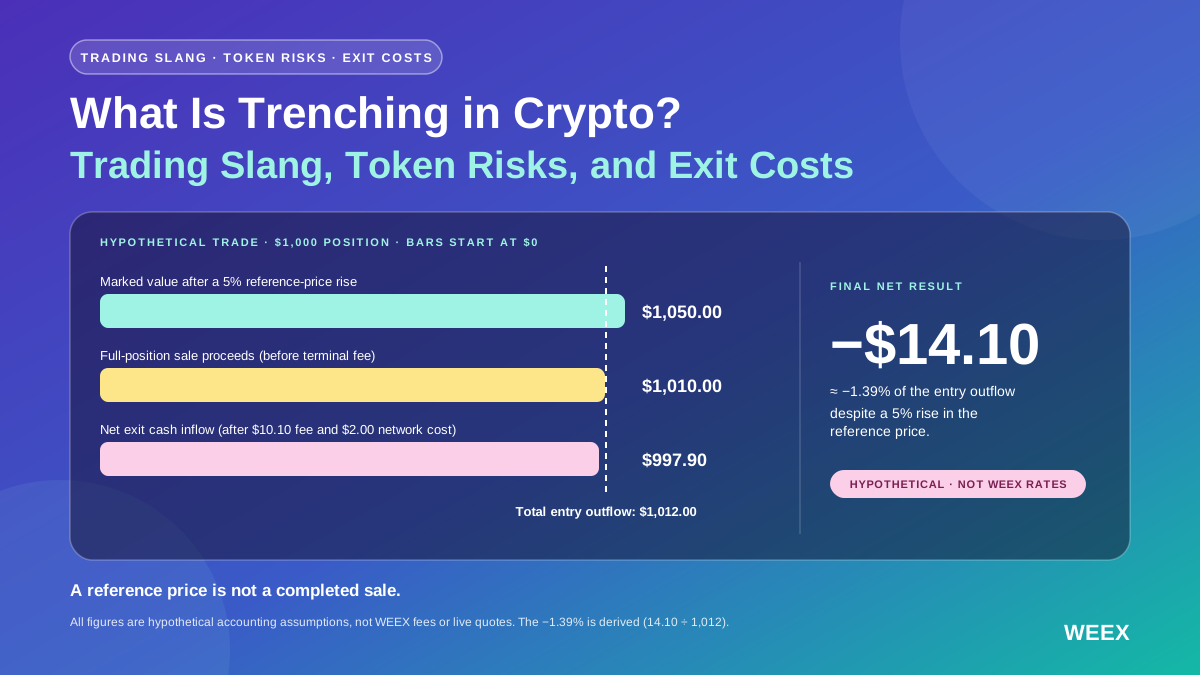
What Is Trenching in Crypto? Trading Slang, Token Risks, and Exit Costs
What is trenching in crypto? Learn the slang, token checks, liquidity risks, and how a rising token can still produce a loss after trading costs.
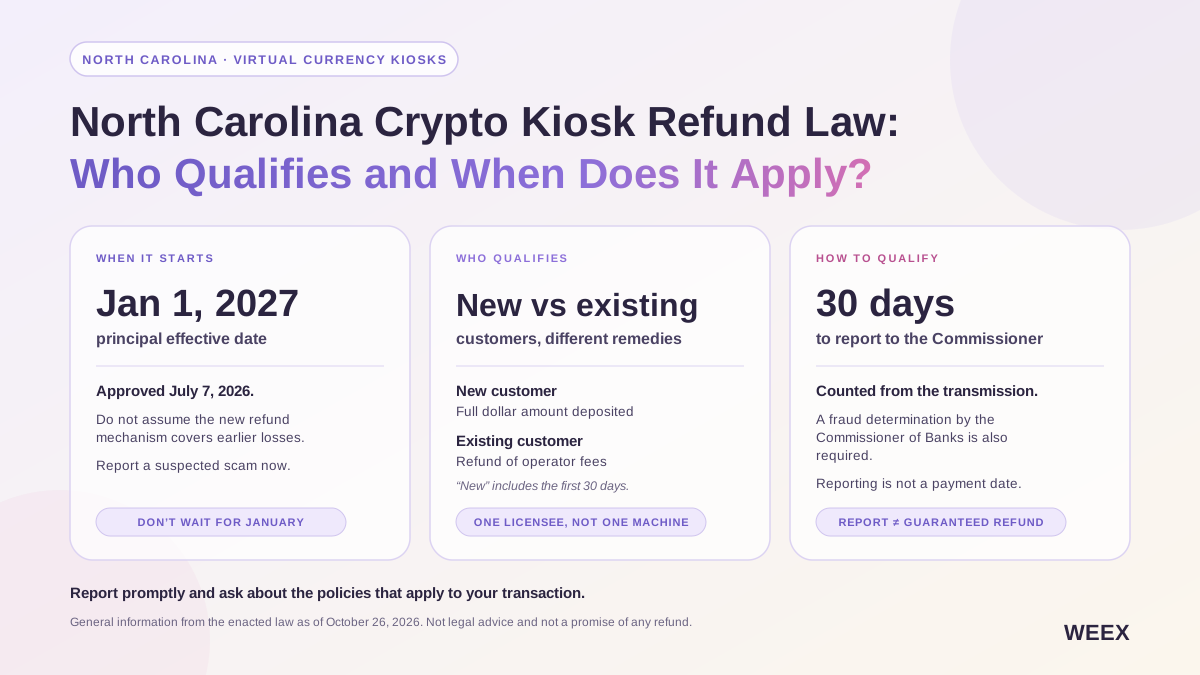
North Carolina Crypto Kiosk Refund Law: Who Qualifies and When Does It Apply?
Understand North Carolina’s crypto kiosk refund law: the January 2027 start date, who qualifies, reporting deadlines, and documents victims should keep.

[Bitcoin $0 Controversy②] "$0 is an Exaggeration"... Reasons Wall Street Disagrees
[ETH Letter] Meritz Securities Reviews Tokenization of Korean Securities Based on OP Stack

Progressive Party Opposes Further Delay of Cryptocurrency Income Tax

JPMorgan's Tokenized Fund on Solana: What MONY and JLTXX Mean for Institutional Adoption of RWA
Real and Fake Cryptocurrency Market Makers: What Makes a Market Maker Legitimate?

Michaël van de Poppe sees four crypto trends: AI, Ethereum, Sui, and digital assets

Coppock Curve and Crypto Trading: How to Use the Trend Reversal Indicator

Bitcoin Records U.S. Constitution Again... This Time with a Mysterious Code

Hedge funds hold $2 trillion in US debt, but their next trade could require fewer bonds
Weekly: $68,000 Theft from Ukrainian in Trust Wallet, Circle's Lawsuit Against Trump Over $2 Billion in UAE, and Historic Solana Update

ZachXBT Accuses CoinDCX of Losing $16 Million in Client Funds

NYSE’s owner is backing 24/7 stock tokens without Wall Street’s usual price rules
JPMorgan Now Offers Two Tokenized Money Market Funds on Solana
Follow the Money: $630 Million for Strive, Tether Activity and Attention to CeFi
HTX Research Analyst Chloe: Despite Significant Net Inflows into Bitcoin Spot ETFs, Macroeconomic Data Suppresses Rebound Potential
Killa: Frequent Short-term Trading Risks Missing Major Market Movements, Patience in Holding Positions is Important
China's fiscal revenue rose 5.1% by September, but land sales continue to decline

90% of Revenue from Meme Coins, Yet Valuation Rivals Pump: What Should Meteora Be Worth?
Former FTX Executive Slams Netflix's New Series: Turning Financial Fraud into a 'Romantic Film' is Absurd

Ripple teams up with $10B payments firm Arf to expand RLUSD use on XRPL

One billion dollars in three days is not enough. Bitcoin faces a significant challenge
WEEX Exclusive:Major Indexes Close Higher; Focus on TSLA, META Stock Earnings | WEEX TradFi Daily(October 22, 2026)
Major Indexes Close Higher; Focus on TSLA, META Stock Earnings | WEEX TradFi Daily(October 22, 2026)
The three major indexes closed higher on October 21, led by the Nasdaq. SpaceX beat earnings expectations and disclosed AI-business revenue; merger discussions with Tesla also helped lift AI and crypto-related stocks. Bitcoin traded near $84,000 and Ethereum near $2,470. LIT led majors on compliance-license expectations. On October 22, investors will watch Procter & Gamble, Southern Copper and Union Pacific before the open, followed by Western Digital and Newmont after the close.

Irish drug lord’s lost Bitcoin fortune comes back to life as $41 million moves to Coinbase

ZachXBT Reports on Cryptocurrency Laundering via FreedomXMR on Hyperliquid
Pump.fun 'optimized for addiction': what the internal messages cited in court really say
Rayls Bridges Traditional Finance and Decentralized Finance
The Week Ahead: 4 Key Moments for the Crypto Market
What Is Trenching in Crypto? Trading Slang, Token Risks, and Exit Costs
What is trenching in crypto? Learn the slang, token checks, liquidity risks, and how a rising token can still produce a loss after trading costs.
North Carolina Crypto Kiosk Refund Law: Who Qualifies and When Does It Apply?
Understand North Carolina’s crypto kiosk refund law: the January 2027 start date, who qualifies, reporting deadlines, and documents victims should keep.
[Bitcoin $0 Controversy②] "$0 is an Exaggeration"... Reasons Wall Street Disagrees





