
How to Build a Crypto Trading Bot With an Exchange API: A Beginner’s Guide

 Prefer us on Google

Crypto trading bots have become increasingly popular among traders who want to automate repetitive trading tasks. Instead of watching price charts continuously, a trading bot can collect market data, analyze predefined conditions, and execute orders automatically.
However, building a crypto trading bot does not mean creating a system that automatically generates profits. A bot only follows the rules programmed by its developer. If the strategy is weak, market conditions change, or trading costs are ignored, the bot can still lose money.
For beginners, the goal of building a trading bot should not be chasing guaranteed returns. A better approach is understanding how automated trading works, creating a simple strategy, testing it carefully, and improving the system over time.
What Is a Crypto Trading Bot?
A crypto trading bot is a software program that connects to a cryptocurrency exchange and automatically performs trading actions based on predefined rules.
In manual trading, a trader needs to monitor prices and decide when to enter or exit a position. A trading bot replaces this process with programmed instructions.
For example, a simple bot might follow a rule such as:
“When the short-term moving average crosses above the long-term moving average, open a position. When the opposite happens, close the position.”
The bot does not understand market news or predict the future. It simply checks whether certain conditions are met and executes the instructions.
A complete trading bot usually contains four main parts:
| Component | Function |
|---|---|
| Market data | Provides prices, K-line data, volume, and order information |
| Strategy logic | Determines when to buy, sell, or wait |
| Trading execution | Sends orders through exchange API |
| Risk control | Manages position size and potential losses |
Among these components, strategy and risk management usually have a greater impact on results than the programming itself.
What Do You Need Before Building a Crypto Trading Bot?
You do not need to be a professional quantitative researcher to build a basic trading bot. However, understanding several fundamentals is important.
First, you need basic knowledge of cryptocurrency trading. This includes understanding trading pairs, market orders, limit orders, futures leverage, fees, and liquidation risks.
Second, programming knowledge is required. Python is commonly used in quantitative trading because it is relatively easy to learn and provides many tools for processing market data. Beginners should focus on practical skills such as handling data, sending API requests, and managing errors.
The third and most important part is risk management. A bot should not only answer “when to trade,” but also “how much to trade” and “when to stop.”
A strategy without risk control may produce good results in a short period but suffer large losses when market conditions change.
How Does a Crypto Trading Bot Work?
A crypto trading bot usually follows a simple workflow:
Collect market data → Analyze conditions → Generate trading signals → Submit orders → Record results
The first step is collecting market information from an exchange. This may include current prices, historical candles, trading volume, or order book data.
The strategy module then analyzes this information. For example, a trend-following bot may look for continuous price movement, while a grid bot may attempt to capture repeated price fluctuations within a range.
When trading conditions are met, the bot sends an order request through an exchange API.
The API acts as a connection between the program and the exchange. It allows software to communicate with the trading platform, but it does not decide whether a strategy is profitable.
-- Price
Choose a Strategy Before Writing Code
One common mistake beginners make is focusing on programming before defining the trading logic.
A trading bot needs clear rules first. Without a clear strategy, the developer cannot know what the program should do or how to evaluate its performance.
Common beginner strategies include trend following, grid trading, and simple momentum strategies.
For example, a grid strategy may place multiple buy and sell orders within a defined price range. It attempts to benefit from repeated price movements, but it may perform poorly when the market breaks strongly in one direction.
A trend strategy may work well during strong market movements but struggle in sideways markets.
There is no strategy that works in every environment. The key is understanding when a strategy may work and when it may fail.
How to Connect a Trading Bot to an Exchange API?
An exchange API allows a trading bot to interact with a trading platform without requiring manual operation.
Depending on the available functions, an API can allow a program to obtain market data, check account information, submit orders, and manage trading activity.
The typical development process is:
Read API documentation → Create API Key → Connect market data → Test order functions → Monitor performance
For example, developers can review the WEEX API documentation to understand available API services, including market data access, REST API functions, and WebSocket connections.
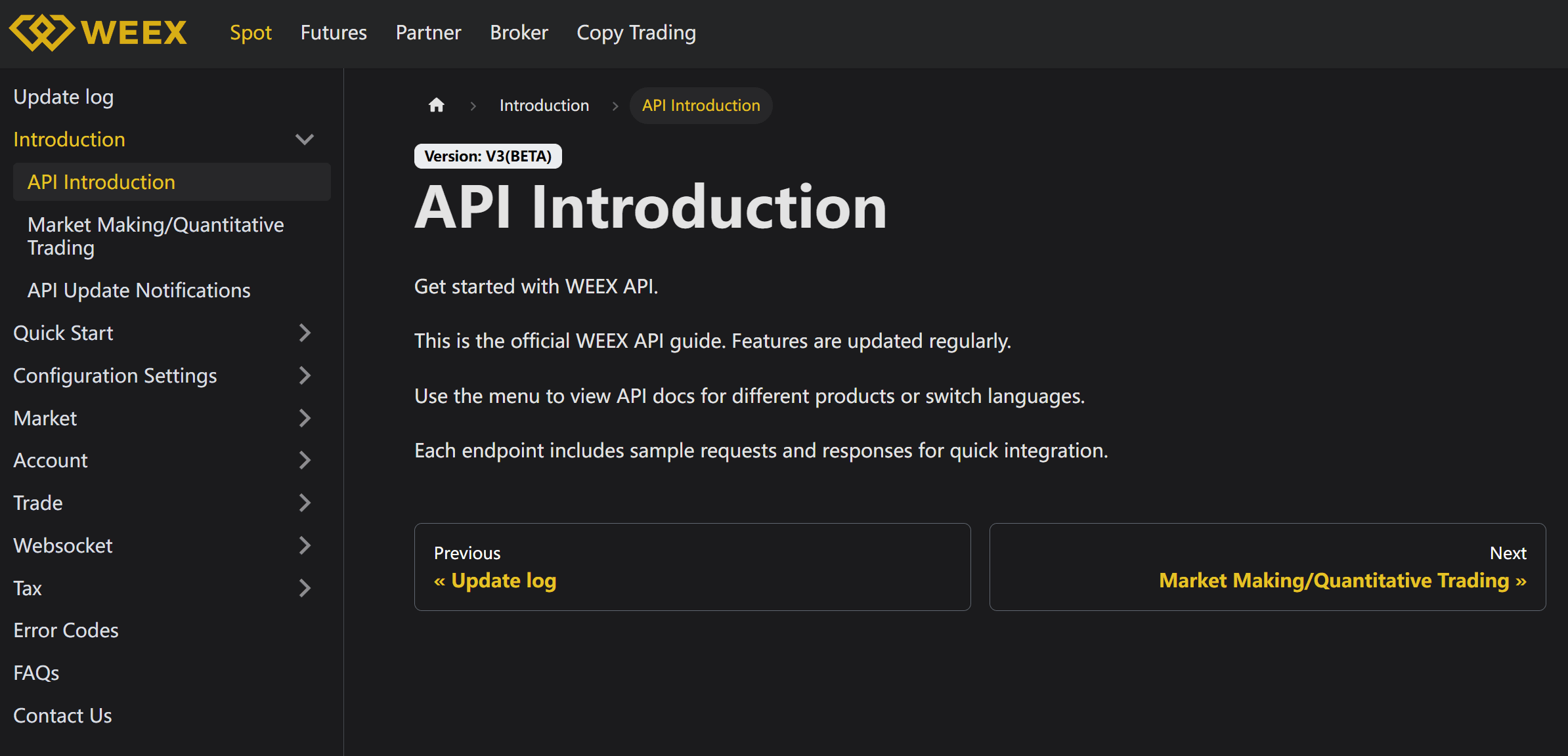
WEEX API can be used as the technical connection layer between a trading program and the platform. However, the API itself does not create a trading advantage or guarantee profits. The quality of results still depends on the strategy, execution logic, and risk management.
When developing a bot, developers should pay attention to technical details. For example, trading pairs should use the correct format, such as BTCUSDT. Order identifiers should also be handled properly to avoid duplicate requests or execution errors.
Different use cases, such as spot trading and futures trading, may require different permissions and API settings, so developers should always check the latest documentation.
How to Keep API Keys Secure?
Security is one of the most important parts of automated trading.
An API Key gives a program access to certain account functions. Users should follow the principle of granting only the permissions that are actually required.
For example, a program that only reads market data does not need trading permissions. A trading bot usually needs order permissions, but it should not have unnecessary withdrawal access.
Users should also avoid sharing API Secret information through messages, emails, or public code repositories.
If an API Key is suspected to be exposed, it should be removed immediately and replaced with a new one.
A legitimate trading bot should never request a wallet seed phrase, private key, exchange password, or verification code. These credentials provide direct control over assets and should always remain private.
How Should You Test a Crypto Trading Bot?
Before using real funds, a trading bot should go through several testing stages.
The first stage is backtesting. Historical market data can help evaluate how the strategy performed in previous conditions. However, backtesting results should not be treated as future guarantees.
A reliable test should consider realistic factors such as trading fees, slippage, and market volatility.
The next stage is simulation or paper trading. This helps verify whether the program can correctly receive data, generate signals, and handle orders.
Only after the system performs consistently should users consider small-scale live testing.
Real markets often behave differently from historical data because of liquidity changes, execution delays, and unexpected price movements.
Common Mistakes When Building a Crypto Trading Bot
Many beginners focus too much on finding a profitable strategy and ignore system reliability.
One common mistake is optimizing a strategy only for historical performance. A model that performs perfectly in past data may fail in real markets because it has adapted too closely to previous conditions.
Another mistake is ignoring trading costs. Fees, funding rates, and slippage can significantly reduce returns, especially for high-frequency strategies.
Technical stability is also important. A professional trading bot needs to handle situations such as API failures, network interruptions, rejected orders, and abnormal market data.
Is Building a Crypto Trading Bot Worth It?
Building a crypto trading bot can be useful for people who want to learn quantitative trading or automate a strategy they already understand.
However, it is not suitable for users looking for a guaranteed income solution. Automation improves execution speed and consistency, but it does not remove market uncertainty.
For beginners, a practical learning path is:
Understand trading basics → build a simple strategy → test with historical data → connect API → run with limited funds → improve gradually.
The purpose of automation is not to eliminate risk, but to make trading decisions more systematic.
Conclusion
Building a crypto trading bot with an exchange API requires more than writing code. A complete system needs a clear strategy, reliable market data, secure API management, proper testing, and continuous risk control.
Exchange APIs, including services such as WEEX API, provide the infrastructure needed for automated trading programs. However, they are only tools for connecting software with trading platforms. They cannot guarantee profitability.
For beginners, the most important step is not building the most complex bot, but understanding how the system works and testing it carefully before increasing exposure.
This content is provided for general informational purposes only and doesn't constitute financial, investment, legal, or tax advice. Any events, rewards, online promotions, or related information mentioned herein should not be considered a recommendation, solicitation, or invitation to purchase, sell, trade, or otherwise deal in any crypto assets. Crypto assets are highly volatile and may result in loss. The availability of WEEX services, products, and related events may vary by region. You are responsible for ensuring that your participation is in accordance with applicable local laws and regulations.
You may also like
View moreWEEX Elite Trader Support: Exposure, Levels, Fund and Payouts
Beginner3 minCopy TradingCan You Close a WEEX Copy Trade Early? How to Take Profit Now
Beginner3 minCopy TradingWEEX Copy Trading: Can You Set Your Own Leverage and Stop-Loss?
Beginner3 minCopy TradingHow Copy Trading Platforms Stop Churning and Bag-Holding Traders
Beginner4 minCopy TradingHow to Use Flicker with WEEX to Review Crypto Trades
Beginner5 minHow to Become a WEEX Elite Trader: Levels, Rules and Profit Share
Beginner3 min





