
What Happens When the AI Bubble Bursts? MIT University Responds

 Prefer us on Google



The surge in investment in artificial intelligence has become one of the largest spending waves in technology history, but a new study warns that if these investments do not lead to the expected productivity growth, the bursting of the AI bubble could cause widespread damage to financial markets. According to this study, large tech companies need to increase their productivity by 2.7 times by 2030 to break even on their investments.
According to Mihan Blockchain, Jessica Wachter, a finance professor at Wharton and former chief economist of the U.S. Securities and Exchange Commission (SEC), estimates that Alphabet, Microsoft, Amazon, Meta, and Oracle will spend nearly $1.1 trillion on data centers by 2027. These calculations also take into account capital costs, a 15% return, and infrastructure depreciation.
What Happens If the AI Bubble Bursts?
Wachter and her colleague believe that large tech companies need a 2.7-fold increase in productivity by 2030 to justify these costs. If this growth does not materialize, the massive capital spent on AI infrastructure could lead to unprecedented misallocation of capital. Wachter described this situation as "the largest misallocation of capital in history."
Signs of pressure from these investments on companies' financial status are also evident. Alphabet faced a $5.9 billion shortfall in free cash flow in the last quarter; an occurrence that has not happened since the company went public in 2004.
Debt Transfers AI Bubble Risk to the Market
The potential problem is not limited to tech companies. Morgan Stanley estimates that more than half of the $2.9 trillion planned spending on data centers by 2028 will be financed through external funding. Thus, if the returns on AI investments decline, part of the risk could be transferred to the credit market and investors.
In one example, Meta transferred 80% of the shares of the Hyperion data center in Louisiana to the private equity firm Blue Owl Capital. Stein van Nuyvenburch, a professor at Columbia Business School, warned that such debts are finding their way into more parts of the financial market through pension funds and private credit instruments.
Gary Gensler, former SEC chair and professor at MIT Sloan School of Management, also believes that this wave of investment will eventually face a period of retreat, although the timing is uncertain; he described this situation as "a common bet of the capital market and the economy."
In the cryptocurrency market, Arthur Hayes, a market strategist, has proposed a different scenario. He believes that if a credit crisis arises from the AI bubble, the Federal Reserve may inject more liquidity into the economy to counter its effects; a scenario that, from Hayes's perspective, could drive the price of Bitcoin to one million dollars.
However, it remains unclear how and when this bubble might deflate. The main issue is whether the productivity growth resulting from AI can keep pace with the massive investments made in its infrastructure.
-- Price
This content is provided for general informational purposes only and doesn't constitute financial, investment, legal, or tax advice. Any events, rewards, online promotions, or related information mentioned herein should not be considered a recommendation, solicitation, or invitation to purchase, sell, trade, or otherwise deal in any crypto assets. Crypto assets are highly volatile and may result in loss. The availability of WEEX services, products, and related events may vary by region. You are responsible for ensuring that your participation is in accordance with applicable local laws and regulations.
You may also like

Bitcoin and Asch's Experiment: The Power of Monetary Consensus

Block Festa 2026 to Open Tomorrow in Yeouido: Digital Asset Investment Institutions and Domestic and International Leaders Gather

$1 Billion in Revenue! How Collector Crypt Dominates On-Chain Card Games?

BTCS Completes Compliance Steps for DeFi Liquidity in Tokenized Stocks

Blockworks Launches On-Chain Intelligence Product Intel Integrating Messari Data

Liquid Network Releases Security Audit Update, Community Demands Missing Bitcoins

Spanish Civil Guard Investigates Scam Involving Fake Cryptocurrency Investments

Seven Intriguing Details from Anthropic's IPO Prospectus

Has the U.S. Government's Attitude Toward Cryptocurrency Changed After the CLARITY Act Vote Failed?

ATOM Price Prediction October 2026: Can Cosmos Break $1.80?

Who Defines Ethereum? Cultural Convergence and the Truth of Cryptocurrency
Spain says self custody crypto does not need Form 721 reporting

Federal Reserve Refines Stablecoin Regulation Draft: 1:1 Reserves, Two-Day Redemption, and Weekly Reporting

Is it worth participating in Jumper's new token offering after raising $52 million?
Circle Freezes Approximately $201,000 of Stolen Funds from Bitget
IRS Targets Crypto ETFs Over Tax Compliance Issues
Why Is Quant (QNT) Price Rising? The Clearing House Tokenized Deposit Deal Explained
Why is Quant (QNT) rising? Explore The Clearing House tokenized deposit deal, QNT utility, price risks and how to trade QNT on WEEX.

Ukraine ranks 7th globally in cryptocurrency usage, Chainalysis report
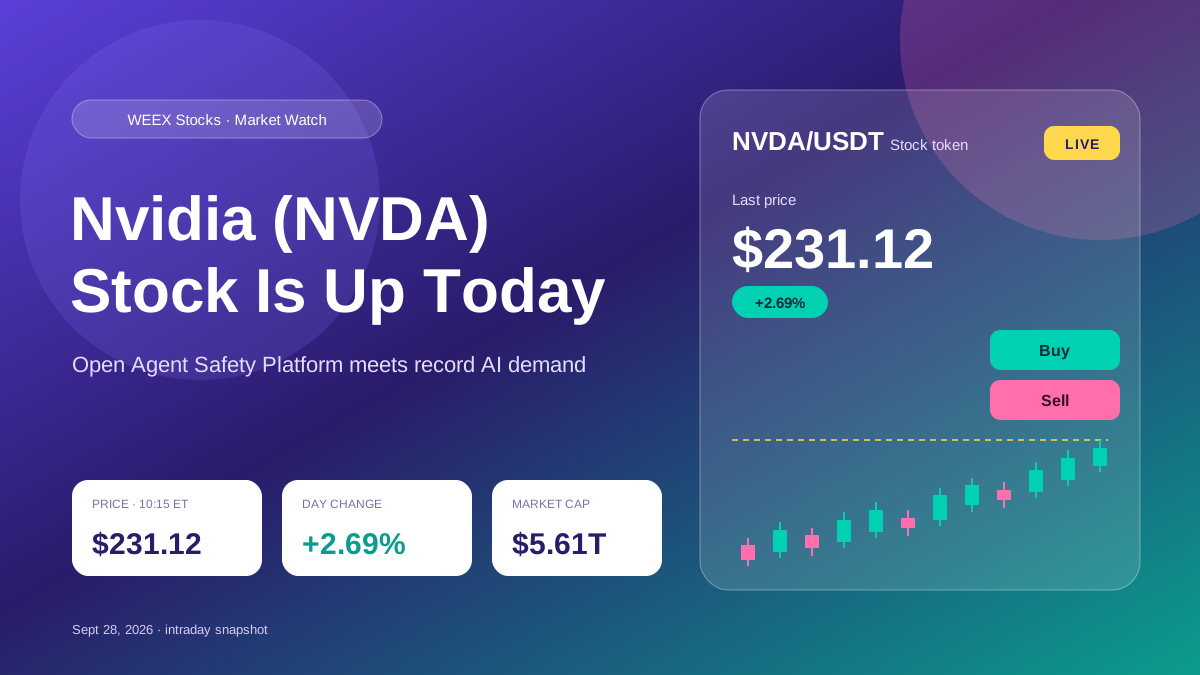
Why Is Nvidia (NVDA) Stock Up Today? New AI Agent Safety Platform Fuels the Rally
Why is Nvidia stock up today? Explore the AI agent safety launch, Nvidia’s growth outlook, key risks and how the NVDA token works on WEEX.

Bitcoin: A Computing Token Network to Protect Against AI Misuse?
Belarus Registers First Two Crypto Banks as High-Tech Park Enterprises

Why Is No One Buying Spot Stocks While Leverage Is Exploding in U.S. Stocks on the Blockchain?

QQQ Price Prediction for October 2026: Can It Break $750?

The SEC Publishes a New Crypto FAQ - What Does It Imply?

Bitwise Keeps XRP ETF Filing Updated, But Green Light Still Missing

Blockchain: IBM Connects Its Digital Asset Platform to Swift's Ledger

XPL Price Prediction 2026: Can Plasma Reach $0.15 After Unlock?

Stablecoins and Tokenized Deposits: Banks Could Lose $230 Billion

El Salvador Residency: The New Frontier of Financial Freedom

AMF warns Pump.fun is unregistered and unauthorized in Québec
Bitcoin and Asch's Experiment: The Power of Monetary Consensus
Block Festa 2026 to Open Tomorrow in Yeouido: Digital Asset Investment Institutions and Domestic and International Leaders Gather
$1 Billion in Revenue! How Collector Crypt Dominates On-Chain Card Games?
BTCS Completes Compliance Steps for DeFi Liquidity in Tokenized Stocks
Blockworks Launches On-Chain Intelligence Product Intel Integrating Messari Data
Liquid Network Releases Security Audit Update, Community Demands Missing Bitcoins


