
From Pump.fun to Collector Crypt: Has Solana's income throne changed hands?

 Prefer us on Google
Author: Chloe, ChainCatcher
The on-chain narrative of Solana is spreading from meme coins to tokenized trading cards. In the past, Pump.fun was almost representative of Solana's consumer-side revenue; however, entering the second quarter of 2026, Pump.fun's quarterly revenue began to slow down, while Collector Crypt has shown a stronger recent growth curve.
Data from DefiLlama shows that Pump.fun's revenue in the first quarter was $108.3 million, and has dropped to $69.2 million in the second quarter so far, a decrease of 36.1% compared to the previous quarter. During the same period, Collector Crypt's revenue curve has clearly risen.
Collector Crypt's revenue in the first quarter was $12.3 million, and has risen to $25.8 million in the second quarter so far, growing by 108.8%; in the past week, revenue reached $5.1 million, accounting for about 38% of its total revenue of nearly $13.5 million over the past 30 days. This set of data indicates that while Pump.fun still has a larger scale, Collector Crypt is achieving stronger short-term growth momentum.
From the data summary, it may not be that Pump.fun has lost its scalable growth, but rather that the sources of Solana's consumer transaction fees are beginning to diversify. The meme coin sector is still large, but tokenized trading cards, random card packs, physical redemptions, and on-chain secondary markets are becoming another consumer scenario that can genuinely charge fees, complete transactions, and retain users.
Is Collector Crypt's Profit Source Stable?
The core operating model of Collector Crypt is to host physical graded trading cards and mint corresponding NFTs on Solana. After users purchase random card packs, they receive digital cards linked to real physical cards; they can then choose to hold the NFT, sell it on-chain, sell it back to the platform, or redeem the physical card.
Collector Crypt's revenue mainly comes from random card pack sales, secondary market transaction fees, and royalties; when calculating revenue, the buyback costs incurred when users sell cards back to the platform are also deducted. Additionally, Collector Crypt purchases trading cards in bulk and acquires inventory at a discount of about 5% to 15%; if users do not want to keep the cards after opening the packs, they can sell them back to the platform at a price about 7% to 15% lower than the market price.
This allows Collector Crypt to retain an operating profit margin of about 4% to 5%. According to estimates, taking a $1,000 card pack as an example, Collector Crypt's overall profit margin is about 5.14%; after deducting user rewards and other incentive costs, the net profit margin is about 4.44%.
The reason this model has attracted attention is that it does not just sell on-chain images, but connects on-chain transactions with real-world collectibles. Collector Crypt surpassed $1 billion in cumulative transaction volume in May 2026; the platform opened more than 215,000 tokenized collectible card packs in a single week, and over 30% of users have redeemed physical cards.
Solana's Revenue Ranking Has Not Fully Reversed
However, Collector Crypt has not truly replaced Pump.fun in total volume. From 2026 to date, Pump.fun's revenue is approximately $177.5 million, and the overall revenue of the Pump ecosystem is about $466.5 million; in contrast, Collector Crypt's revenue in 2026 is about $38.1 million. In cumulative revenue, Pump.fun exceeds $1 billion, the overall Pump ecosystem is about $1.18 billion, while Collector Crypt is about $58.4 million.
Therefore, the so-called "change of the income throne" is more accurately described as a narrative shift in recent revenue momentum and daily income rankings, rather than a complete reversal of historical cumulative scale.
Pump.fun's model relies on a speculative token issuance cycle: users continuously issue new tokens, trade on early price curves, and then some tokens enter the public market, generating transaction fees at various stages. Collector Crypt's model is a different consumption cycle: users purchase random card packs, obtain on-chain certificates for corresponding physical collectibles, and then engage in on-chain trading, instant sellbacks, or physical redemptions. Both can generate fees, trading volume, and market attention, but the reasons for attracting users differ.
Pump.fun leans more towards attention, volatility, and early meme coin chips; Collector Crypt leans more towards collecting, scarcity, gamified experiences, and real asset anchoring. This is also where the focus of discussions about Solana's consumer applications is changing: revenue no longer solely comes from meme coin issuance but can also come from collectibles that are closer to real assets.
Conclusion
Ultimately, whether Collector Crypt's revenue is sustainable depends first on whether the demand for random card packs can be maintained. If the demand for card packs remains strong, Collector Crypt's 30-day revenue may continue to approach that of Pump.fun; if the demand for random card packs cools, the phenomenon of Collector Crypt's recent revenue being highly concentrated may turn from a growth signal into a risk.
Additionally, Collector Crypt's second growth variable is whether it can expand from Pokémon cards to sports cards and other collectibles. Data indicates that Pokémon cards currently dominate Collector Crypt's monthly trading volume; however, in physical card exhibitions, sales of sports cards and Pokémon cards are roughly equal, while on-chain sports cards currently only account for 3% to 4% of Collector Crypt's $88 million monthly trading volume.
Collector Crypt's third variable is regulatory pressure. If multiple regulatory jurisdictions begin to examine the random card pack mechanism under a "blind box regulatory framework," it could slow Collector Crypt's growth.
Therefore, under unchanged macro conditions, Pump.fun will still be the larger revenue engine, while Collector Crypt will continue to appear at the top of Solana's application revenue rankings. In this scenario, Solana's consumer application revenue will no longer rely solely on meme coin issuance but will gradually spread to more consumption scenarios.
The key change for Solana is not that Pump.fun is completely replaced, but that the structure of consumer revenue has broadened. Pump.fun has proven that meme coin issuance can become a highly profitable consumer application on Solana; Collector Crypt has demonstrated that tokenized physical collectibles can also generate real revenue, real transactions, and real user behavior.
-- Price
This content is provided for general informational purposes only and doesn't constitute financial, investment, legal, or tax advice. Any events, rewards, online promotions, or related information mentioned herein should not be considered a recommendation, solicitation, or invitation to purchase, sell, trade, or otherwise deal in any crypto assets. Crypto assets are highly volatile and may result in loss. The availability of WEEX services, products, and related events may vary by region. You are responsible for ensuring that your participation is in accordance with applicable local laws and regulations.
You may also like
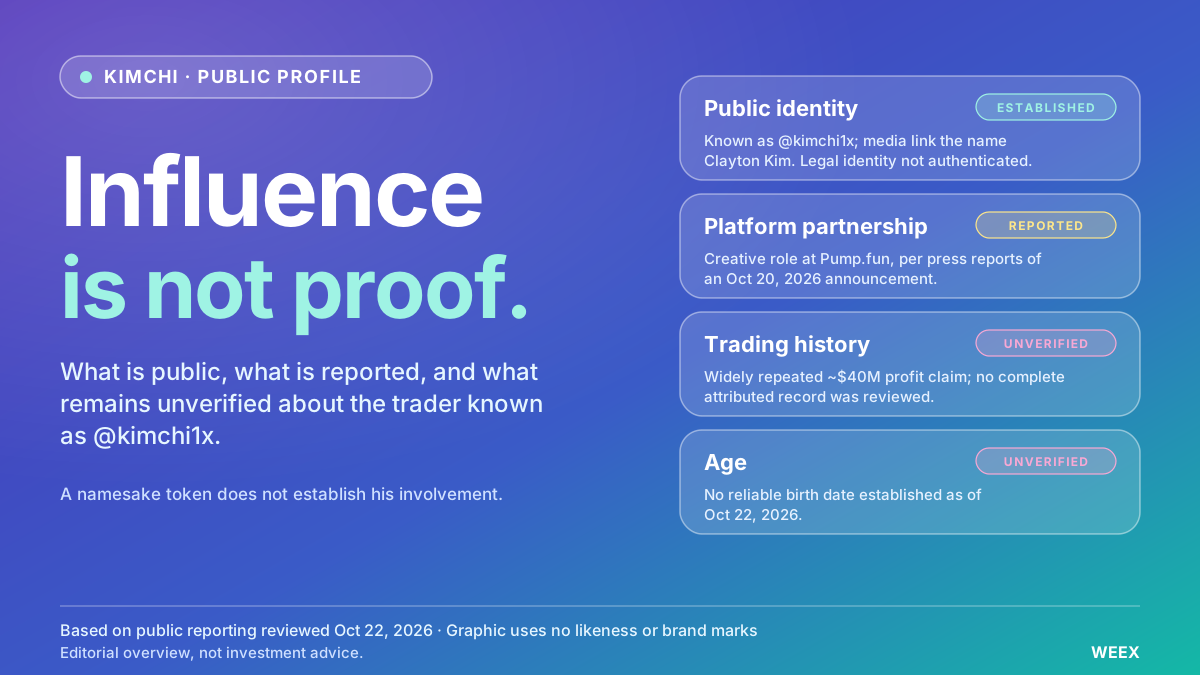
Who Is Kimchi Crypto Trader? Age, Real Name, and Trading Background
Who is Kimchi crypto trader? Check what is known about his age, the name Clayton Kim, trading background, profit claims, and Pump.fun partnership.

PUMP Price Hit a New Post-October High as Pump.fun Out-Earned Hyperliquid: What the Revenue Gap Really Shows
PUMP rose to roughly $0.0064, its highest level since the October 2025 "1011" selloff, after Pump.fun edged past Hyperliquid in 30-day protocol revenue. The headline is real, but the revenue gap is only a couple of percent, and the token is still well below its record high.

Pump.fun Reports Weekly Revenue of $10.74 Million, Highest Since Late January

Curve Founder Criticizes Pump.fun, Sparking Solana Controversy
$3,800 for 6.6 million: ai16z Accused of Insider Trading

web3: Solana, BNB, and Sui Push Upgrades as Altcoin Divergence Intensifies
Top Four Market Makers Suffer Collective Losses of $23.5 Million in the Past 30 Days, Two May Have Suspended Liquidity Provision

DEX Spot Volume Reaches 24% of CEX Volume in July

Why the Billion-Dollar Revenues of Crypto Projects Did Not Lead to Token Growth

Pump.fun Fires Employees Two Months Before They Receive Their PUMP Tokens

Pump.fun Employees Miss Out on Seven-Figure PUMP Tokens Before Layoffs
Castle Labs: $726 Million Revenue from 6 Protocols in the First Half of the Year, Negative Net Value Inflow for Token Holders

ARK Invest researcher predicts more crypto shutdowns

Hyperliquid and Two Other Platforms Account for Nearly 80% of Total Application Revenue

Experts Warn Against Projects Impersonating XRP

Pump.fun Developer Company Hiring Head of Growth Marketing with Salary Up to $1 Million
Pump.fun Launches BOOST Mode to Enhance Liquidity of New Migrated Tokens by Approximately 20%
LAB Token Unlock Day: Team-Related Entities Continue Selling, Allocation Value Drops to $4 Million
Pump.fun Repurchases and Destroys Nearly 15% of PUMP Supply, Protocol Revenue Reaches $5.9 Million

NOXA.Fun Protocol Fees Reach $2.33 Million, Four Times That of Pump.fun
Pump.fun Hiring Legal Director in New York with Salary Up to $5 Million

Pump.fun App Launches Robinhood Chain Token Trading Feature
Cash Flow Showdown in a Bear Market: Spotlight on 8 Crypto Projects with Buybacks

Data: Pump Fun deposited 68,600 SOL to Kraken in the early morning, worth 5.65 million USD
Pump Sells 4.73 Million SOL, Generating $805 Million in Fees
Pump Fun Deposits 68,596 SOL to Kraken, Worth $5.65 Million

ANSEM Updates Ecosystem, Bitcoin ETF Sees Net Inflow of $266 Million
pump.fun Weekly Report: Weekly Revenue of $7.2 Million, Cumulative Burn of 41.8% of Circulating Supply

ANSEM Ecosystem Update: Creator Fees Supplement LP, Airdrop SOL to Community Contributors

The cryptocurrency industry has become a traditional industry
Who Is Kimchi Crypto Trader? Age, Real Name, and Trading Background
Who is Kimchi crypto trader? Check what is known about his age, the name Clayton Kim, trading background, profit claims, and Pump.fun partnership.
PUMP Price Hit a New Post-October High as Pump.fun Out-Earned Hyperliquid: What the Revenue Gap Really Shows
PUMP rose to roughly $0.0064, its highest level since the October 2025 "1011" selloff, after Pump.fun edged past Hyperliquid in 30-day protocol revenue. The headline is real, but the revenue gap is only a couple of percent, and the token is still well below its record high.
Pump.fun Reports Weekly Revenue of $10.74 Million, Highest Since Late January
Curve Founder Criticizes Pump.fun, Sparking Solana Controversy
$3,800 for 6.6 million: ai16z Accused of Insider Trading
web3: Solana, BNB, and Sui Push Upgrades as Altcoin Divergence Intensifies
Contents
Latest articles


Latest coin listings on WEEX


