
6GW Nuclear Power Supply Agreement: Non-Binding Framework with Nano Nuclear and Tillman

 Prefer us on Google
Nano Nuclear Energy (NANO Nuclear Energy·$NNE) has entered into a non-binding commercial framework with Tillman affiliates to explore a power supply plan for micro-reactors exceeding 6GW in the U.S. AI industrial zone. The target capacity is projected to exceed 2GW by the mid-2030s and 6GW by 2040.
In a statement on the 24th, Nano Nuclear announced that it would evaluate and develop applications for the KRONOS MMR energy system with Tillman Global Holdings and Tillman Digital Gateway (TDG). The framework identifies Nano Nuclear as Tillman's anticipated primary nuclear technology provider.
The core of this agreement is that it ties the power demand of AI data centers to the commercialization schedule of next-generation nuclear power within a single business structure. Tillman Digital Gateway is presented as a platform for developing AI industrial zones and data center pipelines in the U.S., while Nano Nuclear is reviewing plans to deploy micro-reactors to meet this demand.
Tillman is a company that develops large-scale digital and energy infrastructure. The statement from Nano Nuclear explains that Tillman has secured approximately $16 billion (about 22.16 trillion KRW) in capital since its establishment. However, Tillman's official business page states that the investment capital exceeds $10 billion, indicating that the criteria and calculations may differ.
The compensation structure is also included in the framework. Tillman may receive warrants to purchase up to $100 million (about 138.5 billion KRW) worth of common stock from Nano Nuclear. Multiple warrants will vest only if there are binding agreements for future reactor purchases.
The initial restricted stock grant is set at $5 million (about 6.9 billion KRW), a significant portion of which is tied to achieving project development milestones. However, the actual stock compensation and reactor purchases are not automatically linked.
Warrants are rights to purchase company stock under specified conditions. In large-scale infrastructure collaborations, it is common to design compensation rights to arise gradually based on conditions such as follow-up contracts, customer acquisition, and progress in licensing. This structure is closer to long-term development options than to contracts for confirmed commercial deployment.
Nano Nuclear's KRONOS MMR is introduced as a 15MWe high-temperature gas-cooled micro modular reactor. The company's website states that this reactor is in the pre-application stage for construction permits with the U.S. Nuclear Regulatory Commission (NRC).
On the 12th, Nano Nuclear updated that the NRC has officially reviewed the construction permit application for the KRONOS MMR deployment at the University of Illinois. The same document states that the company holds $580 million (about 803.3 billion KRW) in cash and short-term investments.
Micro modular reactors are a concept for small nuclear power plants designed for factory production and on-site deployment. They typically supply power in smaller units than large nuclear plants and are proposed to be located closer to demand sites. However, actual commercial operation requires a sequence of design reviews, construction permits, operating licenses, fuel supply, and site and customer contracts.
As the power demand for AI data centers increases, nuclear power companies are emphasizing their ability to provide stable power supply 24/7. Data centers have high GPU and server density, making power supply and cooling facilities prerequisites for business schedules. Delays in securing power can also delay server deployment and customer contracts.
Nano Nuclear has already been pursuing partnerships targeting the AI data center power market. On May 6, the company announced a memorandum of understanding with Supermicro to explore integrating on-site nuclear power into AI server and data center platforms. This Tillman framework is another example of an initiative to alleviate the bottleneck of AI data center power infrastructure with nuclear power.
Previously, we reported that NuScale Power Corporation's (NuScale Power·$SMR) 6GW small modular reactor supply plan also started at the non-binding agreement stage. At that time, the key issue was that there were still business-specific licensing, fuel supply, construction, and financing procedures remaining before actual power production could occur.
This announcement is also difficult to interpret as an order or commencement of construction. Nano Nuclear stated that final contracts, customer agreements, funding, regulatory approvals, and project requirements must be met. The same document noted that there is a risk that the collaboration between the two parties may end at the exploratory stage.
For data center operators, this means having the option to secure long-term power sources in advance. Conversely, for Nano Nuclear, there is a concern that if technology licensing and actual purchase agreements are delayed, expectations may not translate into reality.
The criteria for subsequent judgments will be the progress of KRONOS MMR licensing, customer agreements for Tillman projects, and whether binding reactor purchase contracts are signed. The currently disclosed target capacities are set for the mid-2030s and 2040.
-- Price
This content is provided for general informational purposes only and doesn't constitute financial, investment, legal, or tax advice. Any events, rewards, online promotions, or related information mentioned herein should not be considered a recommendation, solicitation, or invitation to purchase, sell, trade, or otherwise deal in any crypto assets. Crypto assets are highly volatile and may result in loss. The availability of WEEX services, products, and related events may vary by region. You are responsible for ensuring that your participation is in accordance with applicable local laws and regulations.
You may also like
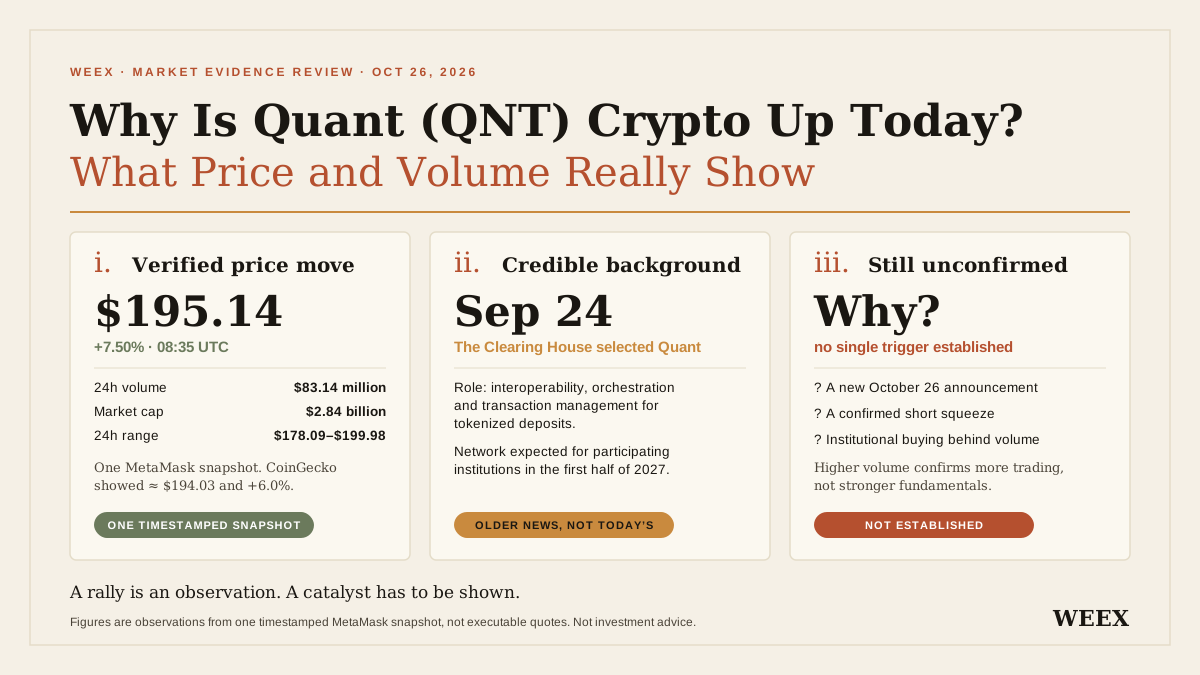
Why Is Quant (QNT) Crypto Up Today? What Price and Volume Really Show
Why is Quant (QNT) up today? Review price and volume evidence, the banking partnership timeline, token-demand assumptions, and risks before trading.
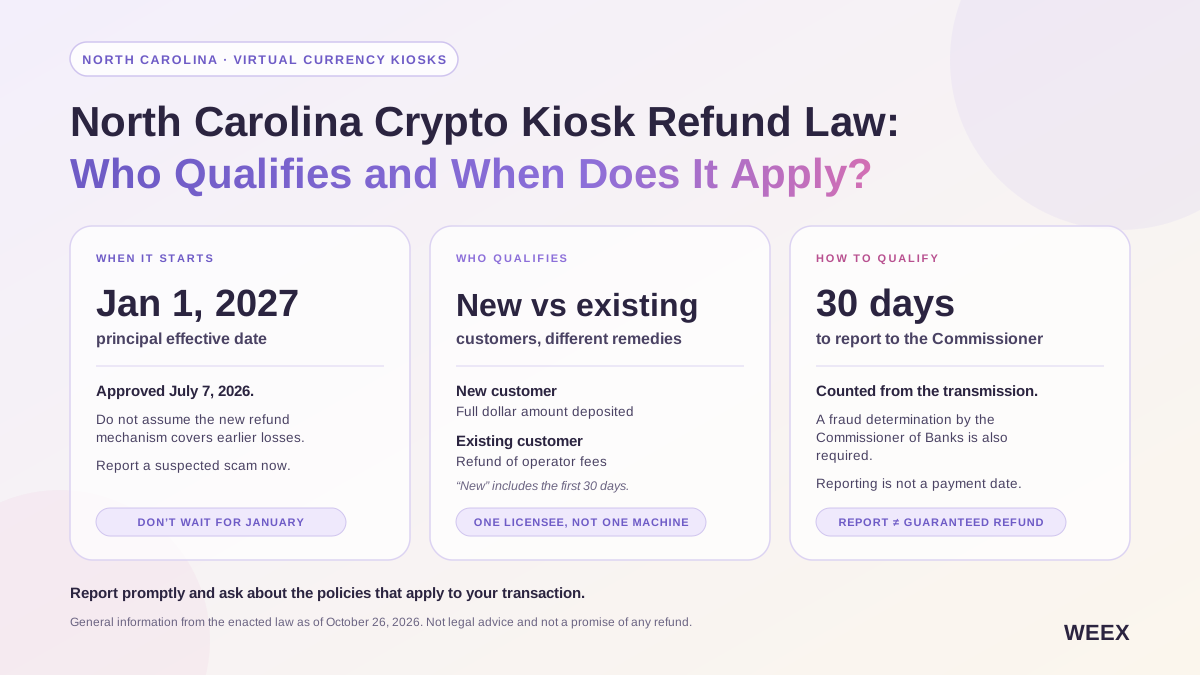
North Carolina Crypto Kiosk Refund Law: Who Qualifies and When Does It Apply?
Understand North Carolina’s crypto kiosk refund law: the January 2027 start date, who qualifies, reporting deadlines, and documents victims should keep.

AI Reduces Vulnerability Discovery Costs, Crypto Industry Divided in Response

Ethereum: Glamsterdam postponed after risks detected on 13 contracts

Who is Making Money from Digital Dollars? Profit Sharing Among Stablecoin Issuers, Distributors, and Payment Providers
![[ETH Letter] Meritz Securities Reviews Tokenization of Korean Securities Based on OP Stack](/public-static/31_556776148b.png?format=avif)
[ETH Letter] Meritz Securities Reviews Tokenization of Korean Securities Based on OP Stack
Ethereum Releases CALLSTATUS Instruction EIP Draft

Paradigm Releases Audited Built-in JIT Compiled New EVM evm2
Weekly: $68,000 Theft from Ukrainian in Trust Wallet, Circle's Lawsuit Against Trump Over $2 Billion in UAE, and Historic Solana Update

Delay of the Glamsterdam Update on Ethereum Postpones Activation on Hoodi

Arbitrum Launches Developer Guild, Offchain Labs Becomes First Member
Hyperliquid L2 Elysium to Deploy Node at TheHUB in Tokyo

Heatbit's $899 Water Heater Element Mines Bitcoin While It Heats Your Tank

Ethereum Delays Test of Glamsterdam Update

Cryptocurrency Exchange Acknowledges Error After Reports of Millions in Losses

Ethereum Hoodi Testnet Glamsterdam Hard Fork Delayed
A Midnight privacy-vault demo needs outside signers to release Ethereum tokens

Robinhood Chain Surpasses Ethereum in Revenue: $51 Million vs $41 Million in Q3

CoinDCX Deposit Address Used for 10 Months, $15.8 Million User Deposits Untracked

Earning Millions Monthly: How Crypto Frontends Make So Much Money?

Why earning XRP yield through this wallet could actually cost you money
Kaspa finalizes 3 standards for native tokens and covenant apps

Zebec Network reports $100,000 buyback of 40.5M ZBCN in Q3

ARK Invest Q3 DeFi Report: Stock Tokenization Drives On-Chain Trading to 9%

Decibel launches Aptos Encrypted Mempool to protect traders from MEV

ZeroDev Founder Analyzes EIP-8288 to Enhance Ethereum's Scalability

Arkansas Appeals Court Asked to Reinstate Cryptocurrency Mining Restrictions for Foreign Investors

Samsung Wallet to Integrate USDC: What Should Phone Manufacturers Consider?

Hyperliquid Seeks Perpetual Contracts on AI Computing Power, Requests CFTC Approval

Morgan Stanley Warns of Multiple Risks in U.S. AI Infrastructure Investment, Predicts 32 GW Power Shortage by 2028
Why Is Quant (QNT) Crypto Up Today? What Price and Volume Really Show
Why is Quant (QNT) up today? Review price and volume evidence, the banking partnership timeline, token-demand assumptions, and risks before trading.
North Carolina Crypto Kiosk Refund Law: Who Qualifies and When Does It Apply?
Understand North Carolina’s crypto kiosk refund law: the January 2027 start date, who qualifies, reporting deadlines, and documents victims should keep.
AI Reduces Vulnerability Discovery Costs, Crypto Industry Divided in Response
Ethereum: Glamsterdam postponed after risks detected on 13 contracts
Who is Making Money from Digital Dollars? Profit Sharing Among Stablecoin Issuers, Distributors, and Payment Providers
[ETH Letter] Meritz Securities Reviews Tokenization of Korean Securities Based on OP Stack





