
XRP Crashes to $0.87 as ETF Assets Fall Below $1B: Is a Rebound Coming?

 Prefer us on Google

Key Takeaways
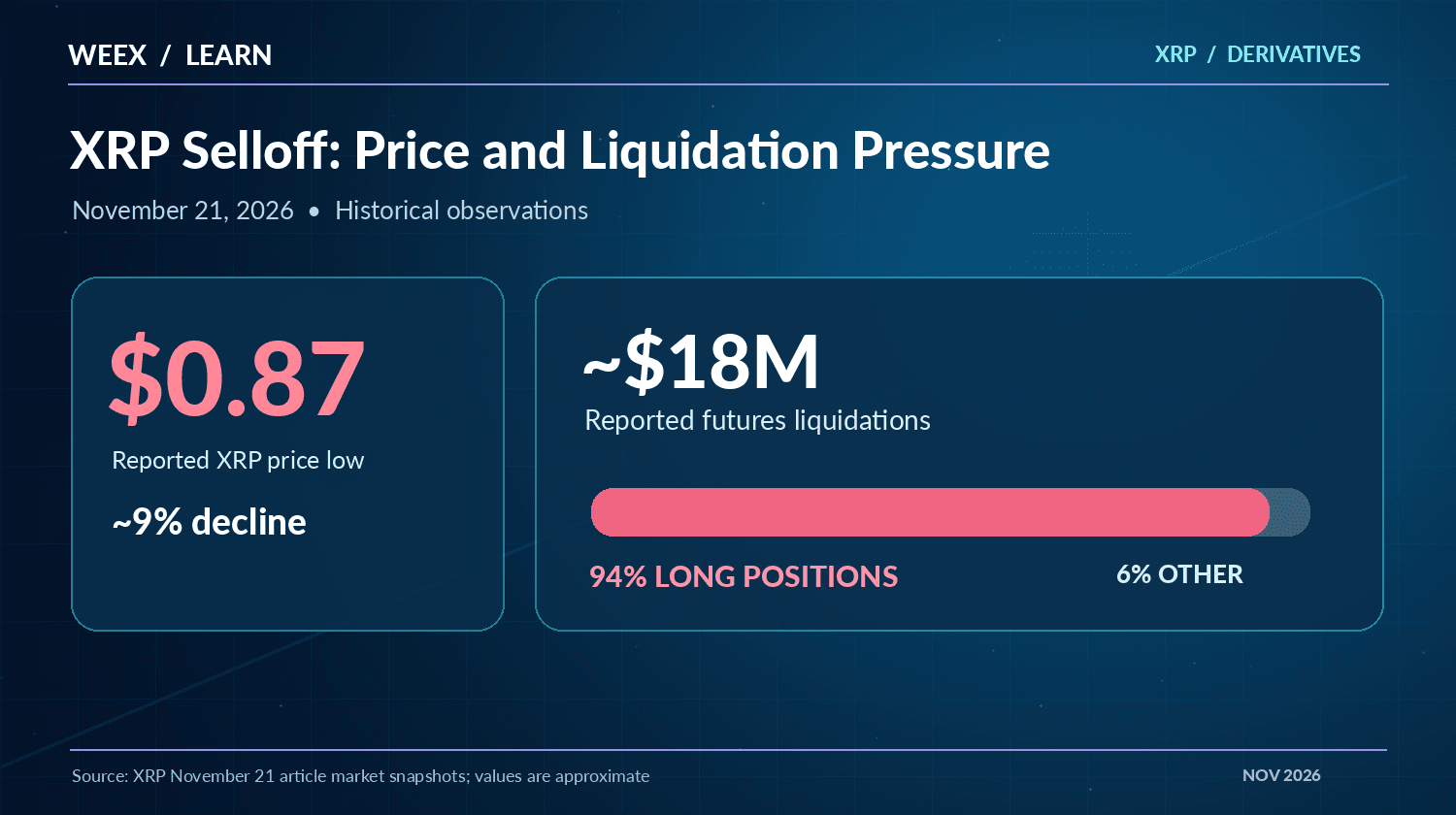
- XRP fell to approximately $0.87 on November 21, 2026, declining around 9% over 24 hours and reaching its lowest reported level since November 2024.
- U.S. spot XRP ETFs held approximately $989.61 million in combined net assets as of November 20, falling below the $1 billion threshold.
- Approximately $18 million in XRP futures positions were liquidated over a 24-hour period during the selloff, with long positions accounting for roughly 94% of the losses.
- XRP subsequently recovered toward $0.94 on November 23, but ETF outflows, leveraged positioning and broader cryptocurrency volatility remain important risks.
The XRP price fell to approximately $0.87 on November 21 as leveraged liquidations and weakening ETF demand intensified the cryptocurrency market selloff. The XRP price decline coincided with U.S. spot XRP ETF assets slipping below $1 billion despite substantial cumulative inflows since launch. This article examines the XRP price crash, ETF withdrawals, liquidation pressure and the conditions that could support or undermine a recovery.
Why Did XRP Price Crash to $0.87?
XRP experienced a sharp decline on November 21, 2026, falling approximately 9% over 24 hours and reaching a reported low near $0.87.
According to CoinDesk, this marked XRP's weakest price level since November 2024. The decline occurred during a broader cryptocurrency selloff that affected Bitcoin, Ethereum, Solana and other major digital assets.
The movement was particularly significant because XRP had already been trading below the psychologically important $1 level. A further decline toward $0.87 intensified attention on whether selling pressure was approaching exhaustion or whether additional downside remained possible.
However, the price movement should not be attributed solely to XRP-specific news. The broader market experienced substantial risk reduction, while leveraged traders faced forced position closures across multiple cryptocurrencies.
XRP Market Selloff: Key Figures
| Metric | Reported Observation |
|---|---|
| Asset | XRP |
| Main Selloff Date | November 21, 2026 |
| Reported Price Low | Approximately $0.87 |
| 24-Hour Price Change | Approximately -9% |
| Seven-Day Price Change | Approximately -11.5% |
| XRP Futures Liquidations | Approximately $18M over 24 hours |
| Share of Liquidations From Long Positions | Approximately 94% |
| XRP Futures Open Interest | Approximately $1.77B |
| Reported Futures Trading Volume | More than $3B over 24 hours |
| Subsequent November 23 Reference | Approximately $0.94 |
Sources: CoinDesk — XRP Falls 10% as Long Bets Unwind, November 21, 2026; XRP ETF and Market Data Tracker, November 23, 2026. Observations refer to different dates and measurement windows.
The figures show how rapidly XRP market conditions deteriorated during the selloff.
The 24-hour liquidation total was relatively small compared with the entire cryptocurrency market, but the concentration of losses among leveraged long positions suggests that traders expecting higher XRP prices were particularly exposed.
The later recovery toward $0.94 indicates that some buying interest returned after the sharp decline. However, a rebound from an intraday low does not establish that a lasting market bottom has formed.
Why Did XRP ETF Assets Fall Below $1 Billion?
U.S. spot XRP exchange-traded funds experienced a significant decline in combined net assets during November.
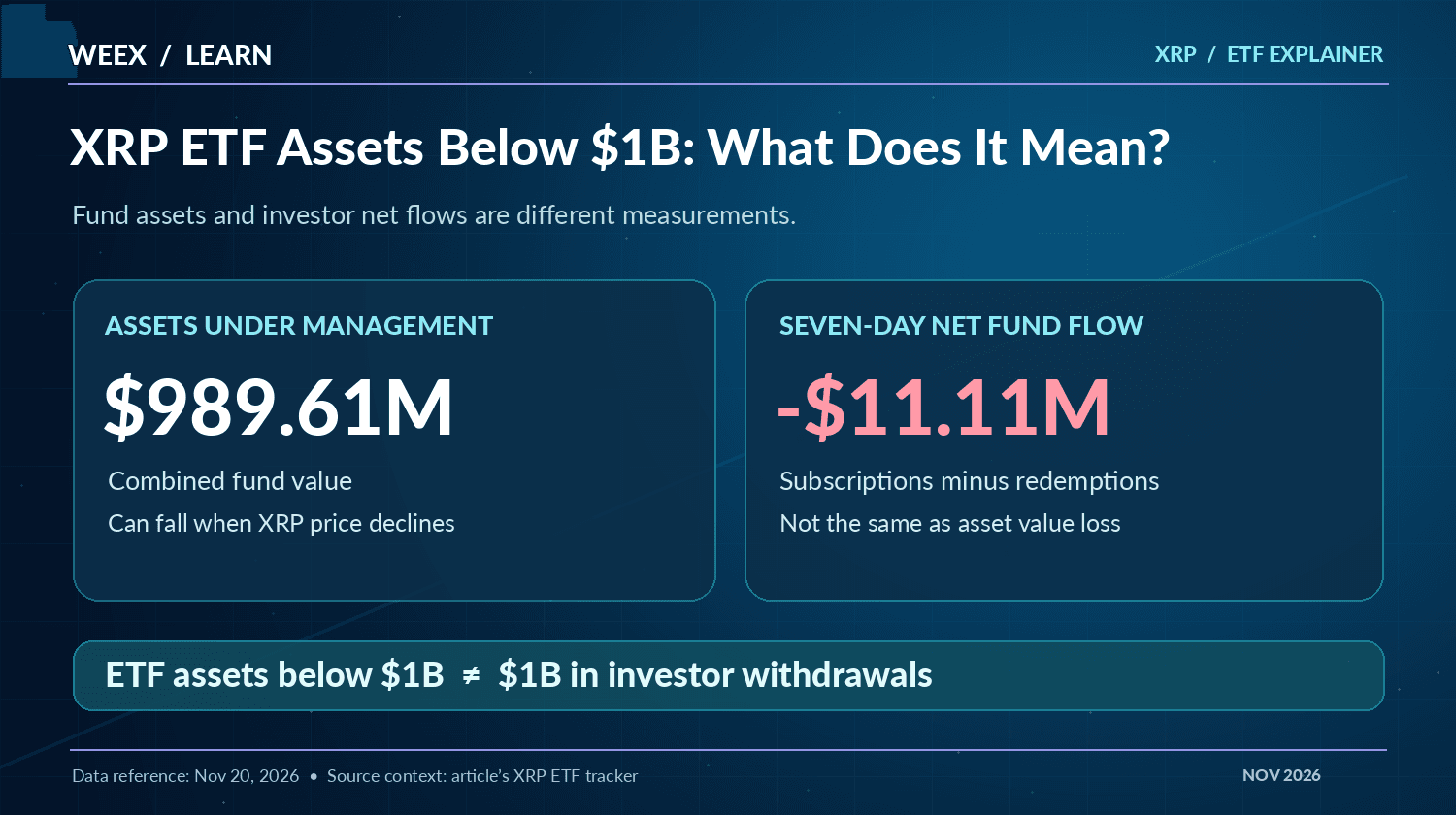
According to SoSoValue-derived figures, five U.S. spot XRP ETFs held approximately $989.61 million in total assets as of November 20, falling below the $1 billion level.
This development attracted attention because XRP ETFs had previously accumulated substantial investor capital since their launch.
CoinDesk reported approximately $1.78 billion in cumulative net inflows, showing that the current asset value was considerably lower than the total historical net inflows into the products.
At first glance, these figures may appear contradictory. However, they measure different aspects of ETF performance.
XRP ETF Market Data: November 2026
| ETF Metric | Reported Value |
|---|---|
| Combined Assets Under Management | $989.61M |
| Number of Tracked U.S. Spot XRP ETFs | 5 |
| Seven-Day Net Fund Flow | -$11.11M |
| November 20 Net Fund Flow | Approximately -$4.97M |
| Cumulative Net Inflows Since Launch | Approximately $1.78B |
| November 20 ETF Trading Volume | Approximately $35.18M |
Sources: CryptoTuts — XRP ETF Tracker, using SoSoValue data through November 20, 2026; CoinDesk November 21 market report. Figures represent different cumulative and reporting periods.
The distinction between fund flows and assets under management is essential.
Net fund flows measure subscriptions and redemptions during a defined period, while assets under management reflect the market value of the assets held by the funds.
Because spot XRP ETFs are exposed to the cryptocurrency's price, their combined asset value can decline significantly when XRP falls, even without equivalent investor withdrawals.
Consequently, the fact that ETF assets have dropped below $1 billion does not mean investors withdrew the difference between $1.78 billion in cumulative inflows and the funds' current asset value.
Why Do ETF Assets Shrink During a Crypto Selloff?
A spot XRP ETF generally holds XRP through a custody structure and offers shares that investors can trade through securities markets.
When the underlying cryptocurrency loses value, the market value of the fund's holdings decreases.
If investors also redeem fund shares, the amount of XRP or cash held within the product may decline further, depending on the fund's creation and redemption arrangements.
This means falling ETF assets can reflect two different forces: market-price depreciation and actual net withdrawals.
Understanding the relative contributions of these forces helps investors interpret ETF activity more accurately than looking at total asset values alone.
-- Price
Are XRP ETF Investors Losing Confidence?
The recent ETF outflows suggest weaker net demand during the reporting period, but they do not independently establish that all institutional investors have abandoned XRP.
The seven-day net outflow of approximately $11.11 million indicates that redemptions exceeded subscriptions across the tracked funds during that period.
However, ETF flow data does not identify every investor behind the transactions or reveal whether investors are reducing their overall cryptocurrency allocation, switching between products or implementing short-term portfolio adjustments.
Moreover, the cumulative net inflows of approximately $1.78 billion indicate that the products previously attracted substantial capital.
The latest outflows should therefore be evaluated as part of a broader trend rather than interpreted as proof of a permanent reversal in institutional interest.
What Should Investors Watch in XRP ETF Data?
| Indicator | What It Measures | Why It Matters |
|---|---|---|
| Daily Net Flows | New subscriptions minus redemptions | Short-term ETF demand |
| Weekly Net Flows | Aggregate flows over several sessions | Persistence of investor demand |
| Assets Under Management | Current value of fund assets | Combined impact of price and holdings |
| Trading Volume | Value of ETF shares traded | Market participation and liquidity |
| Cumulative Net Flows | Historical subscriptions less redemptions | Longer-term fund demand |
| XRP Market Price | Value of the underlying cryptocurrency | Direct impact on ETF asset valuations |
Source: ETF data methodology and general spot ETF structure.
These indicators are more useful when interpreted together.
For example, a decline in assets under management alongside minimal net withdrawals may primarily reflect a falling XRP market price.
Conversely, sustained net redemptions while prices remain relatively stable may indicate a more direct reduction in demand through the ETF channel.
For readers tracking this relationship, the WEEX XRP ETF Tracker provides a dedicated page for monitoring fund-related data.
How Did Leveraged Liquidations Accelerate the XRP Selloff?
Derivatives markets played an important role in the November 21 decline.
CoinGlass data cited by CoinDesk showed approximately $18 million in XRP futures liquidations over a rolling 24-hour period, with roughly 94% associated with long positions.
A leveraged long position allows traders to gain exposure to XRP price movements using collateral that may be smaller than the position's full notional value.
If the market falls sufficiently, the trader's remaining collateral may no longer satisfy the exchange's margin requirements.
When that happens, the platform may automatically liquidate the position.
Why Do Long Liquidations Matter?
During a sharp market decline, forced liquidation of leveraged long positions can add to selling pressure or accelerate market movements through the derivatives market.
As more traders are liquidated, liquidity conditions may deteriorate and price movements can become more volatile.
This dynamic can create a feedback loop in which declining prices trigger additional forced position closures.
However, liquidation data alone cannot establish the exact cause of a price decline.
Spot-market selling, macroeconomic conditions and broader investor sentiment may have initiated or contributed to the movement before the largest derivatives liquidations occurred.
What Does Negative Funding Mean?
CoinDesk also reported that funding rates turned negative on major XRP perpetual futures markets during the selloff.
Perpetual futures funding payments are generally designed to help align contract prices with the underlying market.
When funding is negative, traders holding short positions typically pay traders holding long positions under the relevant contract's funding mechanism.
Negative funding can indicate bearish positioning, although its interpretation depends on market conditions and the size of the funding rate.
A negative rate does not guarantee that XRP will continue falling or that a short squeeze will occur.
Can XRP Recover After Falling Below $0.90?
A recovery is possible, but the evidence available as of November 23 does not confirm a durable trend reversal.
After touching approximately $0.87 during the November 21 selloff, XRP recovered toward $0.94 by November 23, according to market observations cited in the ETF tracking data.
This rebound suggests that buying activity returned at lower prices.
However, the market remains sensitive to liquidity conditions, investor positioning and the broader performance of major cryptocurrencies.
What Could Support an XRP Rebound?
Improving ETF flows: A reduction in net withdrawals or a return to sustained inflows could signal stronger investment-product demand.
Reduced liquidation pressure: Lower leverage and more stable derivatives positioning may help limit forced selling during periods of volatility.
Broader cryptocurrency recovery: XRP may benefit if Bitcoin, Ethereum and other major digital assets stabilize and market-wide risk appetite improves.
Actual network and payment adoption: Increased usage of the XRP Ledger could strengthen long-term utility, although adoption does not translate directly into predictable short-term price gains.
What Could Prevent a Recovery?
Continued ETF withdrawals could weigh on sentiment, particularly if accompanied by weak spot demand.
Further declines in Bitcoin or other major assets may also create additional pressure across the cryptocurrency market.
Meanwhile, high leverage and concentrated derivatives positioning could amplify renewed selling if prices approach additional liquidation thresholds.
XRP Market Scenarios
| Scenario | Conditions to Monitor | Potential Interpretation |
|---|---|---|
| Recovery | ETF inflows improve and buying demand strengthens | Greater chance of sustained stabilization |
| Consolidation | ETF flows stabilize and leverage declines | XRP trades in a less volatile range |
| Renewed Decline | Selling pressure and liquidations accelerate | Recent lows may be tested again |
| Short-Term Rebound | Oversold conditions produce temporary buying | Recovery may be limited without stronger demand |
Source: Market scenario analysis based on November 2026 observations. These scenarios are not guaranteed price targets.
Investors should avoid interpreting any single indicator as definitive evidence that the market has reached a bottom.
For additional context, see WEEX's discussion of XRP Trading Below $1 and the December Escrow Release.
Does the XRP Selloff Change Its Long-Term Outlook?
The November decline raises questions about valuation and investor expectations, but a short-term market correction does not independently determine the long-term usefulness of a blockchain network.
XRP is the native cryptocurrency of the XRP Ledger, a blockchain designed to support transfers, asset issuance and other financial applications.
Its market price reflects the interaction of supply, demand, liquidity, speculation and investor expectations.
Actual use of the network may contribute to demand for transaction services, but it does not establish a direct mathematical relationship between adoption and token price.
Investors should also consider the distinction between Ripple, the private company, and XRP, the cryptocurrency.
Developments involving Ripple's commercial operations or partnerships do not necessarily create an immediate financial entitlement for XRP holders.
For a broader market perspective, see the WEEX analysis XRP Price Prediction 2026–2027: Can XRP Recover After Falling 65% From Its January High?.
How to Buy or Trade XRP on WEEX
WEEX offers XRP spot trading and USDT-margined perpetual futures, allowing eligible users to access different forms of exposure to the cryptocurrency.
Spot trading and leveraged derivatives involve different risk characteristics and should be evaluated separately.
Step 1: Open the XRP Trading Market
Visit the WEEX XRP/USDT Spot Trading Page to review the available quotation, order book and supported trading functions.
Users interested in derivatives can separately access the WEEX XRPUSDT Perpetual Futures Market.
Step 2: Prepare USDT and Review the Order
Sign in to WEEX, complete applicable verification requirements and ensure the account contains sufficient USDT.
For spot trading, select an available order type and review the intended XRP quantity, transaction price and fees.
For futures, check the position size, leverage, funding rates and liquidation conditions.
Step 3: Place the Order and Manage Risk
Confirm the relevant order details before submitting the trade.
During periods of elevated volatility, traders should pay particular attention to market liquidity, execution conditions and the possibility of sudden price changes.
Leveraged futures can magnify losses, and forced liquidations may occur when available margin falls below required levels.
For further asset background, visit the WEEX XRP Token Information Page.
Conclusion
The XRP price decline to approximately $0.87 on November 21 reflected a combination of broad cryptocurrency weakness and substantial leveraged long-position liquidations. At the same time, U.S. spot XRP ETF assets dropped below $1 billion, drawing attention to the relationship between investor flows and underlying market valuations.
Although the XRP price subsequently recovered toward $0.94, ETF outflows and derivatives positioning remain important indicators of market conditions. The decline in fund assets should not be confused with an equivalent amount of investor withdrawals.
For traders monitoring the XRP price, the main considerations are whether ETF demand stabilizes, liquidation pressure diminishes and broader cryptocurrency market conditions improve. None of these developments guarantees a sustained rebound.
FAQ
1. Why did XRP fall to $0.87 in November 2026?
XRP fell to approximately $0.87 on November 21 during a broad cryptocurrency market selloff. The decline coincided with around $18 million in XRP futures liquidations over 24 hours, most of which involved leveraged long positions.
2. Why did XRP ETF assets fall below $1 billion?
The five tracked U.S. spot XRP ETFs held approximately $989.61 million in combined assets as of November 20. Their total asset value was affected by both market-price declines and investor fund flows, so the decrease should not be interpreted entirely as net withdrawals.
3. How much money flowed out of XRP ETFs?
The tracked U.S. spot XRP ETFs recorded approximately $11.11 million in net outflows over the November 14–20 reporting period. Around $4.97 million in net withdrawals was reported for November 20. These figures are historical observations and may change in subsequent trading sessions.
4. Could XRP recover above $1?
A recovery is possible if market liquidity improves, ETF withdrawals moderate and broader cryptocurrency sentiment strengthens. However, the available data do not confirm a durable trend reversal, and XRP may remain volatile.
5. Can users trade XRP spot and futures on WEEX?
WEEX provides XRP/USDT spot trading and XRPUSDT perpetual futures, subject to product availability. Spot trading involves purchasing the cryptocurrency, while perpetual futures provide derivative exposure and may involve leverage, funding payments and liquidation risk.
This content is provided for general informational purposes only and doesn't constitute financial, investment, legal, or tax advice. Any events, rewards, online promotions, or related information mentioned herein should not be considered a recommendation, solicitation, or invitation to purchase, sell, trade, or otherwise deal in any crypto assets. Crypto assets are highly volatile and may result in loss. The availability of WEEX services, products, and related events may vary by region. You are responsible for ensuring that your participation is in accordance with applicable local laws and regulations.
You may also like
View moreDOJ Seeks Forfeiture of $1.1 Billion in USDC Linked to Binance Hack: What Happened?
Beginner7 minWhat Is Moonriver (MOVR)? WEEX Spot Market
Beginner3 minWhat Is SoSoValue (SOSO)? WEEX Spot Market
Beginner3 minJensen Huang Returns—and AI Stocks Explode: Can the Rally Last?
Beginner8 minWhat Is DigiByte (DGB)? WEEX Spot Market
Beginner3 minNVIDIA Rehires Jensen Huang Just 11 Days Later: What Changed Behind the Scenes?
Beginner7 minWEEX Product Guide





