
What Is MetaMask? A Complete Guide to the World's Most Popular Web3 Wallet

 Prefer us on Google

If you have ever tried to use a decentralized application, you have probably encountered MetaMask. It is the wallet that most people start with when they enter Web3. Whether you are swapping tokens on Uniswap, minting an NFT, or connecting to a blockchain game, MetaMask sits between you and the network.
This guide walks through what MetaMask actually is, how it works under the hood, and what happens when you click that "confirm" button. No fluff. No unnecessary jargon. Just a straightforward breakdown of the wallet that millions of people use every day.
Key Takeaways
- MetaMask is a non-custodial wallet. You control the private keys, not some company.
- A 12-word recovery phrase is generated when you set up the wallet. Lose it, and you lose access to everything.
- Every transaction requires a Gas Fee, which pays for network processing.
- MetaMask works on Ethereum and dozens of other networks like BNB Chain, Polygon, and Arbitrum.
- Always review token approvals. Unlimited approvals can expose you to unnecessary risk.
What Is MetaMask?
MetaMask is a cryptocurrency wallet that runs as a browser extension and a mobile app. It was originally built for Ethereum but now supports many other blockchain networks. People use it to store digital assets, send and receive tokens, and connect to decentralized websites and applications.
Unlike a bank or a centralized exchange, MetaMask does not hold your money. It gives you a way to interact with your funds on the blockchain. Your assets live on the network, not inside the wallet itself. The wallet simply shows you what you own and lets you move it around.
Who Uses MetaMask and Why?
The typical MetaMask user falls into one of these groups:
- DeFi users – lending, borrowing, and earning yield on platforms like Aave and Compound
- Traders – swapping tokens on decentralized exchanges such as Uniswap
- NFT collectors – buying and selling digital art on marketplaces like OpenSea
- Gamers – connecting to blockchain-based games
- Developers – testing smart contracts and building dApps
For many people, MetaMask is their first real interaction with blockchain technology. It lowers the barrier to entry by handling the complex cryptography behind the scenes. You do not need to understand the technical details to start using it, although knowing the basics helps you avoid costly mistakes.
-- Price
How MetaMask Works Under the Hood
The Recovery Phrase
When you install MetaMask and create a new wallet, the software generates a list of 12 random words. This is your recovery phrase, also called a seed phrase.
Think of it as the master key to your wallet. From these 12 words, MetaMask derives all your private keys and addresses. If you lose access to your device, you can restore everything using that phrase. If someone else gets hold of it, they can steal everything.
The recovery phrase never leaves your device. MetaMask does not store it on any server. Write it down on paper. Store it somewhere safe. Do not take a photo of it. Do not save it in a cloud document. Treat it like you would treat a physical safe deposit box key. In fact, treat it with more care, because there is no bank to call if you lose it.
Private Keys and Signing
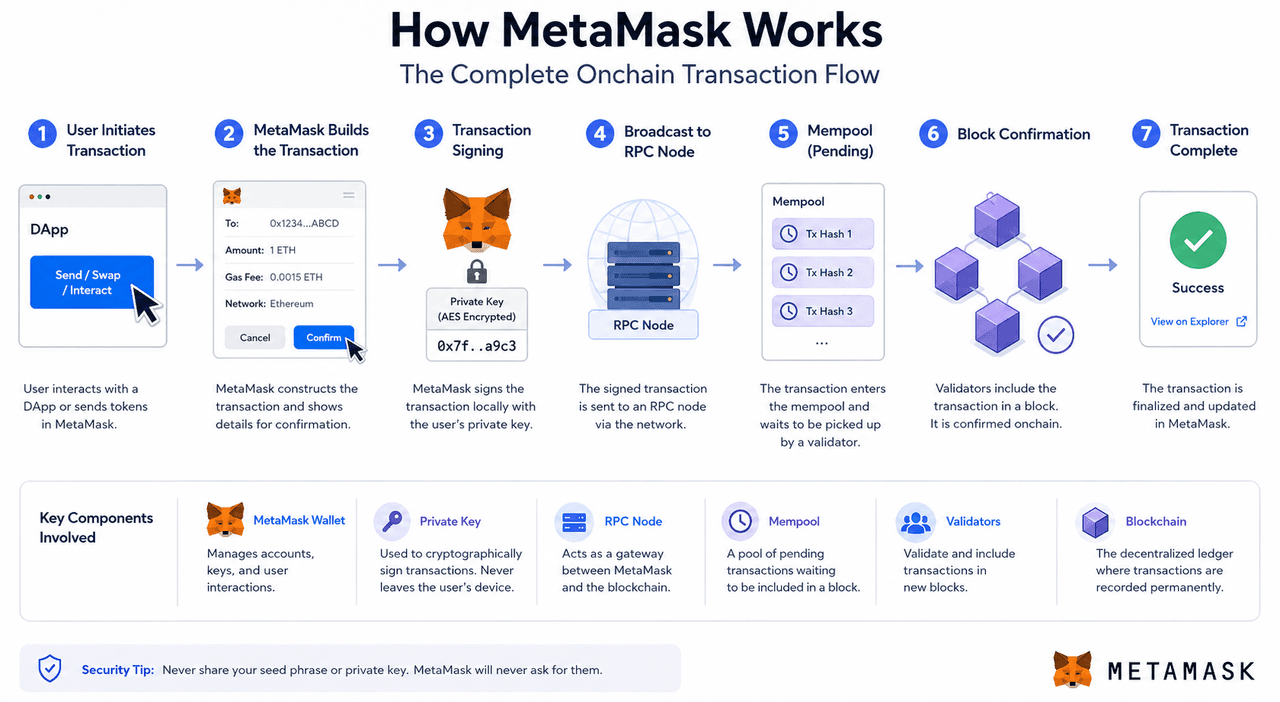
Each account in MetaMask has a private key. This key proves that you own the address and authorizes transactions. When you send funds or interact with a smart contract, MetaMask uses your private key to sign the transaction.
Here is the important part: the private key never gets transmitted anywhere. MetaMask creates a digital signature locally and sends that to the network. The blockchain verifies the signature without ever seeing the key itself. This is how crypto wallets stay secure even when connected to potentially untrustworthy websites.
Connecting to DApps
MetaMask injects a JavaScript object into your browser called window.ethereum. This object allows websites to request your wallet address, ask you to sign messages, and initiate transactions.
When a dApp asks to connect, MetaMask shows a popup asking for permission. You approve it, and the site can see your public address. It cannot move your funds unless you manually approve a transaction.
This is where many newcomers get confused. Connecting your wallet does not give a website access to your funds. It simply lets the site know who you are. You only expose your assets when you confirm a transaction or sign an approval.
What Happens When You Send a Transaction?
Most people use MetaMask to send tokens or interact with contracts. The process follows a clear sequence.
Building the Transaction
You enter a recipient address and an amount. MetaMask fills in the Gas Fee estimate and a nonce, which is a number that keeps transactions in order. If you are calling a smart contract, the wallet also includes the contract data.
Confirming in the Wallet
A window pops up showing:
- How much you are sending
- The network fee
- The total cost
You review this information and click confirm. Until you do this step, nothing gets broadcast to the blockchain. This is your chance to catch mistakes.
Signing the Transaction
MetaMask uses your private key to sign the transaction data. This signature proves that you authorized the transfer. It happens locally on your device without exposing your key.
Broadcasting to the Network
The signed transaction gets sent to an RPC node. MetaMask uses a default node provider unless you have configured a custom one. The node relays the transaction to the broader network.
Waiting for Confirmation
The transaction sits in the mempool until a validator picks it up and includes it in a block. This can take seconds or minutes, depending on network congestion and the Gas price you set. Once included, it moves from "pending" to "confirmed."
Gas Fees Explained
Every transaction on Ethereum costs money. This fee is called Gas. It compensates validators for the computing power required to process your transaction.
MetaMask estimates Gas automatically based on current network conditions. You can adjust it manually:
- Higher Gas usually means faster confirmation
- Lower Gas means slower processing or even failure
When the network is busy, Gas prices go up. Layer 2 networks like Arbitrum and Optimism offer cheaper transactions because they handle processing off-chain before settling on Ethereum.
MetaMask vs. Centralized Exchanges: Which is Better For You?
Many newcomers confuse MetaMask with exchanges like Coinbase or Binance. The differences are important.
| Feature | MetaMask | Centralized Exchange |
| Who holds the keys? | You | The exchange |
| Can you connect to dApps? | Yes | No |
| Do you need KYC? | No | Usually yes |
| Who secures your funds? | You | The exchange |
| Can the exchange freeze your account? | No | Yes |
MetaMask gives you full control but also full responsibility. Exchanges offer convenience but require trust in a third party. Each has its place, and many people use both for different purposes.
Security Practices for MetaMask Users
The most common way people lose funds is through human error, not technical hacking. A few basic habits prevent most problems.
- Protect your recovery phrase: Write it down on paper and keep it in a secure location. Do not store it digitally. Do not share it with anyone.
- Check every transaction: Scammers sometimes create fake dApps that request malicious approvals. Verify the URL and contract address before confirming anything.
- Use hardware wallets for large holdings: Devices like Ledger and Trezor connect to MetaMask and keep private keys offline. This adds a layer of protection that software wallets cannot match.
- Keep your software updated: MetaMask releases updates that fix bugs and improve security. Install them when they become available.
FAQ
1. Is MetaMask safe to use?
MetaMask is generally safe when used properly. The software has undergone multiple security audits. Most issues come from user mistakes, such as sharing recovery phrases or approving malicious contracts. Following basic security practices significantly reduces risk.
2. Can I use MetaMask on mobile?
Yes. MetaMask offers a mobile app for both iOS and Android. It includes the same core features as the browser extension.
3. Does MetaMask support Bitcoin?
No. MetaMask was built for Ethereum and EVM-compatible networks. It does not support Bitcoin natively. Some workarounds exist through wrapped tokens, but native BTC transfers are not possible.
4. What happens if I lose my phone or computer?
You can restore your wallet on any device using your 12-word recovery phrase. The funds are not stored locally—they exist on the blockchain. The phrase is the only way to regain access.
5. Can I have multiple accounts in MetaMask?
Yes. MetaMask allows you to create and manage multiple accounts within the same wallet. Each account has its own address and private key, all derived from the same recovery phrase.
Disclaimer: This content is provided for general informational and educational purposes only and should not be considered financial, investment, legal, or tax advice. Nothing in this article constitutes an offer, recommendation, solicitation, or invitation to buy, sell, or trade any crypto asset or use any specific service. Crypto assets are highly volatile and involve a high degree of risk. You may lose some or all of the value of your investment and should not invest funds you cannot afford to lose.WEEX services may not be available in all regions and are subject to applicable laws, regulations, and user eligibility requirements. Please carefully assess risks and confirm local requirements before making any financial decisions.
This content is provided for general informational purposes only and doesn't constitute financial, investment, legal, or tax advice. Any events, rewards, online promotions, or related information mentioned herein should not be considered a recommendation, solicitation, or invitation to purchase, sell, trade, or otherwise deal in any crypto assets. Crypto assets are highly volatile and may result in loss. The availability of WEEX services, products, and related events may vary by region. You are responsible for ensuring that your participation is in accordance with applicable local laws and regulations.
You may also like
Nike Stock and the China Sales Collapse: What a 30% Revenue Drop and Cutting Thousands of Distributors Actually Signals
BTC to MYR: Why the Ringgit Price of Bitcoin Has Two Legs
Logista Stock (LOG): The August 2026 Interim Dividend, the Four Dates That Decide Who Is Paid and What the Company Is
Manta Network (MANTA) Token Unlock: Supply Details, Allocation Breakdown and Price Risks
ETHFI Price Today: Why Ether.fi Is in Focus Ahead of Its Token Unlock
Santander Reveals a $4.3 Million Bitcoin Investment: What Europe's Biggest Bank Buying IBIT Actually Signals
SNDK Stock and the $93.9 Billion NBM Agreements: What SanDisk's New Business Model Actually Changes
Is Reddit Stock a Buy After Falling From Its Highs? What the S&P 500 Inclusion Actually Changes
Reddit Stock Jumps 11% After S&P 500 Inclusion: What Joining the Index on August 18 Actually Changes
Santander Stock and the Webster Acquisition: What the Federal Reserve Approval Actually Changes
What Is IREN? How the AI Data Center Company Behind Microsoft's $9.7 Billion Contract Actually Works
IREN Stock and the Microsoft Delivery: What Completing Horizon 1 and Getting Nvidia's Exemplar Status Actually Mean
MU Stock After the 28% Drop: What Micron's HBM Backlog Says
Is OpenAI Publicly Traded? The Foundation That Controls It, and the Ticker That Isn't Theirs
Is HIMS Stock a Buy After the Earnings Selloff? What the Full-Year Guidance Raise Actually Implies
CRWV Stock After Q2: Demand Is Fine, the Interest Bill Isn't
Is Bitcoin Preparing for a Bullish Breakout? Key Technical Indicators and On-Chain Data
MSFT Stock and the 30 Million Copilot Seats Milestone: What Growing From 20 Million Actually Changes
RKLB Stock After Q2: Record Revenue, Wider Loss, Narrower Window
Apple Stock and CXMT: What Testing Chinese Memory Chips for iPhone Actually Means for AAPL
Jensen Huang Stock Advice: What He Said and What It Returned
Metaplanet (3350): What the Japanese Retail Boards Argue About — and How to Check Each Claim
KGHM Stock Forum: Copper, Silver, and the Argument the Thread Keeps Getting Backwards
JSW Stock Forum: What the Threads Are Actually Arguing About — and What They Cannot Tell You
What Is Phantom Wallet? How to Install the Official Version Safely and Use It
How Zero Knowledge Proofs Are Used in Blockchain Today
What Is Zero Knowledge Proof? A Beginner's Guide
PGP vs End-to-End Encryption: What's the Difference?
Opendoor Stock Price Prediction 2026-2027: Can OPEN Reach the $4.95 Analyst Target After the Q2 Turnaround?
Apple Stock Is Adding Android Phones to Trade-In: What the Strategy Shift Actually Means for iPhone Growth
Nike Stock and the China Sales Collapse: What a 30% Revenue Drop and Cutting Thousands of Distributors Actually Signals
BTC to MYR: Why the Ringgit Price of Bitcoin Has Two Legs
Logista Stock (LOG): The August 2026 Interim Dividend, the Four Dates That Decide Who Is Paid and What the Company Is
Manta Network (MANTA) Token Unlock: Supply Details, Allocation Breakdown and Price Risks
ETHFI Price Today: Why Ether.fi Is in Focus Ahead of Its Token Unlock
Santander Reveals a $4.3 Million Bitcoin Investment: What Europe's Biggest Bank Buying IBIT Actually Signals
Contents
Popular coins
Latest articles


