
United States Oil Holdings (USOH): Does This Token Really Own Oil?

 Prefer us on Google

United States Oil Holdings (USOH) is a Solana-based token that markets itself as fractional, "barrel-backed" exposure to America's strategic oil reserves. The name sounds like a regulated commodity fund. It is not one. USOH is a speculative SPL token whose central claim — that each unit is redeemable against real crude — has no audit, no legal redemption terms, and no verifiable custodian behind it as of July 2026.
That gap between the branding and the paperwork is the whole story with USOH, and it is where most buyers get hurt. This piece does three things the typical "what is USOH" page skips: it tests the specific 1:1 barrel-backed and BlackRock-custody claims against what real-world-asset (RWA) tokenization actually requires, it explains why USOH's own price data doesn't agree from one source to the next, and it gives you the exact on-chain checks to run before you touch it.
What is United States Oil Holdings (USOH)?
USOH is an SPL token issued on the Solana blockchain. Its marketing, hosted at usoh.info, frames it as "fractional exposure to the United States' strategic oil holdings — collateralized, custodied, and structured with institutional partners including BlackRock," and advertises a "1:1 barrel-backed ratio" of one token per barrel of underlying oil.
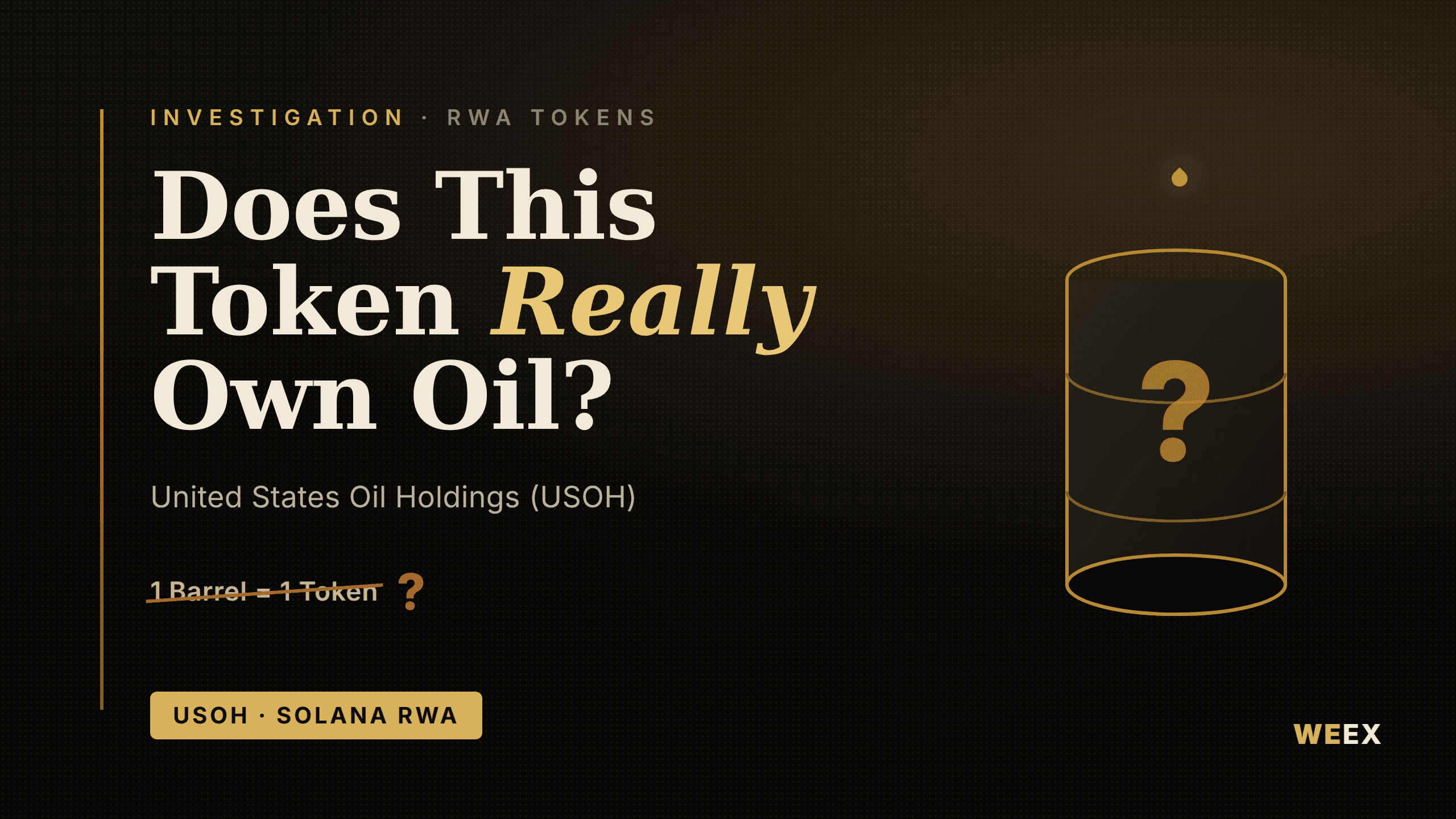
Strip away the language and what remains is a standard Solana token: transferable, tradable on decentralized exchanges, and priced entirely by supply and demand in its liquidity pools. There is no prospectus, no named issuer taking legal responsibility, and no disclosed team. The "oil holdings" exist in the token's name and its website copy — not in any document a holder could enforce.
This matters because the crypto market has a real tokenized-oil and RWA category, where issuers publish reserve attestations, custody agreements, and redemption mechanics. USOH borrows the vocabulary of that category without supplying its substance.
Does USOH actually own any oil?
Short answer: there is no public evidence that it does, and the claims it makes are the kind that would be trivial to prove if true.
Two assertions on the USOH site deserve direct scrutiny. First, the "1:1 barrel-backed" claim. A genuine barrel-backed token needs a custodian holding the physical crude (or a legally equivalent claim on it), a third-party audit or reserve attestation confirming the barrels exist, and a redemption process letting holders convert tokens to the underlying value. USOH publishes none of these. A one-to-one ratio stated on a marketing page is a design assertion, not proof of reserves.
Second, the claimed BlackRock partnership. Naming a major institution as a "custody partner" is a serious representation. No BlackRock disclosure, filing, or press material corroborates any relationship with USOH, and the token's own site provides no partnership documentation, contract, or contact. Unverified association with a household-name institution is one of the oldest trust-manufacturing tactics in fraudulent and semi-fraudulent token launches — it should raise suspicion, not lower it.
To be precise about what is and isn't established: USOH the token demonstrably exists and trades on-chain. What is unestablished is everything that would make it an asset-backed instrument rather than a narrative one. Until audited reserves, a named custodian, and enforceable redemption terms appear, the honest classification is a speculative token wearing a commodity costume.
| USOH marketing claim | What a real oil-backed RWA provides | USOH status (as of July 2026) |
|---|---|---|
| "1:1 barrel-backed" | Third-party reserve audit / attestation | Not published |
| "Custodied with BlackRock" | Named, confirmable custodian + agreement | No corroboration from either side |
| "Fractional exposure to reserves" | Legal claim + redemption mechanism | No redemption terms disclosed |
| Institutional structuring | Identifiable issuer taking liability | Anonymous; no issuer named |
USOH price and market data: why the numbers don't agree
If you look USOH up on three sites, you may see three different prices and market caps. That is not a glitch — it is the single most important practical fact about this token.
Multiple distinct tokens on Solana use the ticker $USOH. Aggregators reported at least eight. Because a Solana token's real identity is its contract address, not its symbol, each of these "USOH" tokens has its own price, liquidity, and holder base — and its own risk of being abandoned.
The divergence is stark. In mid-July 2026, Solana Compass indexed one USOH contract (BGuwU5SdeH93cT3WyN2K4e4vJuqyaFBAkzaZ2wtJUSoH) at roughly a $16 million market cap with about 6,000 holders. On July 14, 2026, an OKX price page tracking a different USOH contract showed the token down 99.92% over 24 hours, with a market cap near zero and liquidity under $2 — effectively a dead pool. WEEX's own wiki analysis, from around the same window, cited a roughly $6 million market cap and about 2,400 holders. These are not conflicting reports on one asset; they are snapshots of separate tokens sharing a name.
| Source / snapshot (mid-July 2026) | Contract | Market cap | Holders |
|---|---|---|---|
| Solana Compass | BGuwU5…tJUSoH | ~$16M | ~6,000 |
| WEEX wiki analysis | (as cited) | ~$6M | ~2,400 |
| OKX price page (Jul 14) | different contract | ~$3 (collapsed −99.92%) | ~650 |
The takeaway is not "USOH is worth $X." It is that quoting a single USOH price is meaningless unless you specify the contract, and that at least one version of this ticker has already gone effectively to zero.
How to verify which USOH you're actually looking at
Before buying any token that shares its name with others, verify the contract on-chain. For a Solana token this takes a few minutes with a block explorer. WEEX's beginner's guide to Solscan walks through the interface; the checks that matter for USOH are:
Confirm the exact contract address matches the one you intend to trade, character for character — not just the symbol and logo, which anyone can copy. Check the holder distribution: if the top 10 wallets hold a large share of supply, a single sell can crater the price. Check mint authority (can new tokens be printed?) and whether liquidity is locked or burned. Look at the trade tape for one-sided, buy-only activity, a honeypot tell where buyers can't sell.
These are the same red flags that define exit scams generally. WEEX's guide on how to spot a rug pull on DexScreener covers the pattern in depth: unlocked or tiny liquidity, concentrated holders, and adjustable contract permissions are the combination that most often precedes a collapse like the one already visible on one USOH contract.
Is USOH a scam or legit?
There is no public proof that USOH is an outright scam, and it would be inaccurate to call it one on current evidence. The token is functional on-chain, and "unverified" is not the same as "fraudulent." But the absence of proof of fraud is a low bar, and it is the wrong one for a money decision.
The accurate framing is risk classification. USOH sits firmly in the high-risk, speculative bucket: unaudited asset-backing claims, an anonymous team, an institutional name-drop nobody has confirmed, thin and fragmentable liquidity spread across colliding tickers, and at least one version already near zero. None of that requires malice to lose you money — a narrative token with no floor simply reprices to whatever the last buyer will pay, which is often nothing.
USOH is not alone in the pattern. It belongs to a wave of "United States [Commodity] Reserve" Solana tokens; its close cousin, United States Water Reserve (USWR), openly amounts to a meme coin with no ownership link to real water. Same template, same institutional-sounding name, same lack of underlying claim. Recognizing the template is the best defense.
What matters most
If you remember one thing: a token's name is not a title deed. "United States Oil Holdings" confers no more legal claim on U.S. oil than a T-shirt reading "FBI" makes you an agent. The barrel-backed and BlackRock claims are exactly the assertions a real project would rush to document — and their absence, not their presence, is the signal.
Frequently asked questions
1. Is USOH backed by real oil?
There is no published audit, custody agreement, or redemption mechanism proving USOH is backed by physical oil as of July 2026. The "1:1 barrel-backed" line appears only as marketing copy, so holders should treat USOH as an unbacked speculative token unless the project releases verifiable reserve documentation.
2. Is USOH partnered with BlackRock?
USOH's website names BlackRock as an institutional partner, but neither USOH nor BlackRock has published any documentation confirming a relationship. An unverified association with a major institution is a warning sign, not a credential.
3. Why do I see different USOH prices on different sites?
Because multiple Solana tokens share the $USOH ticker — aggregators counted at least eight. Each is a separate contract with its own price and liquidity, so a quote is only meaningful alongside the exact contract address.
4. Has USOH already crashed?
At least one USOH contract had collapsed by roughly 99.92% with near-zero liquidity as of July 14, 2026, per an OKX snapshot. Other contracts under the same name were still trading with multi-million-dollar market caps, which is precisely why verifying the contract matters.
5. Can I trade USOH on WEEX?
USOH is a DEX-traded Solana token and is covered in WEEX's crypto wiki for research, but the token itself trades on decentralized venues rather than as a standard WEEX spot or futures pair. Verify the contract on a Solana explorer before interacting with it anywhere.
Risk Warning
Crypto assets are highly volatile and can lose part or all of their value. USOH carries risks beyond ordinary market swings: its asset-backing and custody claims are unverified, so there may be no underlying value or redemption right at all; its team is anonymous, removing accountability; liquidity is thin and split across multiple contracts sharing one ticker, so slippage and exit failure are real; and at least one USOH contract has already fallen effectively to zero. Holder concentration and adjustable contract permissions add rug-pull and honeypot risk. Never buy a token on the strength of its name — verify the contract, the reserves, and the liquidity yourself, and only risk what you can afford to lose entirely.
Disclaimer: This content is provided for general branding and informational purposes only and doesn't constitute financial, investment, legal, or tax advice. Any events, rewards, online events, or related information mentioned herein should not be considered a recommendation, solicitation, or invitation to purchase, sell, trade, or otherwise deal in any crypto assets or to use any services. Crypto assets are highly volatile and may result in loss. WEEX services and online events may not be available in all regions and are subject to applicable laws, regulations, and eligibility requirements. You are responsible for ensuring that your use of WEEX services complies with local laws and for carefully assessing the risks before participating in any crypto-related activities.
You may also like
Is Adobe Stock a Takeover Target? What the 39% Decline From the High Tells Potential Buyers
Is Adobe Stock a Buy After Morgan Stanley Cut Its Target by 34%?
Morgan Stanley Says Micron Stock Selloff Is a Buying Opportunity: Should You Listen?
Micron Stock Has 66% Upside as Open Source AI Models Guzzle Memory: What BofA Actually Said
Microsoft Stock Before July 29 Earnings: What Azure Growth Rate Actually Needs to Show
Microsoft Stock and the AMD AI Partnership: Why Diversifying Beyond Nvidia Matters
Oil Price Above $90: What the US-Iran War Means for Your Portfolio Right Now
Mark Cuban Stock Options Philosophy: The Broadcast.com Sale That Made 300 Employees Millionaires
Mark Cuban Stock Options Philosophy: SpaceX vs Blue Origin and Why the Difference Matters
What Is a Duress Wallet Protocol and How Does It Prevent Forced On-Chain Transfers in 2026
Why Did the 2026 World Cup Become the Ultimate Catalyst for Trump's Crypto Empire
United States Water Reserve (USWR): The Contract You're Actually Buying and Whether You Can Sell It
How Did Trump's $TRUMP Meme Coin Offer VIP Access to the 2026 World Cup Final
CRCL Stock: Why Circle Crashed 70% and Where It Goes Next
USAR Tokenized Stock Explained: How to Trade USA Rare Earth as a Token in 2026
How Trump Used $TRUMP Meme Coin World Cup Tickets to Reverse a 97% Crash in 2026
What else makes Robinhood Chain stand out beyond Meme coins?
Why Was Donald Trump at the 2026 World Cup Final and How Did Fans React
What Is DeXe (DEXE) Crypto and How Does Its DAO Governance Protocol Work in 2026
WEEX $NIGHT Airdrop: Share 50,000 USDT in Rewards on WEEX
GOOGL Stock Forecast: Q2 2026 Earnings and AI Growth Outlook
Tesla Stock Forecast After Q2 2026 Earnings: Will TSLA Rally or Pull Back?
Tesla Stock Is Down 17% in 2026: What Q2 Earnings Need to Deliver to Turn the Story Around
What Is Mark Cuban's Stock Options Philosophy? How SpaceX Turned Welders Into Millionaires
SPCX Stock Price and the $25 Billion Short Position: Is a Short Squeeze Coming?
Is SPCX Stock Price a Buy? What Uber, Airbnb and Rivian's IPO Crashes Tell Investors
SPCX Stock Price Hits All Time Low: What Investors Should Do Right Now
How Will the CLARITY Act and Bank-Grade Stablecoin KYC Rules Change Crypto Trading in 2026
Why Is BitMine Buying Millions of Ethereum Tokens and Staking $9 Billion in ETH in 2026
How to Protect Your Bitcoin from Physical Attacks: Lessons From the NYC Crypto Torture Case in 2026
Is Adobe Stock a Takeover Target? What the 39% Decline From the High Tells Potential Buyers
Is Adobe Stock a Buy After Morgan Stanley Cut Its Target by 34%?
Morgan Stanley Says Micron Stock Selloff Is a Buying Opportunity: Should You Listen?
Micron Stock Has 66% Upside as Open Source AI Models Guzzle Memory: What BofA Actually Said
Microsoft Stock Before July 29 Earnings: What Azure Growth Rate Actually Needs to Show
Microsoft Stock and the AMD AI Partnership: Why Diversifying Beyond Nvidia Matters
Contents
Popular coins
Latest articles





