
Solana Alpenglow Mainnet Date: Why Sept 28 Wasn't Launch Day

 Prefer us on Google


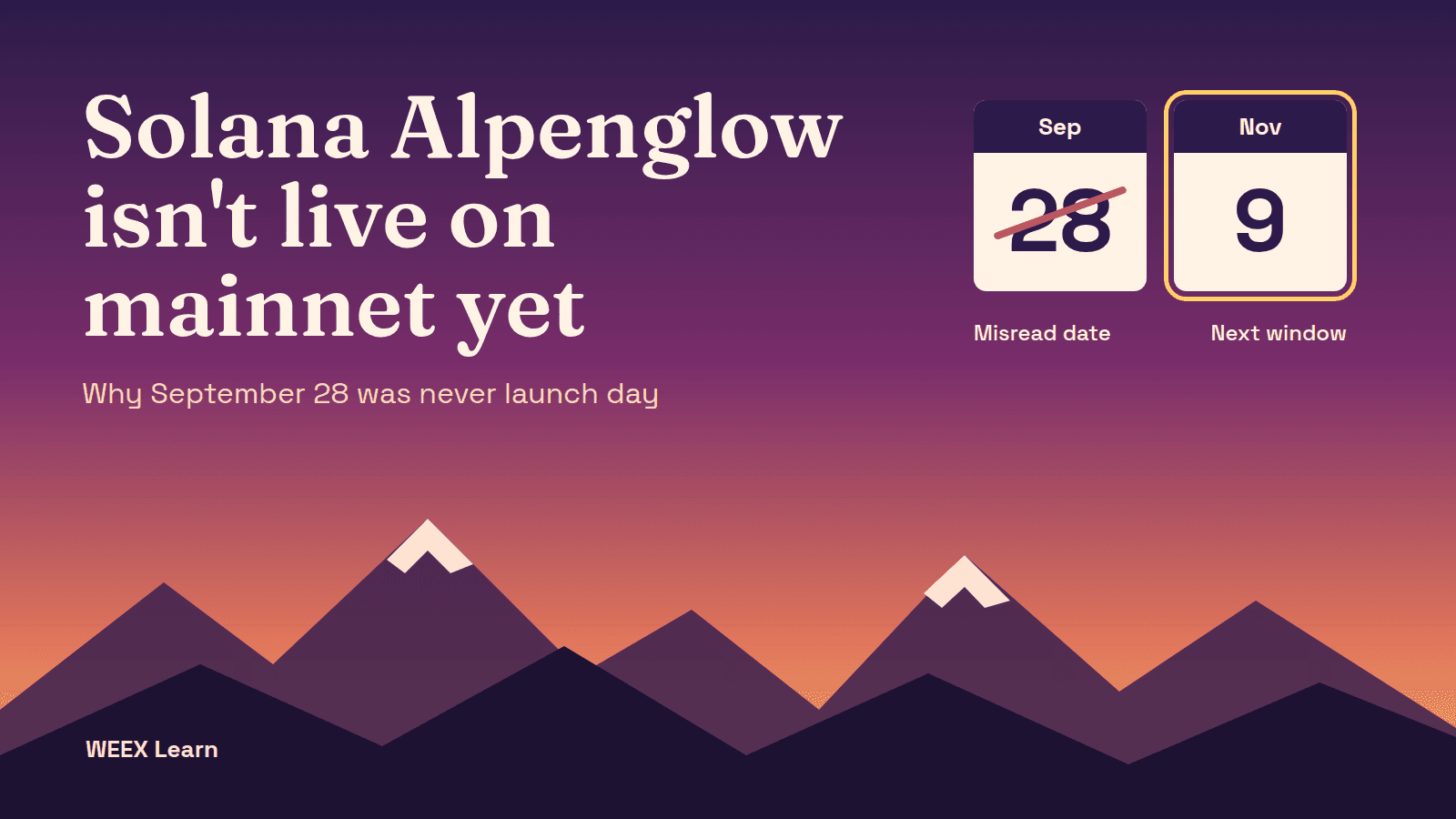
Alpenglow did not activate on Solana mainnet on September 28, 2026, and as of September 29 there is still no confirmed Solana Alpenglow mainnet date. The September 28 figure came from Anza's release schedule, where it marked the day mainnet feature activations could resume, not the day Alpenglow would switch on. The upgrade is running on Solana's testnet and devnet, the next scheduled mainnet window opens November 9, and nothing changes for SOL holders or stakers in the meantime. Below: what the date really meant, what Alpenglow changes, where each network stands, and how to check activation yourself.
Where the September 28 Date Came From
Anza, the team behind Solana's main validator client Agave, published the Agave v4.3 release schedule on August 12, 2026. Its final mainnet row read, in effect, "resume feature activation" on September 28. Version 4.3 carries the Alpenglow code, so many reports joined the two facts and concluded that Alpenglow would go live that day.
That reading skipped a step. Solana ships new protocol features switched off. Each one sits behind a feature gate: code already present in every validator's software that only takes effect once it is deliberately activated and enough stake has upgraded. Gates are flipped at epoch boundaries, and an epoch currently lasts roughly two days. A schedule date therefore opens a window in which gates can be activated. It does not say which ones.
As the weekend approached, Anza's people pushed back publicly. Solana co-founder Anatoly Yakovenko answered launch chatter with a single word, "decel." Roger Wattenhofer, Anza's head of research, questioned activating a consensus protocol that had only been on a public testnet for days and summed it up as "No Alpenrush." Anza's feature-gate tracker still lists SIMD-0326, the Alpenglow proposal, among features awaiting mainnet activation.
What Alpenglow Changes on Solana
Alpenglow is the largest consensus change in Solana's history. Validators approved it as SIMD-0326 in September 2025 with about 98% of the stake vote in favor. It rolls out in two phases.
Phase one, Votor, replaces TowerBFT, Solana's current voting system. Validators send votes directly to each other and aggregate them into certificates instead of posting each vote as an on-chain transaction. A block can finalize after one voting round if validators with at least 80% of stake approve it, or two rounds at 60%. The target is finality of roughly 150 milliseconds, against about 12.8 seconds today.
Phase two, Rotor, would replace Turbine, the layer that spreads block data across the network. It is a separate, later proposal and is not part of the current activation.
Two effects matter beyond the headline speed:
- Vote transactions disappear. Today, validator votes consume a large share of Solana's block space and cost validators fees. Removing them frees capacity and changes validator economics; a proposed Validator Admission Ticket would charge validators directly rather than deduct from delegators' rewards.
- "Confirmed" and "finalized" converge. Exchanges and bridges usually wait for finality before crediting deposits. Once Alpenglow is live on mainnet, that wait could shrink from seconds to a fraction of a second, which is the change ordinary users would actually notice.
Transactions, programs and fees are not changed by Alpenglow itself. It alters how the network agrees on blocks, not how applications run.
Alpenglow Status by Network as of September 29, 2026
The upgrade is further along than a missed date suggests. Here is where each environment stands:
- Testnet: Live. Alpenglow went active on Solana's public testnet in the week of September 22, with Anza confirming the Alpenglow genesis block and TowerBFT's retirement there on September 24.
- Devnet: Live. Devnet migrated around September 25 at epoch 1167, giving app developers an environment to test against.
- Mainnet: Not active. Agave v4.3, which contains the Alpenglow code in a dormant state, has run on mainnet since September 18 and became the recommended version for all validators on September 21.
- Next mainnet window: Anza's Agave v4.4 schedule, published September 22, lists mainnet feature activations resuming on November 9. Like September 28, that is a window, not a promise.
A few open items explain the caution. Firedancer, Solana's second independent validator client, still has to ship Votor support, and Anza wants a clean observation period on public test networks before changing consensus on a chain carrying billions in value. An August bug bounty worth 50,000 SOL was part of the same hardening process.
-- Price
Solana Alpenglow Mainnet Date: How to Track It Yourself
The Alpenglow episode is a textbook case of a secondary-source date outrunning the primary source. Three checks avoid getting caught next time:
- Watch the feature gate, not the headline. Anza's feature-gate tracker is where SIMD-0326 moves from "pending" to "active." Until it does, Alpenglow is not live on mainnet.
- Read schedule entries literally. "Resume feature activation" means the queue is open, not that a named feature is next.
- Look for the client team's own announcement. Anza and the Solana Foundation will announce the mainnet switch directly; a repost of a calendar is not confirmation.
What Alpenglow Means for SOL Holders Right Now
For holders, the honest answer is: nothing to do today. SOL traded around $118.75 on September 28, down about 3% on the day and roughly flat on the week, so the market did not treat the non-event as bad news.
- Staked SOL: No action needed. Delegations keep earning; unstaking still frees funds at the end of the current epoch, so there is no benefit in pulling stake around an upgrade date that has not been set.
- SOL on exchanges: Deposits and withdrawals keep working as normal. Faster crediting is a later benefit, once mainnet activation happens and platforms adjust their confirmation rules.
- Scam risk: Protocol upgrades attract fake "Alpenglow migration" or "token swap" messages. There is no swap, no new token and nothing to claim; any site asking you to connect a wallet or enter a seed phrase for Alpenglow is a scam.
Latency is also where Solana's broader infrastructure is heading. DoubleZero, a dedicated fiber network used by high-performance validators, attacks the same problem from the networking side; our DoubleZero (2Z) explainer covers the project behind that token.
Alpenglow Is Delayed, Not Derailed
The Solana Alpenglow mainnet date has not slipped so much as it was never set. The upgrade is live on testnet and devnet, the code is already sitting dormant on mainnet validators, and the next activation window opens November 9. The bigger lesson is procedural: on Solana, the feature gate is the source of truth. Until SIMD-0326 flips on mainnet, treat every launch date you read as a guess.
FAQ
1. Is Alpenglow live on Solana mainnet?
No. As of September 29, 2026, Alpenglow runs on Solana's testnet and devnet only. The SIMD-0326 feature gate is still pending mainnet activation.
2. When will Alpenglow launch on Solana mainnet?
No date is confirmed. Anza's Agave v4.4 schedule opens the next mainnet feature-activation window on November 9, 2026, but Alpenglow could activate then or later.
3. Do I need to do anything with my SOL for Alpenglow?
No. There is no token swap or migration. Staked SOL keeps earning, and any request to connect your wallet or share a recovery phrase for Alpenglow is a scam.
4. How fast will Solana be after Alpenglow?
Alpenglow targets finality of around 150 milliseconds, down from roughly 12.8 seconds. That is a design target; real mainnet performance will only be known after activation.
Risk Warning
Crypto assets are highly volatile, and you can lose part or all of your investment. Protocol upgrade dates are planning targets that can change without notice, and trading around expected upgrade dates can backfire when timelines slip. Consensus changes carry technical risk, including bugs, validator client issues and temporary network instability after activation. Staking involves lock-up periods and validator performance risk. This article reflects public information as of September 29, 2026 and is not financial advice.
This content is provided for general informational purposes only and doesn't constitute financial, investment, legal, or tax advice. Any events, rewards, online promotions, or related information mentioned herein should not be considered a recommendation, solicitation, or invitation to purchase, sell, trade, or otherwise deal in any crypto assets. Crypto assets are highly volatile and may result in loss. The availability of WEEX services, products, and related events may vary by region. You are responsible for ensuring that your participation is in accordance with applicable local laws and regulations.
You may also like

Best Crypto App for Beginners: Exchange App, Wallet App, or Both?
What Is Gno.land (GNOT)? How GnoVM, Storage Deposits, Tokenomics, and GovDAO Work

Coincheck FLR DAI Delisting Dates and Holder Checklist
Germany's Crypto Tax Draft 2027: What the 50 Percent Substitute Assessment Means

Who Can Operate in Russia's Crypto Market from 5 October 2026

Italian Crypto Tax Return 2026: Filing Deadline, Forms and Gains Rate
XOF, XAF and CDF Are Now Available on WEEX P2P: What Users Need to Know
INTC Stock Surged 14%: Intel Only Has Enough Chips for Half Its Clients
WEEX and MiCA: What the RDWW-1194 Entry in Poland's Register Says
FreeBitco.in Has Shut Down: What Users Should Know
Pi Network vs Other Mobile Mining Projects: What's the Difference
How Does Mining Actually Work on Pi Network?

Is Pi Network Legit, or Is It Considered a Scam?
What a Blockchain Explorer Can and Cannot Tell You
How to Look Up a Wallet Address and Transaction History
How to Buy USDT With NGN via Bank Transfer on WEEX?
How to Verify a Crypto Transaction With a Blockchain Explorer?

Why Did the CLARITY Act Fail in the Senate, and What Happens Next for Crypto Regulation?
15 Notable Robinhood Chain Protocols: Which Assets Trade on WEEX?
Vietnam Decree 284 on Crypto Assets: Scope, Effective Date and Compliance
Vietnam VASP Licence: How the Crypto Licensing Regime Works and How to Verify a Platform
How Does WEEX KYC Verification Work? A Taiwan User Guide
Spot Trading for Beginners: From Deposit and Order to Holding
What Is USDT? A Taiwan Beginner's Guide to Use, Deposits and Risk
Macro Protocol (MTP): Listing Status and a Safe Verification Guide
Airdrops This Week (September 17-23, 2026): Official Conditions and Safety Checks
What the LUSD Attack Shows About DeFi Risk
SEI: The Trading-Focused Blockchain and Its Token on WEEX
Shiba Inu (SHIB): What to Check Before Trading on WEEX
RENDER: The Render Network Token and Trading on WEEX
Best Crypto App for Beginners: Exchange App, Wallet App, or Both?
What Is Gno.land (GNOT)? How GnoVM, Storage Deposits, Tokenomics, and GovDAO Work
Coincheck FLR DAI Delisting Dates and Holder Checklist
Germany's Crypto Tax Draft 2027: What the 50 Percent Substitute Assessment Means
Who Can Operate in Russia's Crypto Market from 5 October 2026
Italian Crypto Tax Return 2026: Filing Deadline, Forms and Gains Rate




