
Is National Oil Dividend Fund (NODF) Backed by Oil? Reserve and Dividend Claims Checked

 Prefer us on Google



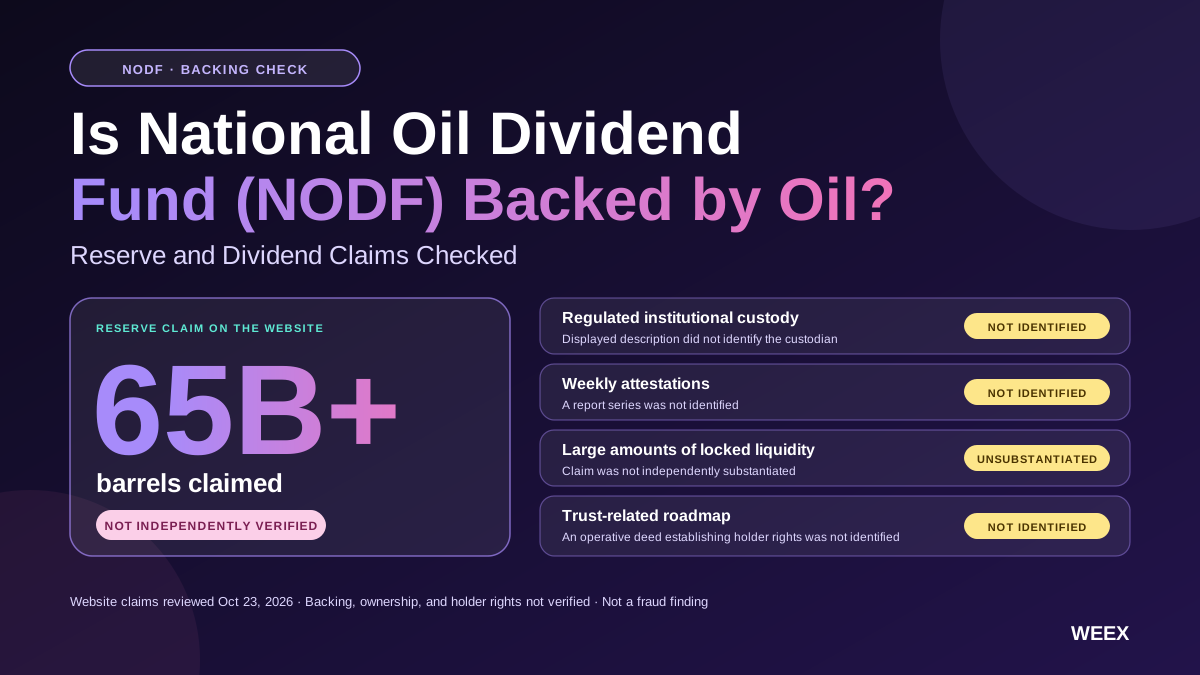
National Oil Dividend Fund (NODF) has not been established as an oil-backed investment through the evidence reviewed for this article. Its website presents reserve, custody, and attestation claims, but our October 23, 2026 examination did not identify the complete documentation connecting specific oil assets to enforceable token-holder rights. A token can exist and trade without giving its holders ownership of petroleum, a redemption entitlement, or a claim on operating income.
Our judgment is that NODF should be evaluated through its asset and legal structure before its price. The decisive question is whether an identifiable issuer controls identifiable assets and has granted identifiable rights to holders of the exact token. References to national energy strategy cannot supply that missing connection.
What Is National Oil Dividend Fund (NODF)?
National Oil Dividend Fund is a crypto name associated with a digital-oil narrative. The reviewed website, nodf.site, connects its token proposition to petroleum reserves, energy security, and on-chain markets. Its footer describes an energy-themed digital asset and disclaims representations of government affiliation or endorsement. (National Oil Dividend Fund)
That description leaves several possible investment structures unresolved.
An oil-themed token might simply trade on sentiment toward energy markets. A different product could represent a contractual claim on oil-related revenue. Another could hold financial instruments whose value depends on oil prices.
These arrangements produce different rights and risks. They should not be grouped together merely because they use similar imagery.
For NODF, the reviewed evidence supports describing the project’s advertised proposition. It does not support treating its advertised reserves as independently verified assets belonging to token holders.
This distinction also answers searches for “NODF stock.” A crypto token’s name does not establish that it represents a publicly listed company, a fund share, or an ownership interest in an energy business. Such a relationship would require separate documentation.
What Did Our Direct Website Review Establish?
Our review focused on what the public page actually disclosed and which supporting records were accessible from it.
The site presented several financial claims, summarized below. “Not verified” describes the result of this review; it does not establish that a document cannot exist elsewhere.
| Website Claim | Supporting Evidence Needed | Review Result |
|---|---|---|
| A reserve thesis exceeding 65 billion barrels | Asset identification, ownership or contractual rights, and a dated technical assessment | A complete supporting package was not identified |
| Regulated institutional custody | Named legal entity, regulator, custody agreement, and confirmation of assets covered | The displayed description did not identify the custodian |
| Weekly attestations | Accessible dated reports, preparer, procedures, and conclusions | A report series was not identified |
| Large amounts of locked liquidity | Exact pools, quote-asset reserves, lock contracts, and unlock conditions | The claim was not independently substantiated |
| A trust-related roadmap | Executed governing documents and an explanation of beneficiary rights | An operative deed establishing holder rights was not identified |
The website’s reserve and trust-navigation links returned sections of the same page during our inspection, rather than a separate documentary evidence package.
This is a disclosure finding, not a determination of misconduct. It means that the page’s asset proposition could not be verified to the standard needed to value NODF as an oil-backed claim.
A useful next disclosure would connect each assertion to an identifiable record. Repeating the assertion in a graphic or another website section would not resolve the gap.
Why Does the Exact National Oil Dividend Fund (NODF) Token Matter?
Asset verification begins with token identity. Otherwise, a valid document or chart can be attached to the wrong market.
The currently reviewed website displayed this Solana address:
8cENLm4vr5cFd9pfy2AcXjEPRv47aZrAMZbYhWWjpump
A TOPONE Markets article updated October 19 identified a different address:
9Cpp25zEnT5k5DUpML3VFX5ePA1fDinwXU4vpM4opump
That difference is directly observable between the two sources. It does not, by itself, establish a migration, a copy, or a shared operator.
Following the reviewed website’s Coinbase button led to a token-specific page whose URL referenced the website-displayed address. This confirms the link destination, rather than the asset’s backing or the operator’s identity.
Before applying any reserve claim, supply figure, or price to a purchase, the reader needs a consistent chain:
Issuer identity → governing documents → exact token address → intended market.
If a migration occurred, its documentation should explain the relationship between the assets and any consequences for holders. Without that evidence, historical information about one mint should not silently become current information about another.
-- Price
What Does “Oil-Backed” Actually Mean?
“Oil-backed” can describe several economically different arrangements. A credible product should specify which one applies.
Physical inventory involves oil already extracted and held under identifiable custody. Production interests relate to future output or proceeds. A royalty interest can provide a share of revenue without ownership of the operating company. A financial instrument can provide oil-price exposure through contracts rather than physical barrels.
| Possible Structure | What the Underlying Asset Could Be | Main Verification Question |
|---|---|---|
| Physical inventory | Identified stored petroleum | Who owns it, and is it available to satisfy holder claims? |
| Production or royalty interest | Rights to specified future proceeds | Which contract creates the entitlement? |
| Financial exposure | Futures, fund interests, or other instruments | What does the issuer actually hold? |
| Oil-themed token | A traded asset using an energy narrative | Does any enforceable underlying claim exist? |
These structures are not interchangeable.
Even genuine ownership of oil-related assets would not automatically give token holders rights to them. The issuer could own assets while issuing a token that grants only community participation or discretionary rewards.
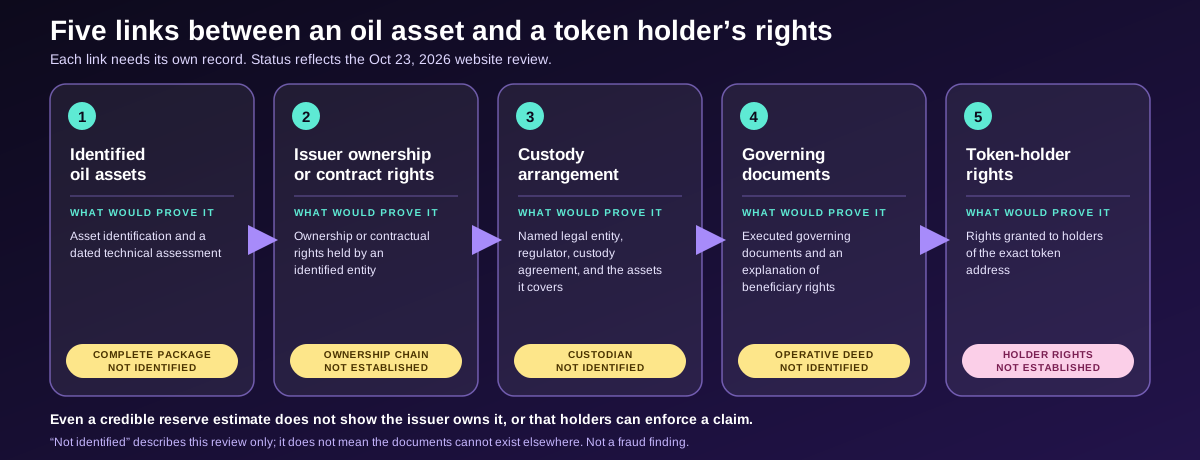
The missing step is the legal and operational connection between the asset and the token.
For NODF, a useful disclosure would therefore explain both sides: what the project controls and what holders can enforce. Either side alone would leave the backing proposition incomplete.
Are Underground Oil Reserves the Same as Stored Barrels?
No. Underground reserves are estimates of recoverable petroleum under specified conditions. Stored inventory is oil that has already been produced.
The U.S. Energy Information Administration defines proved reserves by reference to geological and engineering evidence, recoverability, and existing economic and operating conditions. A reserve estimate is therefore more specific than a broad statement that petroleum exists in a region.
Several separate questions follow.
Which fields or rights are involved? Who holds the relevant interest? What portion is attributable to the entity making the claim? Which costs and obligations attach to extraction? What date and assumptions support the assessment?
Even a technically credible reserve estimate does not establish that a token issuer owns the reserves.
Nor should underground barrels simply be multiplied by the current oil price to calculate token backing. Production requires time, expenditure, infrastructure, and applicable permissions. The economic value of a particular interest depends on its terms and costs.
The practical implication is that a geological quantity cannot be used as a substitute for an issuer’s balance sheet or a holder’s redemption value.
What Would Prove Ownership of the Oil Assets?
A credible ownership claim needs an identifiable asset and a documented chain connecting it to the relevant entity.
For stored oil, the evidence might include ownership records, storage arrangements, inventory confirmations, and information about claims against the inventory. For production or revenue interests, it would involve the contracts defining those interests.
The documentation must identify the actual right. Owning a company that operates near an oil field is different from owning the petroleum. Holding a marketing agreement is different from holding a production entitlement.
A useful ownership review also considers restrictions and competing claims. Assets pledged to another creditor may not be freely available to token holders. A minority interest may carry obligations or limitations absent from a promotional summary.
These are examples of questions a properly documented structure should answer, not findings about undisclosed NODF arrangements.
The present evidentiary gap is that this review did not establish a complete ownership chain for the advertised backing proposition. Until it does, the asset claim should remain attributed to the project.
How Should a Custodian Claim Be Verified?
A custody claim becomes useful when the institution, service, and assets can be identified.
An impressive category label is insufficient. Readers need the custodian’s legal name, jurisdiction, relevant authorization, and confirmation that the stated arrangement covers the assets under discussion.
The scope matters as much as the name. An institution might hold a project’s digital assets without holding oil. It might administer documents without guaranteeing title. It might provide a limited service that does not extend to token-holder claims.
Verification should therefore establish what the custodian is responsible for and what it is not responsible for.
A confirmation should also be current and attributable to the institution. A logo on a project website or a reference to a well-known financial brand is weaker evidence than an authentic statement describing the relationship.
For NODF, the reviewed public page did not provide enough information to complete that exercise. Naming the institution and explaining the arrangement would be a substantive improvement in disclosure.
Would an Attestation Establish That the Token Is Fully Backed?
The answer depends on what the report examines.
An attestation or verification report can be useful when it states the subject matter, date, criteria, procedures, findings, and limitations. Its title or frequency does not establish comprehensive coverage.
For example, a report might confirm that specified assets existed at a particular time without establishing the issuer’s complete liabilities or token holders’ rights.
The PCAOB’s Office of the Investor Advocate has warned that crypto proof-of-reserve reports are not equivalent to financial-statement audits. That general guidance is not a finding about NODF, but it illustrates why the scope of a report must be read carefully.
For an oil-related token, several forms of evidence may be needed: technical assessment of the assets, confirmation of ownership or custody, financial information, and governing documents connecting holders to the structure.
One report need not perform all those functions. The problem arises when a limited report is marketed as if it does.
Until an actual report is available for review, “weekly attestation” remains a stated reporting intention or claim rather than independently examined assurance.
Does National Oil Dividend Fund (NODF) Pay Dividends?
A dividend entitlement cannot be inferred from the project’s name.
A credible distribution mechanism needs an identifiable source of cash, a calculation method, qualifying conditions, and an accountable payer. Holders also need to know whether payments are discretionary or obligatory.
Possible funding sources have different implications. Operating income, royalties, treasury assets, trading fees, and promotional allocations are not the same kind of return.
Consider a hypothetical project distributing fees collected from trading its token. A payment could be genuine while depending on continued speculative turnover rather than oil production. Describing it as an oil dividend would obscure the economic source unless that distinction were explained.
Another project might receive actual oil-related income but distribute only part of it after costs and reserves. Gross revenue would not equal the amount available to token holders.
This review did not verify a complete NODF distribution formula and payment record. The appropriate conclusion is that dividend rights remain unestablished in the reviewed evidence.
What Would an Oil-Income Distribution Look Like?
A transparent distribution can be tested through a cash-flow calculation.
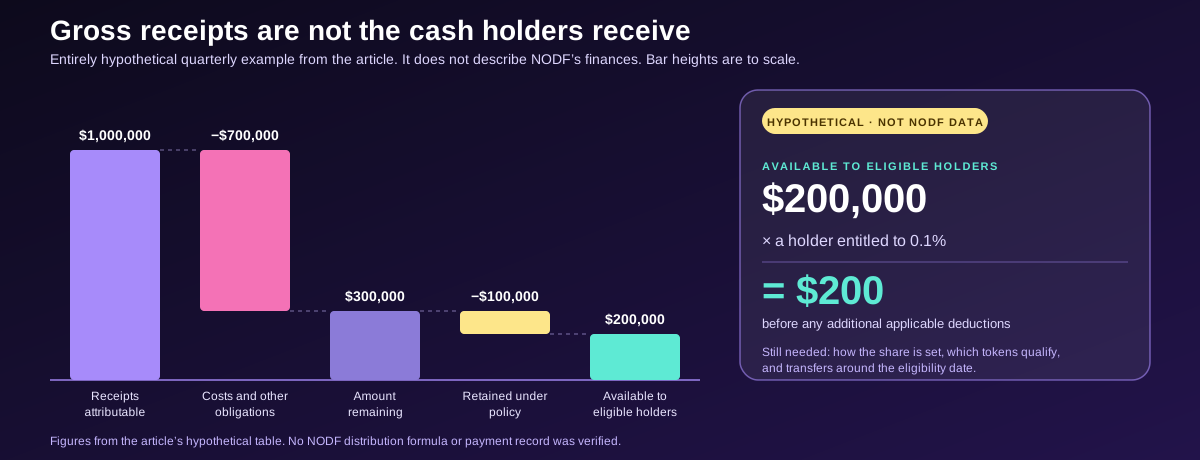
Consider an entirely hypothetical structure with $1 million of quarterly receipts attributable to its assets. Suppose operating costs, financing, and other obligations consume $700,000, leaving $300,000. The governing policy then retains $100,000 and makes $200,000 available for distribution.
A holder entitled to 0.1% of that distributable amount would receive $200 before any additional applicable deductions.
| Hypothetical Quarterly Calculation | Amount |
|---|---|
| Receipts attributable to the assets | $1,000,000 |
| Costs and other obligations | −$700,000 |
| Amount remaining | $300,000 |
| Retained under the distribution policy | −$100,000 |
| Available to eligible holders | $200,000 |
These numbers do not describe NODF. They show the information needed to evaluate a distribution claim.
The calculation should reconcile with financial records and actual payments. It should also explain how the holder’s percentage is determined, whether all tokens qualify, and what happens when tokens are transferred around the eligibility date.
Without those rules, a prospective buyer cannot reliably calculate expected income.
Can Market Capitalization or Locked Liquidity Prove Oil Backing?
Neither establishes ownership of petroleum.
Market capitalization is a valuation derived from token price and supply. Liquidity describes assets available in a trading arrangement. Oil backing concerns an underlying asset claim.
A token could have an active market without owning oil. An entity could own oil-related rights while its token trades in a thin market. Those situations require different analyses.
A liquidity-lock claim also needs precision. The evidence should identify the pool, assets, amounts, lock mechanism, control rights, and release conditions. Locking a liquidity position does not guarantee a stable token price or prevent holders from selling.
Likewise, an apparently large pool value should be examined by asset composition. A position containing mostly the project’s own token does not provide the same exit capacity as an equivalent amount of widely liquid quote assets.
For a buyer, the distinction is practical: backing determines what underlying claim might exist, while market depth affects what a sale may realize. Neither can be substituted for the other.
What Did the October 21 Marketing Milestone Establish?
The reviewed website attached its energy-market narrative to an October 21 date. That date had passed by the October 23 review. (National Oil Dividend Fund)
A completed countdown does not establish that an asset transaction, government authorization, or distribution occurred.
The relevant follow-up evidence would be specific: an executed agreement, an attributable announcement, a published report, or a transaction connected to the claimed milestone.
A broader energy-policy development would still require a separate connection to the token. Events affecting oil markets do not automatically transfer assets or revenue rights to a crypto issuer.
Accordingly, this article does not treat the marketing date as proof that the backing proposition became operative. A useful update would compare the stated milestone with the actual documentary outcome.
Is National Oil Dividend Fund (NODF) Legit or a Scam?
The reviewed evidence does not support a definitive fraud finding. It also does not support presenting NODF as a verified oil-backed fund.
These conclusions can coexist because they answer different questions.
Fraud is not established merely by missing information. But missing information can prevent an investment claim from being substantiated. A buyer does not need to prove wrongdoing before deciding that the evidence is insufficient.
The most defensible assessment is that the oil-backing and distribution propositions remain unverified within this review.
That assessment should change if credible new evidence appears. An identifiable issuer, authenticated asset records, independently reviewable reports, and clear holder rights would materially improve the analysis.
The standard should remain consistent in either direction: classify each new document by what it establishes, rather than treating promotional confidence or public suspicion as proof.
Can You Trade National Oil Dividend Fund (NODF) on WEEX?
This review did not verify a WEEX futures or spot market for the specific NODF asset discussed here. No token-specific promotion or fee discount was verified.
Readers should not infer availability from a similarly named asset or a price-information page. Before depositing any token, confirm that the exchange supports its exact blockchain and address.
The relevant WEEX resource for this article is the WEEX Trust Center, which provides access to platform reserve information and verification resources. It can help readers evaluate WEEX-related disclosures; it does not establish the backing of an unrelated oil-themed token. (weex.com)
Exchange verification and token verification remain separate tasks. A genuine exchange destination does not authenticate every claim made by the website linking to it.
WEEX Editorial View: Treat the Oil Claim as Unverified Until the Rights Are Documented
The decisive gap is the missing connection between petroleum assets and enforceable token-holder rights.
Our review found a public asset narrative, but it did not establish the complete ownership, custody, assurance, and distribution structure needed to value NODF as an oil-backed investment. The address difference between the current website and earlier coverage adds a separate identity question.
We would therefore evaluate a purchase through its observable trading conditions while assigning no assumed value to an undocumented oil entitlement.
That position does not require a scam label. It requires a clear evidentiary boundary: a reserve claim needs asset records, a custody claim needs an identifiable arrangement, and a dividend claim needs defined rights and funding.
FAQ
1. Is National Oil Dividend Fund (NODF) Backed by Real Oil?
Real oil backing was not independently established through the evidence reviewed. A credible backing claim requires identifiable assets, documented ownership or contractual rights, and a demonstrated connection to the exact token.
2. Does National Oil Dividend Fund (NODF) Pay Dividends?
This review did not verify a complete distribution mechanism and payment history. The name alone does not establish an entitlement. Readers need the funding source, calculation rules, eligibility conditions, and attributable payments.
3. Is National Oil Dividend Fund (NODF) a Stock?
The reviewed evidence did not establish that NODF represents listed equity or a fund share. Those rights would require specific governing documents rather than a financial-sounding name.
4. Does a Reserve Attestation Replace an Audit?
A report must be evaluated by its scope. A limited asset confirmation does not automatically establish complete liabilities, ownership, financial condition, or holder rights. An attestation label should not be treated as comprehensive assurance.
5. Is National Oil Dividend Fund (NODF) a Scam?
A definitive fraud conclusion was not established. The narrower finding is that the advertised oil backing and holder-income rights remained unverified in the reviewed materials.
Sources
Public project disclosures: nodf.site, reviewed October 23, 2026, including its reserve claims, navigation, displayed token address, outbound market link, and footer.
Identity comparison: TOPONE Markets’ NODF article, updated October 19, 2026. Technical context: U.S. Energy Information Administration reserve definitions. Assurance context: the PCAOB Office of the Investor Advocate’s proof-of-reserve advisory. Platform resource: WEEX Trust Center.
This review did not authenticate a private custody agreement, executed trust deed, or complete reserve-report series. The cash-flow example is hypothetical.
This content is provided for general informational purposes only and doesn't constitute financial, investment, legal, or tax advice. Any events, rewards, online promotions, or related information mentioned herein should not be considered a recommendation, solicitation, or invitation to purchase, sell, trade, or otherwise deal in any crypto assets. Crypto assets are highly volatile and may result in loss. The availability of WEEX services, products, and related events may vary by region. You are responsible for ensuring that your participation is in accordance with applicable local laws and regulations.
You may also like
Bloom Crypto Bot Wallet Drains: What Happened and What Users Should Check

TSLA Stock After the Flying Roadster Reveal: What the Q3 Results, SpaceX Merger Talk and Analysts Say
SK Hynix Stock Before Q3 Earnings: Special Dividend Reports, HBM4 and What Investors Want to See on October 28
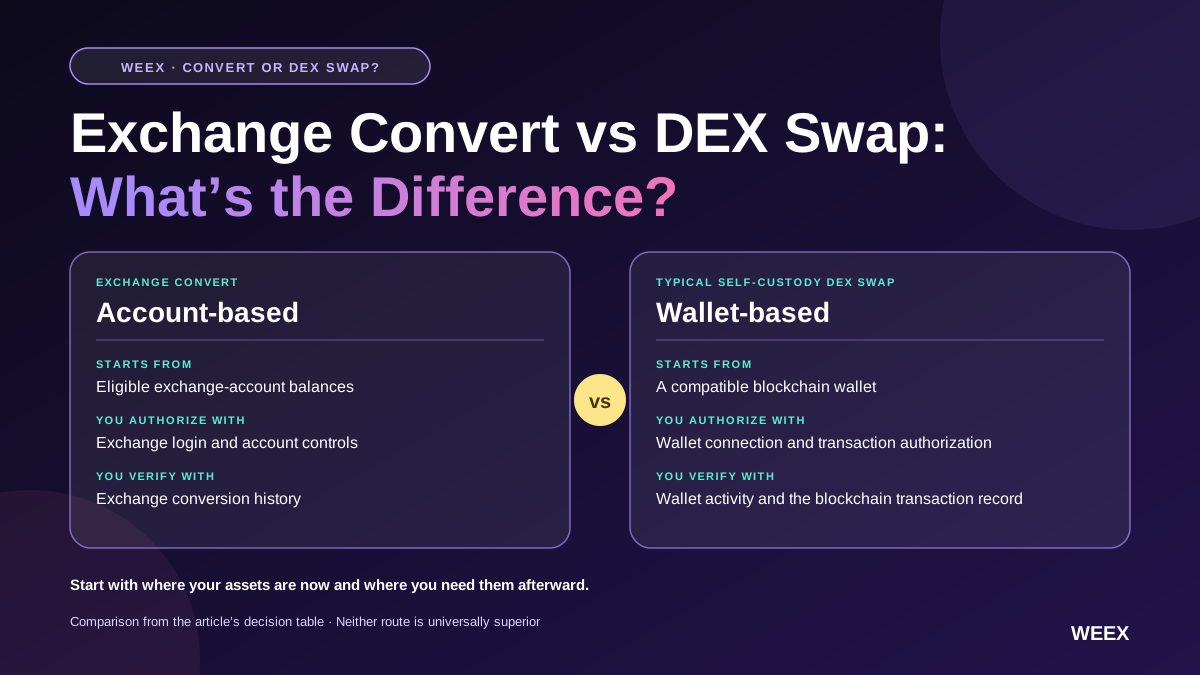
Exchange Convert vs DEX Swap: What’s the Difference? Try Convert Crypto On WEEX!
What Is Crypto Convert and How Does It Work? Try Crypto Convert On WEEX Now!
WEEX Convert Available Balance: How to Check and Use Max
FTR Coin After the Roadster Hype: Why Flying Tesla Roadster Fell Back and What to Check Before Trading
Flying Tesla Roadster (FTR) Coin: What Is It and What to Check Before Trading a Roadster Memecoin
CoreWeave Stock Plunges 15%: Why a Bond Yield Spooked CRWV
PENDLE Price and FLHYon: What Franklin's Bond Token Changes
WEEX 2026 New User Guide: Register, Complete KYC, and Claim the Welcome Bonus (Step-by-Step)
WEEX Convert Guide: How to Swap Crypto on Web and App and What the Quote Really Means
MU Stock Falls Below $1,000: Is the CXMT Threat Real or Just an Excuse to Take Profits?
Stop Limit Order: How It Works and Why It Can Fail to Fill
Best Cold Wallet Crypto for Beginners: 5 Picks Under $150

Best Crypto Broker for Beginners: What to Check in Fees, Regulation, Security and Support Before You Deposit
Who Is David Ellison? Skydance’s Strategy, Media Consolidation, and the Investment Case
PEP Earnings: PepsiCo Beats Q3, Cuts Guidance on North America
ETH Futures: Why Ether Is Falling Faster Than Bitcoin This Week
Third-Party Trading Platforms vs Direct WEEX Trading: Fees, Liquidity, Security, and Control
How Copy Trading, Signal, and Telegram Trading Tools Can Build With WEEX Broker
How Quant Trading Platforms and Bots Can Build With WEEX Broker
How Trading Platforms and Terminals Can Connect to WEEX Broker
How to Buy USDT in Thailand: Payment Methods, Fees and Transfer Checks
What Is RLC Crypto? How iExec (RLC) Powers Confidential Computing

What Is WEEX Fast Connect? How OAuth Connects Third-Party Trading Platforms

How to Become a WEEX Broker: Application, API Setup and Go-Live
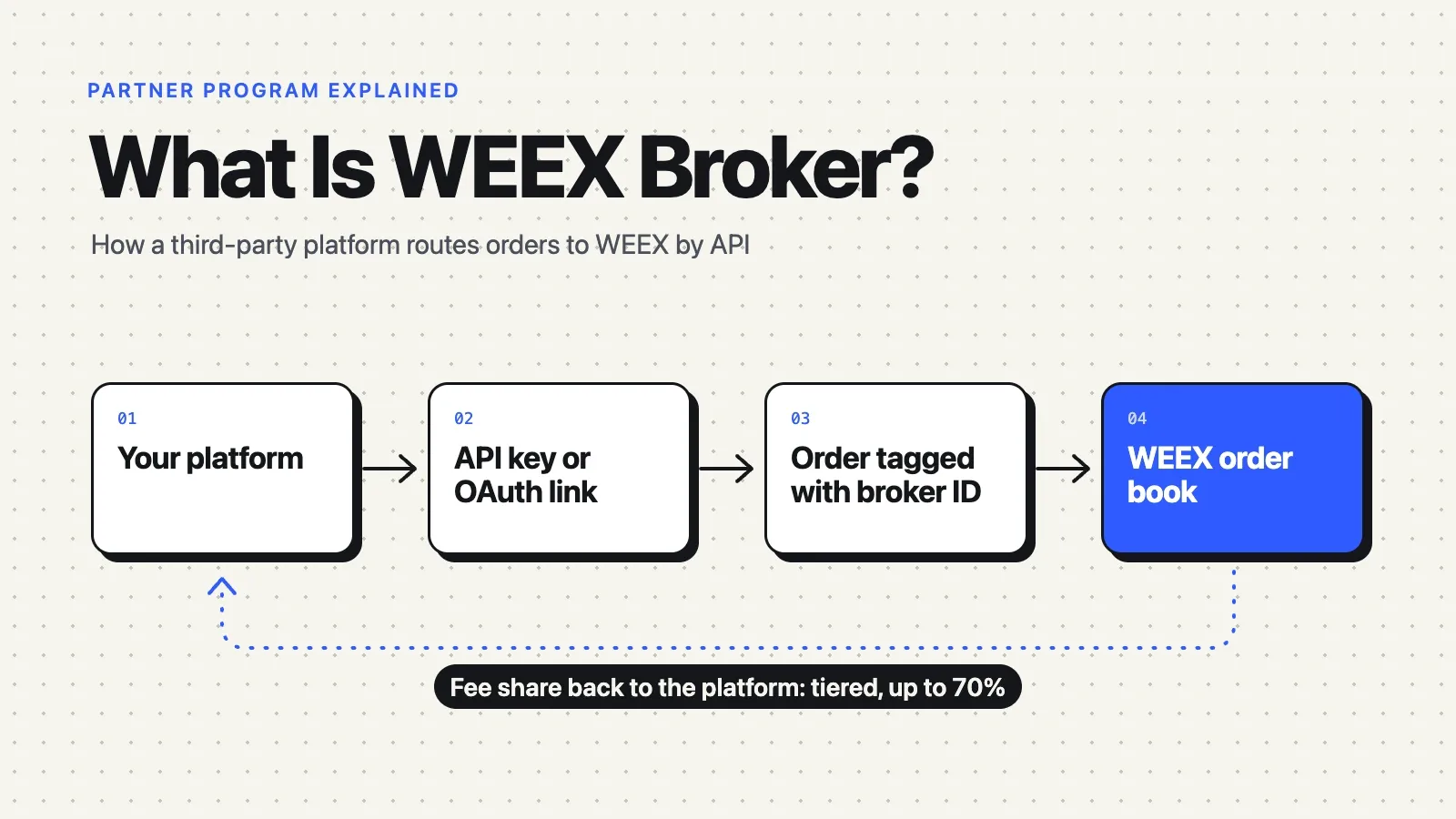
What Is WEEX Broker? API Program, Commissions and How It Works
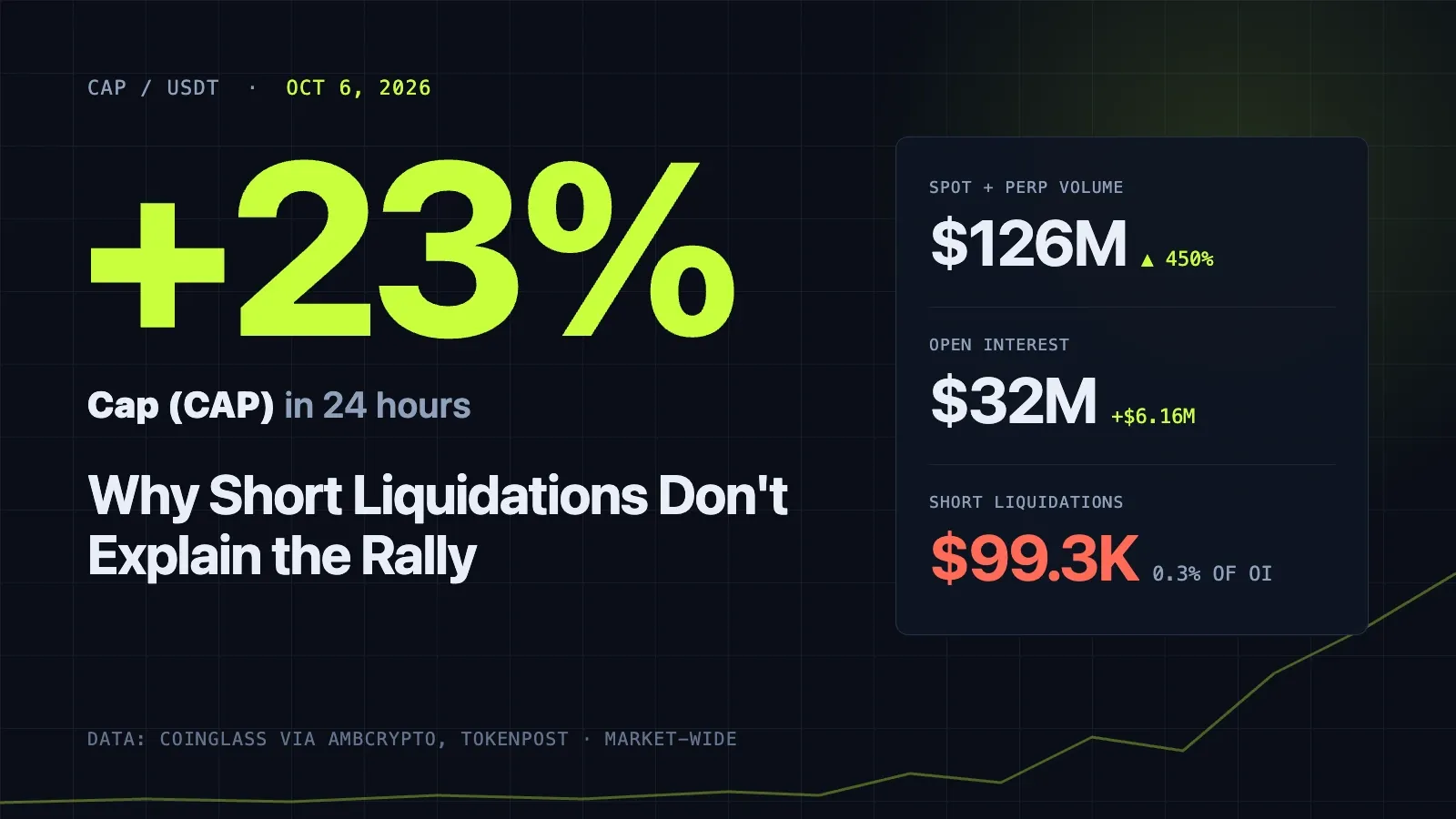
CAP Price Up 23%: Why Short Liquidations Don't Explain the Rally
WEEX TOKEN2049 Day 2 Live Preview: KOLs, AWS, PingCAP and Andrew
Bloom Crypto Bot Wallet Drains: What Happened and What Users Should Check
TSLA Stock After the Flying Roadster Reveal: What the Q3 Results, SpaceX Merger Talk and Analysts Say
SK Hynix Stock Before Q3 Earnings: Special Dividend Reports, HBM4 and What Investors Want to See on October 28
Exchange Convert vs DEX Swap: What’s the Difference? Try Convert Crypto On WEEX!
What Is Crypto Convert and How Does It Work? Try Crypto Convert On WEEX Now!
WEEX Convert Available Balance: How to Check and Use Max
Contents
Popular coins
Latest articles


